Showing posts with label art fair. Show all posts

Friday, January 02, 2026

The ArtReview Power List 100 in the last 20 years (2005, 2015, 2025)

It's always worthwhile to keep an eye on what's changing in the upper echelons of the art genre/business - what's changing and what's not.  

The turn of the year is a good time to reflect on how things are changing....

ArtReview's Power 100 is an annual ranking of the most powerful people in Art and is always worth a look.  

  • The core concept of the list revolves around the mechanisms and impact of influence in the art world.
  • A lot of what changes tends to filter down over time - so it's a bit like looking into the future. 

Changes in the ArtReview Power 100:
who was at the top in the last 20 years 
(see FULL TABLE below)
This post looks at 
  • who are the Power 100 in 2025 
  • how the list has changed RADICALLY in the last 20 years. 

and gives me an opportunity to give my very analytical brain a work out - and to look at the trends over time.

The Power 100 is ArtReview’s annual portrait of power in the artworld. It is an attempt to describe the individuals and groups that have shaped what art has been seen and how it has been seen over the past 12 months (broadly speaking, the calendar year). And yes, that is an indication that ArtReview views the artworld as, essentially, a social structure: a network of relationships that are triggered by the actions of individuals. 
They define this further
The criteria for inclusion are:
  • that each person of the Power 100 has had an active influence on the art being made and shown now;
  • that influence has to be active
Of course, it really all depends on WHO you ask..... 

The Top 10 in the Power 100 2025

Wednesday, October 11, 2023

Review: Women in Art Fair

I visited the inaugural Women in Art Fair (WIAF) at the Mall Galleries this morning.  The art fair is new and is the first art fair dedicated to redressing gender imbalance in the art industry.

Below I'm going to indicate:

  • some positive impressions 
  • artwork I liked; and 
  • some aspects which need improving before the next one!

The WIAF is on this week 11 October to 13 October, 10am to 6pm; 14 October, 10am to 4pm
Entry is £5 and Concessions at £3.50. There is no catalogue or any listing of artists in the fair.

Positive Impressions


  • much more contemporary artwork on show than we've typically seen in previous exhibitions by mainly/only women artists
  • SOME of the artwork was excellent, a lot of it was good. Relatively little was "walk past fast".
  • Some innovative media has been used for some of the artwork - which generally impressed
  • There's a variety of price points on the walls with some good representation within the affordable price range - which I think will do well.

Artwork I liked


There was artwork to like in all three galleries. I'm going to highlight those which grabbed my attention.

West Gallery


View of the West Gallery from the Messanine.

Blackbird Rook is showing two works by Marilyn Hallam who reminds me very much of Bonnard. She lives and works in south east London and St Leonards-on­Sea and has a space in the APT Studios in Deptford. She develops her paintings using a number of processes including sketchbooks, drawing, tracing, collage and painting.

To me they just seemed arresting and luminous.

Two paintings by Marilyn Hallam

The end wall of the West Gallery contains six works - from the "Five Times More" series by textile/ fibre artist Maggie Scott on the end wall of the West Gallery at the Women in Art Fair. I was so impressed by them they're now the feature image on my Making A Mark Facebook Page!
"Maggie Scott creates art from the particularity of who she is: a black woman, a feminist, a daughter, a mother, an activist and a British textile artist. Born in London, Scott graduated from St. Martin’s School of Art in 1976 with BA honours in Fashion Textiles and set up her first studio in London in 1980. Scott became well-known for her sumptuously crafted felt textiles to wear. Her life as a textile artist had existed in parallel with her involvement in gender and race politics, but it was an experiment with a series of large, autobiographical textile pieces which allowed her to combine art an activism. "

Textile art by Maggie Scott
felted Marino wool on silk and stitch
Maggie Scott’s practice is informed by the experience of being black, British and a woman. With Five Times More she depicts the intimate relationship between mother and child, reflecting on both personal and collective experiences of pregnancy, childbirth and motherhood.
I was completely intrigued by how they are made. Somehow or other silk has been attached to felted marino wool and then stitched on top. Photography is definitely involved and there's a hint of a screen print about it too. I found it both simple and relatable and complex in terms of concept and process - and very impressive!
Scott’s technical practice is unparalleled in the landscape of contemporary British art, sitting at the boundary of tapestry and digital media, she employs a combination of photography, digital collage and silk and then injects colour by laboriously pushing vibrant merino wool fibres through silk in a process known as nuno felting. The intensely physical process of felting is followed by the careful process of using stich to emphasise the smaller details of an image, evoking both the physicality of childbirth and the careful attention and tenderness of what follows. In working with fibre Scott pushes a medium traditionally associated with craft into the realm of fine art. As a textile artist Scott employs distinctly feminine materials, but with soft images she speaks hard truths.
Nessie Ramm is an artist producing very unusual art and exhibiting with the brand new Women in Art Gallery in Lewes in Sussex.

I am, of course, a big fan of all those who paint plants, particularly wild/native plants - so I was riveted to see paintings of plants which can be found by the side of the road. 

Nessie produces road verge paintings combined with road signs!  The paintings below are from her 'Reduce Speed' series and are very topical - not to mention sustainable! There was an article about her my road verge work in the February 2023 issue of Countryfile Magazine

Tuesday, October 10, 2023

NEW: Art Fair and Art Auction at the Mall Galleries - this week!

This week there are two new initiatives this week at the Mall Galleries.


Below is a short narrative about both - and I'll be visiting the Women in Art fair tomorrow when it opens and will report back.

Women in Art Fair

The Women in Art Fair a NEW Art Fair specifically celebrating art by women.
website: https://womeninartfair.com/
Instagram: https://www.instagram.com/womeninartfairofficial/
Women in Art Fair seeks the best in contemporary art, photography, textile and sculpture; all mediums. 


Key Features:

A new initiative, WIAF is dedicated to redressing the gender imbalance in the art industry and will take over all three spaces at Mall Galleries (totalling 450 sqm)
The layout of WIAF
  • West Gallery - a booth style art fair - with 9 different booths (not the 21 as indicated)
  • East Gallery - a curated exhibition titled Unnatural Women - The show features seminal artists, such as Paula Rego and Jean Cooke alongside established contemporary names and emerging talent.
  • North Gallery - an exhibition of artwork selected from an Open Call (which I obviously missed!)
    • Theme: The World is A Family. 
    • Artists were invited to submit work for exhibition, alongside galleries, for the inaugural WIAF in October 2023. 
WIAF seeks to create a positive global fair, from which women and those identifying as women, are given an opportunity to show their work and contribute to developing the exchange of ideas around gender, and culture.
It will be very interesting to see how people have responded to this new event. It sounds promising and I'm looking forward to visiting.

Event: Expert Panel Discussion

Thursday, September 28, 2023

The important things to know about pricing Affordable Art

The really important things to know 

about pricing Affordable Art


There are two things you need to know about pricing affordable art.

The first is that what the PUBLIC think is "affordable" is the only game in time.
It's emphatically NOT what the artists or the art galleries and art fairs think it is.
 
That's because they're trying to make money for themselves so they have a huge incentive to call it "affordable" but then pitch the price high!

The second is that it's the PSYCHOLOGICAL VALUE of a number that really matters. A poll I ran revealed that
  • Between 64-70% would buy art up to 500 (of whichever currency)
  • Between 70-91% would buy art up to 1000 (of whichever currency)
  • ONLY 9-10% would contemplate buying art above 1000 (of whichever currency)
The important thing is to identify what are the key hurdle prices which change behaviour. It's akin to the notion that you should always price just below an important hurdle price rather than just above.

Why I got interested in the price of affordable art

I became very interested in the concept of affordable art - and its pricing - back in 2010 (post the banking crisis of 2008 and what followed).  

This was a time when a lot of art galleries were closing - mainly because people were not buying and/or because the people who ran the galleries were not good business people and/or they had no concept of risk management and made no provision for a difficult economic context

The main reason for my interest was that artists were trying to sell in a difficult economic context and kept getting their pricing wrong which meant their sales were also plummeting.

They very much needed to understand 
  • what was deemed "affordable" and would still sell.
  • what were the key hurdle prices within the range they considered affordable.
  • how to avoid shooting themselves in the foot due to poor pricing practices.
We've now had 12 months of a very difficult economic climate with inflation and significant interest rate rises. It's not coming to an end any time soon - even if it has improved somewhat. We are still a long way adrift from where we were two years ago.

Bottom line - we are now back in the same territory as 2010 and the same issues and questions apply re. pricing.

What is an affordable price?

Wednesday, September 27, 2023

What is "Affordable Art"?


This is a discussion for artists, art galleries, art fairs and art dealers - over three blog posts today, tomorrow and Friday - about:

TODAY
  • What is "affordable"?
  • What is Affordable Art and how is it defined?
TOMORROW
  • How to price Affordable Art - the really important things you need to know - find out:
    • who determines what is affordable
    • why people attach importance to specific numbers
    • what are the big price hurdles and 
    • how they can vary between countries
FRIDAY
  • The importance of the minimum price to sales in open exhibitions
These all point in the direction of more information on this very important topic for all those trying selling art in a difficult economic context - particularly all artists, art societies, art fairs and art galleries.

________________________________________


What is "affordable"?


"Affordable" means something different to everybody, 
but generally means 'not expensive' relative to income
and can vary over time, place and economic context

It's a concept which relates to a very wide variety of products and services. 

"Affordable" is emphatically not the same as "cheap"
Very often it means
  • the price that people can "afford to pay" for a non-essential / discretionary good or service using any surplus income....
  • AFTER other necessary / essential demands on their income have been covered 
  • BUT it also depends on 
    • how financially secure they feel; and 
    • How big a financial 'buffer' they feel they need - and how much is left over for discretionary spending - and hence what feels "affordable"

The importance of substitution within the economic context


What seems very affordable in one year can look much too expensive in the next IF essential demands on income have increased (eg mortgage interest rate rises; inflation rate increases)

In this context, people can still have budgets which allow some spending - but not so much as before. Which means "affordable" can have moving goalposts.

Practical examples include:
  • people still have treats - but they are maybe not as big or as expensive (equivalent to still buying art - but at lower prices)
  • people take staycations rather than holidaying abroad because they are deemed more affordable. ( equivalent to people buying art online rather than from galleries because it's a popular thing to do - and also because nobody needs to know you used to buy more expensive art elsewhere)

What is "Affordable Art" and how is it defined?


In the context of art, very rich people are still very rich and can still afford to buy expensive art. But this is utterly irrelevant for most players in the art marketplace.

In my view (and from observation), in a time of economic difficulty, something usually happens within the vast numbers of people on "middle incomes" who like art and have bought it in the past
  • People who have bought expensive art in the past can 
    • start trading down and 
    • start buying more affordable art when they are feeling the pinch. 
  • They're still buying art - but just not spending so much. 
    • So they buy less (reduced sales)
    • or they buy at lower prices (changing the range of prices they're happy looking at)
Plus let's not forget, many artists who sell their "more affordable" art online commented that they made MORE money during the pandemic than they had ever done because people had the money spare for small treats - and couldn't get into the art galleries who were typically also much less good at marketing online!

So what's my definition of Affordable Art?

Saturday, May 13, 2023

Affordable Art Fair Hampstead 2023: A Synopsis

The main point I'd make about the Affordable Art Fair Hampstead which is on Hampstead Heath (about five minutes walk from the Train station is as follows.....

The stars of the show are emphatically the printmakers.  

Walk past an awful lot of 'manufactured art' and head for the Printmaker Stands where you will find artwork which is both good quality and affordable - as in affordable to more ordinary mortals.

Art Affordable Art Fair (Hampstead): My Findings

Here's the criteria for who can get involved in an Affordable Art Fair - all of which are very sensible.
  • All artists must be living.
  • All works must be original, or have an edition of less than the following per media:
    • Sculpture – 25;
    • Prints – 200;
    • Photography – 150.
  • All works must be priced under our price ceiling (see Exhibitor FAQs for more info).
  • Reproductions, even if editioned, are not allowed.
Here's what I found on my visit on Thursday.

What's Affordable?

The art fair lacks a definition for "Affordable". It needs one. In my opinion, it would get more visitors if it signalled more clearly what the price range of the artwork on show is

See more undr "What's Confusing?" below.


What's Good

The stands organised by groups of Printmakers - including:
  • A7 East London Printmakers (busy all day) Facebook East London Printmakers is a not-for-profit, artist run studio based in Mile End. (My other half nearly bought one - we got to the unframed versus framed debate). This is an organisation which also encourages people to use their studios....
  • D11 Printmakers in Residence (also very busy) - The studio in Bermondsey produces all the work by Mychael Barratt and Trevor Price, fellows and respectively the Past President and Vice President of the Royal Society of Painter-Printmakers. Work by other contemporary artists is produced and published by invitation.
  • H8 North London Printmakers - a group of printmakers who believe in bringing high quality affordable prints to everyone. They're very much focused on the price range I would regarded as most people's definition of "affordable".
  • H1 Rebecca Hossack is showing Professor Phil Shaw is a ground-breaking British digital-printmaker - who produces some unique (and funny) digital art prints. Awarded his Doctorate in ink technology, Shaw uses a specialized eight-colour printing process on fine-grade Hahnemuhle paper. He was the former Professor of Printmaking at the University of Middlesex, where he taught from 1980.
  • D7 Arc Fine Arts stand is showing some lovely etchings by Tim Southall 

Mychael Barrett PPRE with "Made in London"
his new screenprint and woodcut about the creative artwork and products first made in London. Underneath is his Gormley's cat (the dog version sold extremely well at the RA Summer Exhibition)

 
'You can't judge a book' by Phil Shaw

My world is a place where humour is a serious matter, and its purpose is not simply to raise a laugh but to call attention to the puzzling absurdities and the dangerous myths, that permeate all our lives." Phil Shaw
Etchings by Tim Southall

Tuesday, August 23, 2022

British Art Fair: how to check out a lot of art galleries in one place

Art Fairs essentially benefit serious art collectors. They offer a very easy way to look at a lot of art - across all price ranges - offered by different art galleries and dealers in one place - with nice food and drink.

After the pandemic decimated art fairs, there's a lot of effort going into making sure those being held in 2022 are a great experience for buyers. Indeed, the British Art Fair is under new ownership for this year's Fair. 

Art Fairs with reputable art galleries also offer a benefit for artists. If you're keen to become a gallery artist and want to check out a number of galleries, then this could also be the place for you! 

You can check out:

  • the art by other artists represented by that gallery - and how it is presented
  • the people representing the gallery
  • what sort of art these art galleries think is worth paying a major fee to show to people with lots of money
  • the general "vibe" you get from the stand. Does it make you feel that this could be an art gallery you'd like to approach at some point in the future.
HOWEVER - and this is VERY IMPORTANT - an artist visiting an art fair is market research activity ONLY!
  • The art galleries are there to sell art to wealthy individuals. Period.
  • They are really NOT interested in talking to artists. 
  • The very last thing you should do is announce you're an artist looking for a gallery to represent them
  • If you pull out an iPad and start pitching your art, you'll get blacklisted and your name will be mud.
copyright making a mark publications

British Art Fair (BAF) 2022


View of the British Art Fair Homepage Cover Image:
Displays by Alon Zakaim Fine Art, The Nine British Art and Alan Wheatley Art at BAF 2019.
Image credit: Piers Allardyce

The 31st British Art Fair is being staged on all three floors of the Saatchi Gallery between 29th September and 2nd October 2022.

Monday, June 13, 2022

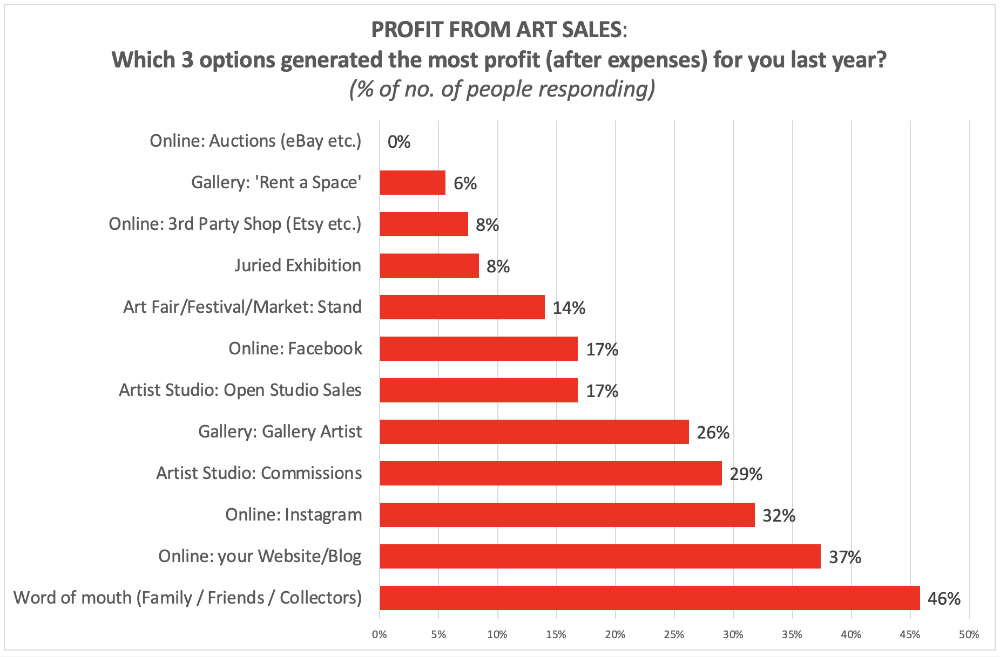
The BEST ways and places to sell your art - RESULTS

Back in January I created a POLL: What was the best place to sell your art in 2021
  • on this blog - and
  • also included it on the How to Sell Your Art on my Art Business Info for Artists website - which introduces the different options for selling art considered on the website.
The question artists were asked was 
PROFIT FROM ART SALES: Which 3 options generated the most profit (after expenses) for you last year? (i.e. 2021)
107 people have responded to it - and this is the chart of their responses - followed by a commentary on all the various options and suggestions about what some of the results might mean. For me they mean it might be instructive to try some more polls focused on particular ways of selling art.


If you want to see a bigger picture of the chart
  • right click and open the pic of the chart in a new tab, you'll see a bigger picture.
  • Or you can go to the  How to Sell Your Art  page my website - which provides a bigger picture
Of course it all depends on what you're viewing it on! I don't think you'll get the best view on a smartphone...

Commentary on profitability of different options for selling art


Scope of responses

Responses are from people who view the Poll and vote. There is no way of knowing which country they are from or whether they are 
  • amateur, 
  • semi-professional (i.e. beyond hobby income) or 
  • professional (i.e. make a living from being an artist).
So the results need to be viewed with this in mind. Nonetheless they provide some interesting perspectives.....


Profitability

Never forget that this is a Poll and Chart about PROFITABILITY i.e. 
  • NOT how many sales you make 
  • but rather which options make you the MOST PROFIT.
People who have successful businesses understand how they make profit. 
Never ever confuse turnover with profit because If you have significant expenses you won't be making much money. 

By way of contrast if you don't need to incur third party expenses and are good at marketing your art, you can eliminate commissions to galleries and listing feeds for third party sites.

The big surprise

Tuesday, January 04, 2022

POLL: What was the best place to sell your art in 2021

I'm going to revive my monthly opinion polls in 2022. On the whole, I think they provided some very useful feedback for both professional and amateur artists and those who aspire to do more with their art - particularly in relation to the business side of art activities.

Most polls have continued in terms of 
I'm starting the year - an the monthly polls - by reviving polling about the best place to sell art. I've run this a number of times and had interesting results each time.  

MOST PROFIT: What was the best place to sell art in 2021?


My first topic is PROFIT
  • WHICH place/option - which generates sales of your art - also generates the most profit?
  • the "most profit" might be due to e.g.
    • LOTS of sales - even if the profit margin between income and expenses is low
    • VERY LOW EXPENSES - so that all sales max out your profit
    • HIGH VALUE SALES - which make you a lot of money - even if expenses are high
You can find the Poll below
Below the Poll I explain what platform I've used to generate it and anything else you might want to know


POLLS PLATFORM


My previous platform (CrowdSignal) no longer works for me, so I'm switching to Google FormsI've just spent a lot of this afternoon learning how to use them for Polls of this sort - but may not have got it right! Do let me know if you run into any problems.

Don't worry, I've set the poll up so that no personal data (like emails) is asked for or collected. 

With any luck we should get a result which indicates the three most popular options for generating PROFIT in 2021 (i.e. income you generated for an option less the expenses associated with that particular option)

I'll also be putting this Poll on my website Art Business Info so that it can continue to collect data on the most profitable places 

You can also find the poll on this page too How to Sell Your Art

Previous Polls

Below you'll also find links to the poll results in 2008, 2009, 2010, 2011 and 2012

Saturday, January 23, 2021

Visit the London Art Fair - Online!

This weekend you can visit the London Art Fair Online.

It usually takes place at the Business Design Centre in Islington - but this year due to the pandemic and lockdown it had a virtual opening ONLINE on Wednesday 20th January (but I guess quite a few of were viewing another event on that day!) It continues until Sunday 31st January 2021.

However the London Art Fair offers 

  • 63 leading Modern and Contemporary galleries in an alternative digital format.
  • Each of the Galleries can feature up to 20 works per gallery
Works are presented with audio and written commentaries narrated by the galleries themselves, allowing you to interact with the works on show in an alternative format.

  • This is ALSO an opportunity for artists to view the type of art which get shown at a leading art fair in the UK - without having to travel/pay to see it.

How to do you view the art galleries and the art?


London Art Fair - six of the galleries

Essentially, click the item in the menu which leads to the content you want to explore
  • Viewing Rooms - takes you to the art gallery microsites
  • the LAD Edit Programme - takes you to the range of events and offers also associated with this art fair e.g. 
    • LAF Selects invites experts, collectors and prominent friends of the Fair to present their own personal highlights from the Viewing Rooms.
    • LAF Workshops - provides a listing of online workshops on offer.
    • LAF Talks - very focused on the art collector perspective. 
I think they'd have done better if they'd 
  • developed some talks and workshops for artists 
  • about how to deal with the current situation and share success stories about how to market art during the pandemic.

London Art Fair - what's on offer


A note about Art Fairs

I think it's safe to say that there are going to be few if any "usual" art fairs for most of this year. 

One of the key reasons is that it appears to be 

  • very difficult to get public liability insurance for communicable diseases and 
  • the insurance market is not offering Covid-19 cover for cancellation and business interruption. 
See this article in The Guardian Government stalls on insurance scheme for UK music festivals (which I picked up on following the cancellation of Glastonbury)

Tuesday, June 09, 2020

My top seven from The Figurative Art Fair

In the age of Coronavirus, the online art fair becomes the norm.

The Figurative Art Fair


Thus we have a new online art fair in The Figurative Art Fair - which is currently online on the Mall Galleries website.

It comprises
  • 248 works for sale 
  • by around 100 elected members of the country’s leading national art societies, including:
    • The Pastel Society (PS)
    • Royal Society of British Artists (RBA)
    • Royal Institute of Painters in Water Colours (RI)
    • Royal Society of Portrait Painters (RP)
    • New English Art Club (NEAC)
    • Royal Society of Marine Artists (RSMA)
    • Society of Wildlife Artists (SWLA)
    • Royal Institute of Oil Painters (ROI)
In the decade of “The Triumphant Return of Figurative Art” (The New York Times, 2015), and at a time of isolation, the societies have come together to celebrate figurative art, contemporary artists, and the spirit of artistic collaboration in their first-ever “figurative” art fair, outside of gallery walls, exclusively online.

All works are for sale and all works are also available for despatch immediately - with FREE delivery!

It's interesting how some artwork I started out to like - and then the photograph was not up to standard and I switched off straight away.  It really highlights why excellent photography is required if you're going to exhibit online. I hasten to add that most have excellent photographs.

Works which caught my eye include the following.


Quince by Charlotte Sorapore

Oil on gesso panel (framed) 35 x 29 cm

This is the one I liked the best - in part because of a really excellent photograph which revealed the wonderful surface of the painting and the mark-making. The light and the optical mixing are also wonderful. A skilled painting of a very simple subject

I'd buy it if I could afford it.

Quince by Charlotte Sorapore

Shallows by Ruth Stage 

Egg tempera (framed) 73 x 83 cm

I'm a big fan of Ruth Stage's egg tempera painting. I wanted to include two but restricted myself to one.  She has a happy knack of abstracting the real and layering up her paintings with paint and marks that make it intensely interesting such that you want to keep on looking at the surface and not just what it represents.

Shallows by Ruth Stage

Leaning Hawthorns by Sarah Bee

Acrylic on gesso primed mount board (framed) 68 x 68 cm

This is a typical Sarah Bee - acrylic underpainting of old and twisted trees and then developed on top through the use of pastel. Each one always looks fresh.


Bonfire at Akeld by Frances Bell

Oil on board (unframed) 36 x 56 cm

Frances works with a very muted and cool palette - and yet always seems to find light within her subject matter

Bonfire at Akeld by Frances Bell

Moment of Majesty, Mt Elijah above Ano Boularii, Sundown by Toby Wiggins

Oil on canvas (framed) 96 x 144 cm

This is big - and reminds me a lot of paintings of New Mexico by both Georgia O'Keeffe (see Georgia O'Keeffe's landscapes of northern New Mexicoand Lydia Baumann (see Painting Georgia O'Keeffe Country). Desert landscapes as a subject are hugely under-rated.

Moment of Majesty, Mt Elijah above Ano Boularii, Sundown by Toby Wiggins


Alcazar Gardens (Seville) by David Curtis (sold)

Oil(framed) 38 x 38 cm

This reminds me of when I visited the Alcazar Gardens and did a pastel painting plein air.

However this is an oil painting. I want to see the brush strokes in every plein air oil painting - and in this one I can. When I look at the enlarged painting it's as if it's in front of me.

I note it has sold and I'm far from surprised.


Social Distancing on the Trent by Chris Myers 

Watercolour (framed) 54 x 102 cm

The title of this one made me smile - because it provides a record of a particular time - and yet it was painted last year. A neat example of how a change of title suddenly makes a painting very relevant and contemporary.

Social Distancing on the Trent by Chris Myers

Sunday, May 24, 2020

Covid-19 #13: Cancellations and Refunds


I've heard various very interesting stories about what has happened in relation to negotiations on cancellations and refunds arising from all those events cancelled in the context of the Coronavirus Pandemic.  For example:
  • art fairs 
  • art events 
  • art exhibitions 
  • open exhibitions / art competitions 
  • art courses / workshops etc 
I'm proposing to do a blog post about this. I'm very interested in the perspectives of both organisers and customers - basically anybody who paid money before the lockdown and has now either got their money back following cancellation of the event or looks likely to lose what they've paid out - and why that has happened.

I'm particularly interested in learning points which can be shared with others

My aim is to provide some learning points and in doing so I shall be highlighting case studies and examples of
  • good practice - both organiser and customer happy
  • poor practice - either organiser and/or customer unhappy
  • bad practice - illegal practices (usually relating to contract law) requiring court action to get appropriate recompense (with the terms and conditions of the 'event' and any insurance cover)
Please message me via 
if you have had to either:
  1. work out what to do if organising an event / exhibition / whatever - plus
    • what advice you got and 
    • what you you did in the end
  2. asked for a refund and 
    • either got one (quickly or otherwise)
    • or not got one - and what reasons you were given as to any failure to do so
    • what action you took as a result - if any.
AND whether

  • you will be taking out better insurance 
  • and/or reading the small print much more closely in future!

Friday, March 13, 2020

Covid-19 and Art #3: The timeline for cancellations and postponements?

This post explores when the coronavirus peak will occur and when it will be all over and hence what's the TIMELINE FOR ARTISTS for cancellations, postponements and rescheduling of art exhibitions, events, workshops and courses and art fairs etc in the future.

The overall timeline relates in part to:
  • when the virus peaks and 
  • how long it is around for - within the context of the summer weather
  • how successful the action measures to flatten the peak are 
  • and whether the government get the timing right for their implementation!

One thing - our best hope in terms of deaths is that this is not going to be speedy.


More specifically, this post is based on
  • what was said yesterday by the Chief Medical and Scientific Advisers to the UK Government.
  • what I've read today - by learned people.
However first I'd like to introduce you to my brand NEW Coronavirus / COVID-19 and Art Resource Page on my Art Business Info for Artists website
This page aims to highlight
  • issues which many people in the art world will need to deal with during the Covid-19 Pandemic - over the next few months
  • what might be potential solutions to the challenges being faced.
  • Plus updates on the current situation for planning purposes
This is where all useful information I come across will go. Plus links to this and previous and future blog posts about this very challenging situation.

My NEW RESOURCE WEBPAGE about the impact of Coronavirus COVID-19 on art and response to this

What's the Covid-19 Timeline looking like?


The timeline will be different in every country because of:
  • different demographics
  • started at different times
  • acceleration through the community varies
However the basic epidemiology of how an epidemic behaves remains the same in broad terms. There are four salient factors/questions to be considered when planning as an artist or art organisation for what to do for the rest of this year.
  • where we are now?
  • when will it peak?
  • how long this will go on for?
  • how influential is the weather?

Where are we now?


Where we are (in the UK) right now is:
  • FOUR WEEKS behind Italy (which sent a shiver down the spine of a lot of people yesterday when that was announced!)
  • we're in the acceleration phase - but nowhere near the Peak - this is the phase when numbers keep doubling every few days until we get an exponential curve which becomes virtually vertical just before the peak
  • at the peak (whenever that is) the numbers stabilise and then start to reduce. However one needs to be wary of the fact this is happening due to poor collection and reporting of data. 
  • HOWEVER: The Peak will become more distant and take longer to reach if 
    • the government succeeds in "flattening the peak" - to match sickness to capacity - and help public services and resources in terms of beds and medical staff accommodate the sickest patients. 
    • if this happens then the doubling of numbers will take longer and the pandemic will "pancake" to some extent 

THE CASE OF ITALY

However today I heard that Italy has definitely NOT yet peaked (i.e. the growth curve for both cases and deaths is still exponential (i.e. still growing and going up in terms of daily numbers). Also bear in mind we are four weeks behind this profile of cases and deaths - although hopefully in the UK it will be flatter.
DAILY NEW CASES IN ITALY 
(courtesy Worldometer)
TOTAL CORONAVIRUS DEATHS IN ITALY
(courtesy Worldometer)

Daily Deaths MIGHT be beginning to flatten out - but in part this depends on how good the reporting processes around the country are working.
  • Deaths on 10th, 11th and 12th were 168, 196 and 189 respectively 
  • BUT that might be due to under-reporting on the 9th when the number reduced!

When will it peak and how long will this go on for (in the UK)?


Measures will cause disruption for very many months and will progress as we get nearer to the Peak. (Statement in the briefing yesterday)
Two things you need to know:
  • the classic curve and timeline is STEEP and SHORT. It has a 
    • very rapid acceleration into a massive peak (doubling of numbers every few days) and 
    • then a similar deceleration as it runs out of people to infect 
    • it's all over in a relatively short time - in that particular place - and there are many more deaths as the health system is totally overwhelmed (just read of the accounts of what it's like in Italian hospitals and how many health staff have died for a taster of what might be like)
    • The virus will meanwhile move on to other places and start all over again..... i.e. this is a pandemic (global).
  • The managed curve and timeline is FLATTENED and LONGER. This means that
    • the acceleration rate is slower, 
    • the doubling rate takes longer
    • the peak comes later
    • the peak is flattened - and hopefully stays within managed healthcare capacity (i.e the reason for pushing/managing the curve)
    • there may be fewer deaths as more people will get active treatment
    • BUT the whole process takes much longer - probably twice as long.
Covid-19-curves-graphic-social-v3


THIS IS MY EXPECTATION - based on what was said yesterday and what I've read today.
Measures need to be in place for up to 13 weeks. Measures only work with cooperation of the population (Statement in the briefing yesterday)
  • OFFICIAL VIEW: with no action it will peak in 4-13 weeks
  • My view:
    • gets pretty bad in the next 4 weeks (by mid-April)
    • but measures taken have a positive effect, the community complies and the peak is moved forward and arrives between 8-13 weeks from now (by mid- May to end of June)
    • it starts to get better in late July/August - but is not over
  • HOWEVER as a result:
    • the deceleration rate takes longer and the end of the epidemic may not arrive until the end of September
In part it will depend on the weather. 
  • If we get a very good summer it will finish faster
  • If the weather is awful then it it will drag on much longer
In part it will depend on the co-operation of the population
  • if people get fed up and stop co-operating with government measures then the curve cannot be managed. 
  • If they stop co-operating just as we get to the peak, then we'll get a Pandora's box situation. 
  • This is why the government is putting off the strictest measures for as long as they think they can get away with this. Other countries will have to hope their population is resilient and behaves well!
So my expectation is "not nice" with LOTS AND LOTS of exhibitions, events, fairs, workshops, courses being cancelled between now and August. Particularly if they are likely to be attractive to older people who have got fed up with staying at home.

Bottom line - if you plan for anything after 1st October you're probably OK. I'd describe this as a cautious view of how it will "pan out" - but I have been known in the past (during my career) for being very good at predicting how things will happen over the longer term.

IMPORTANT NOTE! Those who get the best dates and venues after the pandemic are those who move fastest right now! There's going to be six months worth of activity trying to move forward!!

A CAUTIONARY NOTE: Bear in mind all this is guesswork on my part - even if I'm using facts from authoritative sources - and hence I have no liability for any decisions you make based on my prediction

That's because it's just that "a prediction". It's not a fact. If you want facts you'll have to wait and see how it all works out in the end. :)

My next post


My next post will either be about
  • EITHER the need to take your third party liability very seriously - people could die!
  • OR the legal aspects of ecommerce you need to know if selling art online
Tell me what you think on my Facebook Page.

More Resources


Previous posts include:
Coronavirus / COVID-19 and Artmy NEW webpage on Art Business Info for Artists which covers:
  • Updates
  • Risk Management
  • Practical Measures & Solutions
  • Innovations / Good Ideas
  • Closures of Art Galleries & Museums
  • Cancellation / Postponement of
    • Art Fairs
    • Art Exhibitions
    • Classes, Courses, Workshops
    • Art Schools

Thursday, March 12, 2020

Coronavirus & Art #2: Thoughts and recommendations on the implications of a pandemic

Here's my updated thoughts about the implications of the CO-VID 19 (coronavirus) PANDEMIC for art, artists, art organisations (galleries / societies / schools etc), art exhibitions and private views, art fairs and art schools in the short and longer term.

It comes with a list of ACTIONS which I RECOMMEND artists or art organisations should either be doing or giving serious thought to. 
  • Please SHARE with any artist or art organisation that you think might find it worth a read.
  • You might want to bookmark this - I'll probably come back and update this as I think of more.
Image: CDC/Alissa Eckert, MS; Dan Higgins, MAMS

This post is further to my post last week on Coronavirus & Art #1: Risk Management for Artists & Art Events.

I'm going to aim for an update and further thoughts/sharing of good practice about once a week. [UPDATE: I'll do a timeline re prevention measures in the UK tomorrow following announcements today. Bottom line: 
  • this is the worst health crisis for a generation and is going to go on on for several months and 
  • the peak is weeks/months away
  • we are 4 weeks behind Italy]
Just last week, people were talking about various things still going ahead.

Some were even 'joking' about how this was a really good time to visit Italy while it's quiet.

This week, it's changing - and will keep changing - and will become MUCH more serious.
Now we have:
  • restrictions on movement of anybody within Italy - which is in total lockdown with curfews - with most shops (except food stores and pharmacies) and museums/galleries closed. 
  • all travel to the USA from 26 European countries banned (excluding the UK)
  • the Federal Government in the USA has prohibited all travel for its employees - so nobody is going to international meetings or conferences
  • major football games are being played behind closed doors
  • Israel is requiring 2 weeks quarantine for all visitors
  • India has suspended all visas
  • activities which involve more contact - and the scope for transmission - are being cancelled for a lengthy period eg 
More decisive action is still to come e.g.
  • Spain considering putting Madrid into lockdown; 
  • Ireland is closing all its colleges and schools today and also banning mass gatherings (100 people max. internal and 500 max external)
Plus although the numbers of confirmed cases are climbing it's almost certain there are many, many more which have not yet been diagnosed due to the lack of testing kits and processing capacity. It is already a lot worse than indicated by the official numbers.

[UPDATE: UK has c.600 recorded cases re. testing BUT the Chief Scientific Officer says it is almost certan there are about 10,000 people with the viral infection already in the community]

The numbers of confirmed cases in the UK declared yesterday had doubled on those declared 4 days previously. This is how exponential viruses work - they double every few days and the angle of the curve gets steeper before things get better. The curve for Italy is virtually vertical.

All of the following (for UK artists) is based on the premise that the UK is now very much into the exponential curve of viral infection (and it's likely other countries are the same).

What's going to happen


Below are the things I think will happen soon or in the next few weeks. These include:
  • extended closure of schools and colleges and arrangements for home learning
  • promotion of home working
  • advice to avoid all crowds
  • advice to avoid crowded public transport eg walk or cycle or travel off peak
  • cancellation of all events due to get more than X people (who knows what X is?)
  • closure of some commercial retail outlets

The issue is more when rather than whether given what we've now seen what happens with an outbreak which went out of control in Italy.

When will it end. Who knows? Everything is speculation at the moment. There are theories by learned academics and  advice by leading health and legal people - and unfortunately they don't all agree!

If you are doing anything innovative which you'd like to share or encourage other artists to join please contact me my Facebook Page.

Artists and Art Teachers


On the one hand it's a blessing.
  • Social isolation means LOTS of uninterrupted time to get on with making art.
  • LOTS of people sitting around at home means lots of people flipping through art on a screen - and buying art (we hope). It's your job to make them buy!
On the other hand, it's a curse. There will be no income from:
  • art fairs - if cancelled by organisers and/or poor attendance for those which go ahead
  • art sales - because the chance of your art exhibitions being cancelled is more than likely UNLESS unless you are ALREADY sorted around selling art online. 
  • teaching - because classes and workshops will be cancelled (by you or those attending - it's inevitable)

My RECOMMENDATION:

Friday, March 06, 2020

Coronavirus & Art #1: Risk Management for Artists & Art Events

"By failing to prepare, you are preparing to fail”

It strikes me now is a good time for artists, art teachers, art societies, art organisations as well as art galleries and museums to start thinking through the impact of the Coronavirus (Covid 19) in terms of
  • what are the practical implications 
  • what are the potential risks
  • what mitigating action can be taken.
This is after noting this morning that:
  • art galleries and museums are changing practices
  • art fairs are taking action
  • arts organisations are providing advice
Plus remembering that:
  • not everybody is equipped with the knowledge of how best to prepare and plan for risky situations
  • some might be inclined to snooze at this stage - and then have a really horrible shock later in the year as the impact of the virus hits. 
Don't be one of those who'll be saying "I never thought that......"
    Are you currently sleeping on the job?

    Risk Management for Artists


    I created a Risk Management Resource for Artists for artists some years ago - based on my training in risk management for work.You can find this resource on my Art Business Info for Artists website (in the section on PRACTICE / Office Practices)

    The first half of the first page of "Managing Business Risks" (Version 2)
    This FREE 5 page guide:
    • outlines risk assessment and risk management processes that enable you as an artist to reduce and better manage risks to your art business
    • enables an artist to get a much better appreciation of the relative importance and priority of the different risks you are exposed to and how these might be tackled.
    RISK ASSESSMENT
    • Identify all the risks you’re running
    • Identify their relative level of importance
    • Analyse the probability of the risk actually occurring
    RISK MANAGEMENT
    • Rank the likelihood and importance of different risks to determine priorities
    • Devise a plan to reduce the likelihood of all major risks occurring

    What's Happening


    Art Galleries and Museums are Changing Practices