Showing posts with label commercial art galleries. Show all posts

Friday, July 17, 2026

London is the best city for art! (Time Out Survey)

London has been declared to be the best city in the world for art galleries - according to Time Out’s latest guide to the planet’s top places for culture.

This conclusion arises out of a survey of more than 24,000 people around the world about culture in their cities.
An impressive 81.1 percent of surveyed Londoners said that the city does art galleries better than it does anything else. London was a clear gold medal winner in the category, scoring much higher than Paris (which came second with 67.9 percent) and New York (third with 67.7 percent).
Of course, one of the main reasons for this is that so many are free to access - which is a very significant bonus for both residents and visitors alike.

In addition, 88.4 percent of London’s residents backed London’s museum venues. That put us third, only behind Paris and Madrid. 

Below is a summary of Time's Out View - based on its survey - of:
  • the top 50 art galleries in London
  • the top 25 museums in London.
I really out to get back to doing my twice a year overview of what's on where at the major art galleries....

The Top 50 Art Galleries in London

This is the Time Out Guide to The 50 best art galleries in London

Frankly, I don't think they're in any order of "best". 
  • Rather this is a collection of what they think are the best. 
  • I guarantee that the majority of Time Out Readers will not have heard of the majority of them - which makes it a very odd list in that sense.
  • It also excludes rather a lot of very active art galleries which are well worth a visit - mainly because they forgot to say.....
There is a VERY STRONG Contemporary Art bias

Hence they EXCLUDE:
  • any of the long running and very respectable art galleries (eg Cork Street and associated area) which a lot of artists would give their eye teeth to get into
  • anything to do with art societies - which is sad, because it basically indicates that anything associated with an art society is of no interest. Which is very far from the truth.
As such I'll tell you which I think are the best!
Plus all the ones I have never visited

They are listed in a very odd order - so I have reordered into my particular order of preference

The Sainsbury Wing is now effectively the main entrance to the National Gallery
- and all temporary exhibitions

Friday, January 02, 2026

The ArtReview Power List 100 in the last 20 years (2005, 2015, 2025)

It's always worthwhile to keep an eye on what's changing in the upper echelons of the art genre/business - what's changing and what's not.  

The turn of the year is a good time to reflect on how things are changing....

ArtReview's Power 100 is an annual ranking of the most powerful people in Art and is always worth a look.  

  • The core concept of the list revolves around the mechanisms and impact of influence in the art world.
  • A lot of what changes tends to filter down over time - so it's a bit like looking into the future. 

Changes in the ArtReview Power 100:
who was at the top in the last 20 years 
(see FULL TABLE below)
This post looks at 
  • who are the Power 100 in 2025 
  • how the list has changed RADICALLY in the last 20 years. 

and gives me an opportunity to give my very analytical brain a work out - and to look at the trends over time.

The Power 100 is ArtReview’s annual portrait of power in the artworld. It is an attempt to describe the individuals and groups that have shaped what art has been seen and how it has been seen over the past 12 months (broadly speaking, the calendar year). And yes, that is an indication that ArtReview views the artworld as, essentially, a social structure: a network of relationships that are triggered by the actions of individuals. 
They define this further
The criteria for inclusion are:
  • that each person of the Power 100 has had an active influence on the art being made and shown now;
  • that influence has to be active
Of course, it really all depends on WHO you ask..... 

The Top 10 in the Power 100 2025

Thursday, September 28, 2023

The important things to know about pricing Affordable Art

The really important things to know 

about pricing Affordable Art


There are two things you need to know about pricing affordable art.

The first is that what the PUBLIC think is "affordable" is the only game in time.
It's emphatically NOT what the artists or the art galleries and art fairs think it is.
 
That's because they're trying to make money for themselves so they have a huge incentive to call it "affordable" but then pitch the price high!

The second is that it's the PSYCHOLOGICAL VALUE of a number that really matters. A poll I ran revealed that
  • Between 64-70% would buy art up to 500 (of whichever currency)
  • Between 70-91% would buy art up to 1000 (of whichever currency)
  • ONLY 9-10% would contemplate buying art above 1000 (of whichever currency)
The important thing is to identify what are the key hurdle prices which change behaviour. It's akin to the notion that you should always price just below an important hurdle price rather than just above.

Why I got interested in the price of affordable art

I became very interested in the concept of affordable art - and its pricing - back in 2010 (post the banking crisis of 2008 and what followed).  

This was a time when a lot of art galleries were closing - mainly because people were not buying and/or because the people who ran the galleries were not good business people and/or they had no concept of risk management and made no provision for a difficult economic context

The main reason for my interest was that artists were trying to sell in a difficult economic context and kept getting their pricing wrong which meant their sales were also plummeting.

They very much needed to understand 
  • what was deemed "affordable" and would still sell.
  • what were the key hurdle prices within the range they considered affordable.
  • how to avoid shooting themselves in the foot due to poor pricing practices.
We've now had 12 months of a very difficult economic climate with inflation and significant interest rate rises. It's not coming to an end any time soon - even if it has improved somewhat. We are still a long way adrift from where we were two years ago.

Bottom line - we are now back in the same territory as 2010 and the same issues and questions apply re. pricing.

What is an affordable price?

Wednesday, September 27, 2023

What is "Affordable Art"?


This is a discussion for artists, art galleries, art fairs and art dealers - over three blog posts today, tomorrow and Friday - about:

TODAY
  • What is "affordable"?
  • What is Affordable Art and how is it defined?
TOMORROW
  • How to price Affordable Art - the really important things you need to know - find out:
    • who determines what is affordable
    • why people attach importance to specific numbers
    • what are the big price hurdles and 
    • how they can vary between countries
FRIDAY
  • The importance of the minimum price to sales in open exhibitions
These all point in the direction of more information on this very important topic for all those trying selling art in a difficult economic context - particularly all artists, art societies, art fairs and art galleries.

________________________________________


What is "affordable"?


"Affordable" means something different to everybody, 
but generally means 'not expensive' relative to income
and can vary over time, place and economic context

It's a concept which relates to a very wide variety of products and services. 

"Affordable" is emphatically not the same as "cheap"
Very often it means
  • the price that people can "afford to pay" for a non-essential / discretionary good or service using any surplus income....
  • AFTER other necessary / essential demands on their income have been covered 
  • BUT it also depends on 
    • how financially secure they feel; and 
    • How big a financial 'buffer' they feel they need - and how much is left over for discretionary spending - and hence what feels "affordable"

The importance of substitution within the economic context


What seems very affordable in one year can look much too expensive in the next IF essential demands on income have increased (eg mortgage interest rate rises; inflation rate increases)

In this context, people can still have budgets which allow some spending - but not so much as before. Which means "affordable" can have moving goalposts.

Practical examples include:
  • people still have treats - but they are maybe not as big or as expensive (equivalent to still buying art - but at lower prices)
  • people take staycations rather than holidaying abroad because they are deemed more affordable. ( equivalent to people buying art online rather than from galleries because it's a popular thing to do - and also because nobody needs to know you used to buy more expensive art elsewhere)

What is "Affordable Art" and how is it defined?


In the context of art, very rich people are still very rich and can still afford to buy expensive art. But this is utterly irrelevant for most players in the art marketplace.

In my view (and from observation), in a time of economic difficulty, something usually happens within the vast numbers of people on "middle incomes" who like art and have bought it in the past
  • People who have bought expensive art in the past can 
    • start trading down and 
    • start buying more affordable art when they are feeling the pinch. 
  • They're still buying art - but just not spending so much. 
    • So they buy less (reduced sales)
    • or they buy at lower prices (changing the range of prices they're happy looking at)
Plus let's not forget, many artists who sell their "more affordable" art online commented that they made MORE money during the pandemic than they had ever done because people had the money spare for small treats - and couldn't get into the art galleries who were typically also much less good at marketing online!

So what's my definition of Affordable Art?

Monday, June 13, 2022

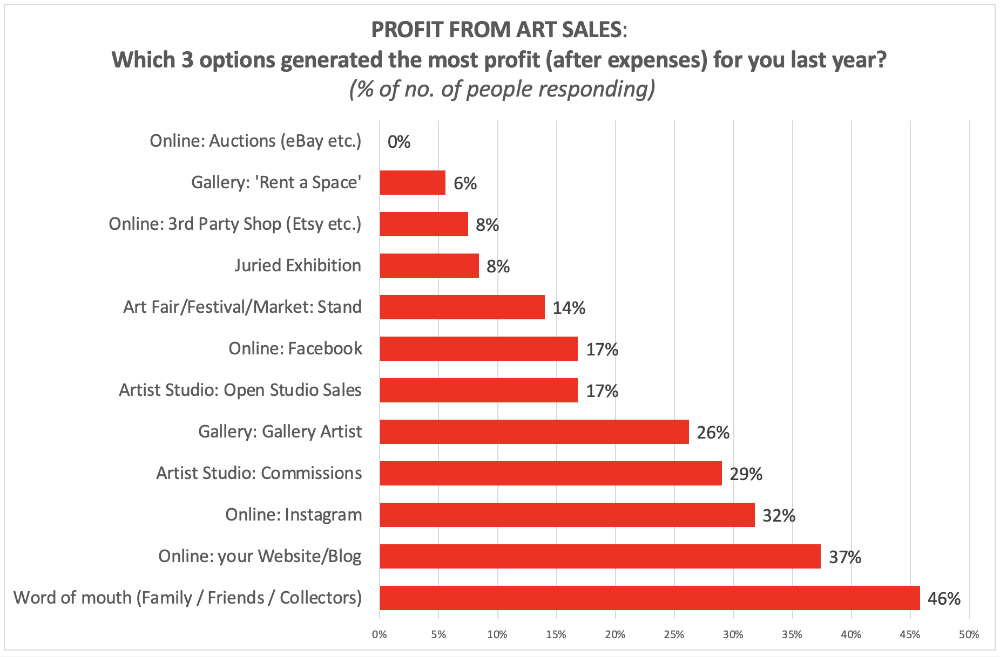
The BEST ways and places to sell your art - RESULTS

Back in January I created a POLL: What was the best place to sell your art in 2021
  • on this blog - and
  • also included it on the How to Sell Your Art on my Art Business Info for Artists website - which introduces the different options for selling art considered on the website.
The question artists were asked was 
PROFIT FROM ART SALES: Which 3 options generated the most profit (after expenses) for you last year? (i.e. 2021)
107 people have responded to it - and this is the chart of their responses - followed by a commentary on all the various options and suggestions about what some of the results might mean. For me they mean it might be instructive to try some more polls focused on particular ways of selling art.


If you want to see a bigger picture of the chart
  • right click and open the pic of the chart in a new tab, you'll see a bigger picture.
  • Or you can go to the  How to Sell Your Art  page my website - which provides a bigger picture
Of course it all depends on what you're viewing it on! I don't think you'll get the best view on a smartphone...

Commentary on profitability of different options for selling art


Scope of responses

Responses are from people who view the Poll and vote. There is no way of knowing which country they are from or whether they are 
  • amateur, 
  • semi-professional (i.e. beyond hobby income) or 
  • professional (i.e. make a living from being an artist).
So the results need to be viewed with this in mind. Nonetheless they provide some interesting perspectives.....


Profitability

Never forget that this is a Poll and Chart about PROFITABILITY i.e. 
  • NOT how many sales you make 
  • but rather which options make you the MOST PROFIT.
People who have successful businesses understand how they make profit. 
Never ever confuse turnover with profit because If you have significant expenses you won't be making much money. 

By way of contrast if you don't need to incur third party expenses and are good at marketing your art, you can eliminate commissions to galleries and listing feeds for third party sites.

The big surprise

Wednesday, September 09, 2020

Hardship lies ahead #1: Checklist for Artists

This post provides some CHECKLISTS FOR ARTISTS 
  • thinking about the future and 
  • wanting to get to grips with the basics of surviving as an artist AND an art business within the context of both Covid AND the Recession.
i.e. Neither the Coronavirus Pandemic nor the Recession are going away completely in a hurry - so it's time to tease out and get to grips with some of the practical implications for the medium and longer term.

For what it's worth I reckon it will be at least two years before we get back to normal.  Possibly three.

In the meantime people have some difficult decisions to make.


"Hardship lies ahead" is the new slogan of the Chancellor of the Exchequer - and he's absolutely spot on.
  • Not all businesses will reopen
  • Not everybody will have a job in the businesses that do
  • Not everybody is going to enjoy the income level going forward that they have had in the past
  • LOTS OF PEOPLE ARE GOING TO FEEL VERY UNCERTAIN - and lack of confidence depresses spending on art.
PLUS at some point, we'll all have to pay for the enormous bailouts which have been going on around the world - which may well mean tax increases in the longer term.

This post is about translating that context into the PRACTICAL IMPLICATIONS for artists and selling art generally and providing CHECKLISTS for
  • artists - this post
  • future posts re.
    • art societies 
    • art exhibitions 
    • art galleries
    • art teachers

A preamble


I last wrote on this topic in The Pandemic Recession: Likely Impact on Art Sales and Artists

HOWEVER I gathered afterwards that quite a few people felt I was probably being too negative and miserable - and that "everything will be back to normal soon".

I wonder if others might also now feel it wise to revise that view?
The COVID-19 pandemic has triggered one of the worst jobs crises since the Great Depression. There is a real danger that the crisis will increase poverty and widen inequalities, with the impact felt for years to come. OECD
Now that
  • business closures and job losses are now being announced on a very regular basis as we begin to come out of the furlough period (i.e. closure of 8 branches of John Lewis is NOT normal! Nor is M&S reducing staff by 950 jobs.)
  • businesses are talking about it taking years to get back to normal AND
  • we're seeing some very fierce covid-19 spikes (i.e. second wave) around the world (notably in the USA) as people "got back to normal" much too fast and without taking appropriate precautions 
  • PLUS as of today we're got local lockdowns in the UK and we're back to no more than 6 people meeting together I think it's time to get serious.
I'm really NOT being negative.

I'm essentially a really pragmatic person who likes to know the parameters of a problem - including the nasty bits!

I'm also a great believer in planning for what's coming.  Probably because I'm "cursed" by a very marked talent for being able to predict what's coming over the horizon - and a very good track record of being right. It has proved to be useful in a career (sometimes) - but there's always been a tendency to want to "shoot the messenger!" when people really don't like the message - so I wasn't surprised at all by the reaction to the last post.

I'm going to be like Chris Whitty and Dr Fauci and just keep saying what needs saying until people get it!! :)


CHECKLIST FOR ARTISTS


Just for a moment consider the following scenario - and how realistic it might be.
  • Your art galleries close down - and your art gets stuck inside
  • Your sales incomes dries up or reduces significantly - because fewer people are buying - because of lack of confidence in knowing how long the pandemic / recession will last
  • Your regular Bread and Butter job which pays basic bills disappears - it's happening to a lot of people even if they are working for FTSE 100 employers!
  • Your online platform suddenly shuts down - don't forget it's not just bricks and mortar businesses which shut down. Small entities are the ones which shut down in the last recession. Consequently all my blogs and websites are with very big hosts for a reason.
  • Your partner loses their job - it happens.
  • You will be living on a much reduced income - do you know how much you need to keep a roof over your head - and or how long you can last on just savings?
  • BUT you haven't got a clue about....
    • what you do that makes money or maximises your income and 
    • which activity/activities is/are basically a self indulgent money pit
Bear in mind a lot of people have had to face this already.

So now is the time when spending some time on working this out is a really good investment. 

Otherwise life may very well come and bite you on the backside when you're not looking!


TIPS: FINANCIALS


Now is a really good time to work out the ABSOLUTE BASICS

  • which income streams maximise profit for time and effort expended and 
  • which represent a really poor return after you take every aspect into account.

Friday, July 24, 2020

About English artist: Norman Neasom

I don't recollect seeing the artwork of Norman Neasom RWS, RBSA (1915-2010) before - but having seen it I very much recommend you take a look too.

He was an English painter and art teacher - based in the Midlands - who produced intense observational drawings and paintings of people in landscapes and interiors. His paintings were very often involved with recording everyday activities and normal life and life events and sometimes the very odd thing that happens. (see below for more detail)
Norman Neasom’s paintings and drawings – like those of a number of other British artists over the past century or so, record both that old, quieter, simpler England, as well as its slow, gradual passing. In Neasom’s work, we can still discover men gathering hay by hand, two old gentlemen in tweeds out for a ride, or a farmer bringing in sheep with his dog. As his obituary in The Independent in 2010 observed, ‘Neasom’s was a benign, pastoral vision in a deeply English tradition.’
This is precisely the type of artwork which I have been known to lament NOT seeing very often at national open exhibitions by art societies.

I'm guessing he probably stopped being active in RWS and RBSA exhibitions before I started reviewing them as I plugged his name into my Google Search box (in the right column) and his name did not generate a reference to

Norman Neasom - cover of Messums catalogue of his work
The Snowdon Horseshoe from Capel Curig by Norman Neasom
gouache on a.b.
Norman Neason obviously developed a very good reputation as his estate is being exhibited by Messums (a notable art gallery in London) - but it closes today!


What I like particularly is you can see he recorded events in his own life and he regularly pops up in his drawings and paintings.

His work is described as belonging to the genre of British realist painting from the inter-war period. Messums suggest that this is a "somewhat underappreciated genre" whose leading light was Stanley Spencer.

Messum comments further about the genre
With more than a hint of nostalgia, it is a period of British art that is gaining increasing attention: in 2017 the Scottish National Gallery of Modern Art even devoted a whole exhibition to the ‘movement’ (if one can call it such), showcasing over fifty British realists from the 1920s and ‘30s, including Gerald Leslie Brockhurst, Meredith Frampton, Winifred Knights and Edward Wadsworth – as well as Spencer, Fleetwood-Walker and Tucker. One might also draw Eric Ravilious into this group, with his closely-observed watercolours devoted to the English countryside of the inter-war years.
I must confess when I first saw his work they made me think of Stanley Spencer (minus religious connotations) at one end of the spectrum and Beryl Cook at the other (particularly in relation to a lot of interior scenes.

Perhaps the artist these works most closely resemble is Beryl Cook, and her comical paintings of hen nights and tea parties. It is interesting to note then, that when the mayor of Redditch met Neasom towards the end of the artist’s life and remarked that some of his work reminded him of Cook’s, Neasom replied, ‘She copied me.’

More about Norman Neasom

Wednesday, July 01, 2020

Virtual exhibitions online - what about the software / webware?


Two things became very apparent during the Pandemic

  • art galleries had their galleries closed - and finally appreciated why websites are important - and why you need more than just small thumbnail images of the artwork on your website - if you've got one.
  • art societies had their exhibitions cancelled - and finally got the point of the "virtual online art exhibition" - but haven't always known how to go about creating one
So........

I plan to write something about how to develop an "online art exhibition" (as a replacement / add on for art gallery / art society exhibitions).

To this end I'm trying to identify relevant website software and/or webware platforms which have the functionality to deliver efficient and effective virtual exhibitions online.  
I'm also contacting software agents re "online art exhibition gallery" software/webware and pricing plans and how they work.

Help please

Can you please 
I'd much appreciate it, if those people who have been involved in developing an online exhibition told me

  • What software / platform host have you used - and what were the pros and cons?
  • When choosing which software / platform option to use what sort of criteria did you use to make a decision?
  • What did you learn from the experience?
  • What would you have done differently and/or spent more time on?
Plus for all those who want to know more about what you need to do to create a virtual online exhibition for an art gallery or art society
  • What do you want to know re how to develop an online art exhibition?

If you just need help with websites


For those wanting to know more about how to develop a better website more about see my HUGE section on Websites for Artists on my Art Business Info for Artists website

Friday, June 12, 2020

The Pandemic Recession: Likely Impact on Art Sales and Artists

In this post I'm beginning to set out an overview of what I think are key issues for artists during The Pandemic Recession. It includes some background reading and covers
  • the biggest drop in economic history since records began
  • the impact on art sales and artists
  • lessons for artists from the 2008 recession 

The biggest drop in economic growth since records began


Below is proof positive that we are very definitely going in a recession despite the fact we've not yet got to the actual point of being able to define a recession i.e. a recession is when growth in the economy falls for two quarters in succession. Technically this is when GDP falls for two three-month periods - or quarters - in a row. (NOTE: The recession will have a different profile in different countries. I tend to talk about the UK because that's where I live)

I know of no better way of persuading people that this recession is very serious than this trend line which was published by the Office for National Statistics (ONS) this morning (SEE GDP monthly estimate, UK: April 2020 if you want the full story). 
  • The trend line for UK GDP goes from January 1997 to the present. 
  • The little blip in the middle is the global banking crisis of 2008 and the aftermath. 
  • The big vertical line on the right is April - when UK GDP dropped by the biggest ever amount since records began.
There has been nothing like this ever before in economic history! That's how bad this is.  Note also it's bigger then the drop that the economic statisticians NOT employed by the government were predicting!


Source: Office for National Statistics – GDP monthly estimate

The impact on art sales and artists


The major implication for artists of the recession is going to be a BIG REDUCTION in available cash to spend on art - which makes selling art a major challenge i.e.
  • No matter what you do you cannot make people spend what they have decided to save - the biggest mistake any professional artist can make is to assume that somehow they have "the magic answer" or are uniquely exempt from either the recession or the constraints within the marketplace.
  • People throughout the economy will conserve their cash during a recession - because they don't know whether they will lose their jobs / businesses until we come out the other side of the recession. It's a very sensible strategy - for them. 
  • Demand for art - and sales of art - will drop significantly because
    • those who budget for art purchases will withhold or reduce the amount they spend on art. 
    • middle range buyers disappear - for a long time (this is what happened in 2008). Keep a very close eye on what sells at what prices.
    • impulse buys of lower priced art will reduce significantly on the front end of the recession and recover slowly
  • Avid art collectors devise means to keep collecting - within their budget
    • buyers substitute eg people switch to prints from paintings and/or buy smaller works - or rearrange all the art on their walls so it feels different until they feel like dipping their toe in the market again (guess what I did this week!)
    • overall initially lower priced art tends to sell better than middle range art (check out the The Artist Support Pledge with a ceiling of £200 - which has generated has generated an estimated £20 million for professional artists and makers across the globe)
  • Specialist genres with a major fan base do much better than generalists - but still typically experience a decline in income i.e. it's not the same for everybody
    • specialist art genres cope better because their fans are faithful - and artists already have a following
    • generalists tend to get hit hard i.e. those not known for anything in particular and who have no following. A "scattergun" approach to painting lots of different subjects does not create a following.
    • professionals with difficult subject matter have limited their market from the outset - and response to their art may be idiosyncratic
    • it's time for professional artists to review the type of art they create going forward
  • Art galleries will close (forever) - meaning fewer places to exhibit art when the recovery comes - leading to a longer recovery time for artists. Essentially this is because an awful lot of gallerists are people who lack business skills and don't consistently maintain an adequate reserve of working capital.  Check out the back stories of those who move over into art dealing at art fairs etc - if they couldn't manage the money last time, it's more than likely they won't be good at managing money going forward. 
The one exception to the gloom and doom is art sales at the very top end of the market - where art is typically bought and sold by people why people with extreme wealth who are, on the whole, resistant to recession fallout. However those reading this blog are typically not in that league so I will ignore that phenomena.

Lessons for artists from the 2008 Recession

...in my view, artists are also most likely to avoid problems and/or achieve success if they are well-informed about the market they are operating in. Recognising problems that you might be facing is the first step to dealing with them. (Me - commenting back in 2008!)
Back in 2008, I wrote a number of posts writing posts about how artists can meet the challenges presented by the current state of the economy then. 

Some suggested I was being unnecessarily pessimistic at the time - but in the end that did not turn out to be the case. (I have a very good track record in "reading the runes"!)
  • Many of the blog posts are as relevant to day as they were then - albeit the circumstances are different
  • I'd suggest a bit of reading would do no harm - particularly for those artists who have zero experience of what it's like selling art in a recession.

Wednesday, June 10, 2020

It's time to talk recession - and what next!

The Covid-19 Pandemic to date has made economic survival very difficult for a number of artists.  However the coming Global Recession is going to make life difficult for a lot more artists - all around the world.

It's time to take stock and think about what this means - in the short term and the next 2-3 years.

This post focuses on:
  • how I'm going to try and help in the coming weeks / months / years
  • how you can contact me - with suggestions and queries and ideas
  • current predictions about a global recession

The OECD published its Economic Outlook report today.
  • This provides forecasts for the scope and size of the recession 
  • The last section below deals with those predictions - and the nuance of the one hit or double hit recession.
  • It focuses on how long this recession and period of uncertainty will last


OECD Projected REDUCTION in GDP in countries across the world (i.e. national economies contract)


Making A Mark - The Way Forward


I'm proposing to write a number of posts in the coming days and weeks
  • focused on how to help artists survive and thrive - for example
    • what to cut
    • what to improve
    • what to build
  • creating checklists of things to think about and do - in relation to creating / marketing / selling / being business-like
    • as an artist
    • as an art teacher
    • as an art gallery
    • as an art co-operative
    • re. art fairs
    • re. exhibitions and competitions.
I'm inviting you to SHARE WITH ME:
  • the strategies you have used in the past which WORKED (eg 10 years ago re the banking recession). I can certainly remember some of the things which happened then which I'd recommend people do think about or don't repeat!
  • the dreadful mistakes you've made in recessions in the past and definitely will NOT be repeating this time around.
  • the innovation you want to embrace
  • the new initiatives and approaches you're thinking of creating / following
  • how you cope with uncertainty
Essentially I want to help in any way I can to share learning from the past - and creativity re. the future.

I'll also be on the lookout for helpful blog posts and articles written by those active in the art economy - whether they are artists, art dealers, art galleries, art fairs or whatever.

You can share contributions - or ask questions you want the answers to - with me via:
I'm pondering on setting up a community linked to one of the pages (probably the Art Business Info for Artists FB Page) to enable artists to share what they need help with and what they are doing to address the various challenges.

The Global Recession - cannot be ignored!


The COVID-19 pandemic is a global health crisis without precedent in living memory. It has triggered the most severe economic recession in nearly a century and is causing enormous damage to people’s health, jobs and well-being. 
OECD’s latest Economic Outlook
What follows is not a pleasant read. However in order to plan to cope with the recession you need to know what's coming at you.

I'll talk more in future posts about very specific issues you will need to address in relation to the business of being an artist - based on what we know happened in the last major recession.


Get on and do!


I firmly believe that the most pragmatic way forward is to 
  • understand what we are facing and 
  • make plans accordingly - for at least the next two years that this Recession will be felt.
I predict that:
  • All artists who ignore the coming recession may well not survive it and will also become impoverished in the process
  • However, start making realistic plans now and you may well come out the other side intact.


The Nature of the Global Recession


Today the the Organisation for Economic Co-operation and Development (OECD) published
The world economy on a tightrope

Conclusion #1: The global outlook is highly uncertain

This is the projected decline in real GDP as a result of the Coronavirus Pandemic for the seven countries which make up 

The darker colour relates to the additional impact (i.e. additional decline in GDP / deeper recession) if a second peak occurs in a significant way. (i.e. why it so important to prevent that from happening!). The one thing that is certain is that the deeper the decline the longer it takes to climb back out of it.

FOR ARTISTS: the significance of this recession, how deep it is and how long it lasts relates essentially to the buying power of their customers in the marketplace. Sales of art - except at the wealthy end of the market - took a deep dive in the last recession and very many art galleries also closed. There's no reason to suppose the same will not happen this time.

This is the outlook for the G7 countries


BELOW is the outlook for the OECD countries - Spain is the worst affected and Korea is the least effected.

The outlook for countries across the world appears at the top of this blog post.

The projected reduction in GDP in OECD member countries

Those taking the biggest hit are the economies with a significant part of their economy dependent on the service sector. Another way of looking at this is those aspects of the economy which are discretionary as opposed to essential.

Conclusion #2: Amid high uncertainty, two scenarios are possible

The two scenarios are:
  • Double-hit scenario: A second wave of infections hits before year-end
  • Single-hit scenario: A second wave is avoided
Overall, economise with not return to the level of performance enjoyed in Quarter 4 of 2019 for at least two years.

Conclusion #3: Unemployment is soaring

Many countries have introduced support measures to protect jobs in the near-term in hard-hit sectors, but young workers in particular are vulnerable.
In the second quarter of 2020 (April - June 2020) the predicted unemployment rates - as a percentage of the population are:
  • USA - 17.5%
  • OECD - 11.4%
  • UK - 11.2%
Unemployment is predicted to continue to increase in Q3 (July - September 2020)

If a second peak occurs this is likely to be towards the end of the year and could have very serious implications for unemployment in Q4 (October - December 2020). Assuming a second peak occurs, unemployment rates are predicted to run at:
  • USA - 16.9%
  • OECD - 12.6%
  • UK - 14.8%
Unemployment is predicted to remain high throughout 2021 - and much higher than pre-Pandemic days.


Conclusion #4: Strong fiscal support is warranted but it has consequences

Public debt will increase very significantly - and at some time this had got be paid back - which may have implications for tax rises and cuts in services.


Conclusion #5: OECD and emerging economies face RECESSION and UNCERTAINTY

The global economy is now experiencing the deepest recession since the Great Depression in the 1930s, with GDP declines of more than 20% and a surge in unemployment in many countries. Even in countries where containment measures have been relatively light, early data are already making clear that the economic and social costs of the pandemic will be large. Growth prospects depend on many factors, including how COVID-19 evolves, the duration of any shutdowns, the impact on activity, and the implementation of fiscal and monetary policy support. Uncertainty will likely prevail for an extended period. Given this uncertainty, two scenarios have been developed to reflect the possible evolution of the global economy. In the double-hit scenario, it is assumed that renewed shutdowns are implemented before end of 2020, following another surge of the COVID-19 virus.


The long road to recovery


Just as the Pandemic is not yet OVER, this is not going to be "just a blip" in art sales. 

I believe we're going to be facing a very different art economy over the next two years. 

It's going to be a long road to economic recovery. My take on the nature of that economic recovery to date is that
  • It's going to look pretty different - and that 
  • We may well see a number of strategic shifts in how the economy - and the art economy - operates in future.
  • Artists will need to be nimble in their thinking and on their feet. 
Are you ready to start addressing these very important issues?