Showing posts with label plant drawings. Show all posts

Monday, January 30, 2023

Review: Lucian Freud - Plant Portraits at the Garden Museum

I went to see Lucian Freud: Plant Portraits at the Garden Museum in Lambeth this afternoon. It's an exhibition I've been meaning to go and see for ages. I even got there just after New Year - only to find they were having an extended seasonal break.

The exhibition is on until 5th March 2023 and the Garden Museum is open Monday – Sunday 10am – 5pm - and has an ace cafe! Entry to the Museum - which includes entry to the exhibition varies by status. I used my Art Fund pass and got in for £7.

Mostly small - but some larger artworks

Anyway, for those who like Lucian Freud here's a summary of the exhibition:

  • It's not a big exhibition
  • most of the artwork is either small or medium sized - but there are some larger paintings
  • However it displays a good range of the artwork he produced in relation to plant
    • produced at different ages
    • in different media
    • of different plants
For those who'd like to know more I did a VERY long post about Lucian Freud - paintings of plants and gardens back in 2018. This includes an inventory if all the paintings - in a timeline - with
  • notes about their context and location
  • links to where you can see them and
  • quotes by people - including Freud himself - about his paintings of plants and why he did them.
Below I've posted 
  • some more of the pics I took of the exhibition - with comments
  • videos made about paintings in the exhibition
  • links to more of my blog posts about Lucian Freud and his paintings / past exhibitions and [a
These are the childhood drawings of plants that he produced. His mother used to save all the artwork he produced as a child. It's amazing how some of the characteristic way he portrayed objects can be seen even at a very young age.

Childhood drawings and paintings

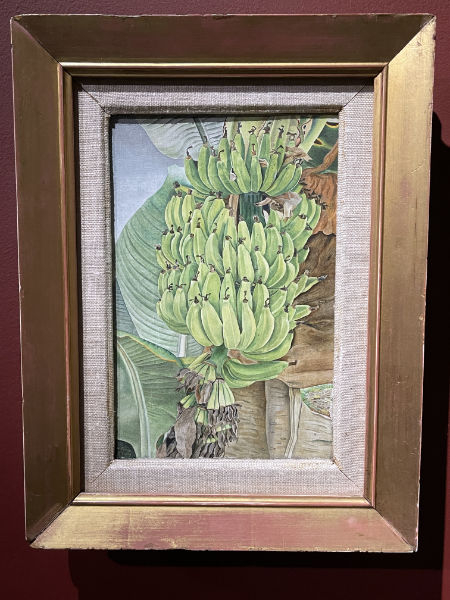
The next part of the exhibition, you can see in the first image above. This part includes a very fine but small painting of bananas on a tree.

Bananas by Lucian Freud
on loan from Southampton City Art Gallery

This was painted from life at Goldeneye, the home of Ian Fleming in Jamaica. Freud spent the tip painting banana trees on the estate.

Bananas is acutely observed and painted in precise, naturalistic detail. Freud said that the subject was a welcome release from portraits: "I noticed I switched away from people when my life was under particular strain...Not using people is like taking a deep breath of fresh air". Bananas was first exhibited at the Venice Biennale in 1954 in a joint exhibition with Ben Nicholson and Francis Bacon.
You can see more of his paintings of plants from Jamaica online - such as this one Plants in Jamaica which was sold at Sotheby's (but is not in the exhibition). 

This is a closeup of the one very large painting called "Two Plants".  Below it are the quotations I used in my 2018 post plus a video about the painting.

Thursday, July 25, 2019

Award winners at the RHS Botanical Art Show 2019

Botanical artists from all over the world who compete for medals at the Royal Horticultural Society's Botanical Art equivalent of the Chelsea Flower Show have to work very hard for their medals and have five years from being approved to exhibit to get it right for a 2.5 day exhibition.

Judges are not satisfied with one painting. They want six - on a theme, botanically accurate and correct, constructed using artistic skills and with a visually aesthetic appeal.

View of some of the exhibits of six (typically watercolour) paintings of plants on a theme at the RHS Botanical Art Show

BELOW are images of the Major Awards

You can also
The Gold Medals were split between:
  • 5 UK Artists (4 English and 1 Scottish)
  • 4 Japanese artists 
  • a group of Russian Artists

The exhibition at the RHS London Botanical Art and Photography Show is open today and closes at 5pm. It's in the RHS Lindley Hall in Elverton Street in Westminster.

Best Botanical Painting 2019


Mariko Ikeda (GM 2017 and Best Exhibit 2017) - Pandanus tectorius of Micronesian Atoll (Watercolour on vellum)

Mariko lives in Tokyo. She has a Ph.D. in the Sciences of Art (2009) and has been a Botanical Art Instructor in Tokyo since 2006. In terms of previous awards she has
  • won 1st Prize (twice) at the Botanical Art Competition run by the National Museum of Nature and Science in Tokyo.
  • won a Gold Medal for her exhibit of Pandanus at the RHS Botanical Art Show in 2017 and was also awarded Best Exhibit in show.
  • this year won another Gold Medal and Best Painting.
Best Botanical Painting: Mariko Ikeda : P.Tectorius ‘En Khelen’

Mariko Ikeda GM (2017 + Best Exhibit, 2019 + Best Painting) Pandanus tectorius of Micronesia

Best Exhibit 2019


Naomi Gumma (Japan) - A Gift from the Gods: The Life Cycle of the Shimonita Welsh Onion (Tempera on paper)

This is Naomi's first visit to RHS and she has won a Gold Medal and Best Exhibit!  She also dressed in sync with her plant!

Best Botanical Art Exhibit 2019: Naomi Gumma GM (2019): The Lifecycle of the Shimonita Welsh Onion


Judges Special Award 2019

Betsy Rogers-Knox: Exploring the Seasons at Beckley Bog

This was awarded because of the significant educational value of Betsy' watercolour paintings about bog plants growing in a specific environment.

Exploring the Seasons at Beckley Bog - The Botany and Beauty of Vascular Plants and Bog Benefits
Betsy Rogers-Knox

Judges’ Special Award 2019: Betsy Rogers-Knox

[NOTE: Most of my writing about botanical art is now on my Botanical Art and Artists website - and I'm currently writing up this year's awards - and TIPS -  from the RHS London Art and Photography Competition 2019 on my news blog - which you can subscribe to if interested]

Sunday, August 26, 2018

Lucian Freud - paintings of plants and gardens

Lucian Freud painted plants and gardens as well as people and animals.

I was reminded of this last Friday when I saw Two Plants at Tate Britain.

Two Plants Lucian Freud
Today I decided to review the paintings of plants and gardens by Lucian Freud as I'd never looked at them all.

Below you can find an inventory - in a timeline - with

  • notes about their context and location
  • links to where you can see them and 
  • quotes by people - including Freud himself - about his paintings of plants and why he did them.

In between are my photos of the above painting after I gave it my usual nose to canvas inspection..... I found the way in which he applied paint to very interesting.

All we need now is an exhibition dedicated to his paintings of plants and trees. There's certainly a lot of paintings to pick from!


Paintings of plants and gardens by Lucian Freud

"The subject matter has always been dictated by the way my life has gone. I noticed that when I was under particular strain, I didn't feel so like staring at people or bodies all day." It was at times like these that the palm, the Egyptian Book, thistles, cyclamens, buttercups, substituted for sitters. Seeing through the skin
You can see his plant paintings in The Lucian Freud Archive.

The links below are to
  • either Bridgeman Images which represent his work for licensing purposes.
  • or where paintings can be viewed in Galleries (if possible)
All are oil paintings unless otherwise indicated

The ones I know about are:
"one of the most memorable potted plants in the history of modern art"Lawreence Gowring about the Yucca which appears in Freud's paintings
  • 1953 - Bananas (Southampton City Art Gallery) 
  • 1953 - Plants in Jamaica - meticulous observation of exotic Caribbean vegetation at the Goldeneye villa of Ian and Ann Fleming on Jamaica, where Freud stayed during a visit in 1952-1953. Sold for £481K in 2011
For Freud, Jamaica's relaxed and vibrant island culture represented a welcome escape from the turmoil surrounding his private life back in London. This was reflected in the two paintings that he produced whilst he was there, Bananas(Collection of Southampton City Art Gallery) and Plants in Jamaica; both of which were conspicuously devoid of any human presence. "I noticed I switched away from people when my life was under particular strain," recalled Freud. "I preferred working in complete isolation. Not using people is like taking a deep breath of fresh air" (the artist cited in: Exhibition Catalogue, Venice, Museo Correr, Lucian Freud, 2005, p. 35).

The tropical beauty of the verdant Caribbean landscape provided Freud with a fresh and fertile source of inspiration for his painting. Perhaps more importantly, the painting en plein air that it required brought to his work an unprecedented immediacy and technical vitality that Freud developed over the course of the next ten years into an altogether more fluid approach to both subject and technique. 

Sotheby's Catalogue note for Plants in Jamaica | Auction 2011
Intimately observed down to its smallest, naturalistic detail, the all over composition of Plants in Jamaica is delicately articulated in modulating tones of radiant greens and browns. Using the finest sable brushes, in this work, Freud provides a mesmerizing visual manifestation of his renowned proclamation that: "The picture in order to move us must never merely remind us of life, but must acquire a life of its own, precisely in order to reflect life." (Lucian Freud, Some Thoughts on Painting, July 1954)
  • 1955 Cyclamen - a stem, a flower and three leaves on a wall at Coombe Priory bought by and his second wife, Caroline Blackwood as a place where she could stay when he was in town. One of only two Freud murals now in existence (see Wall Flower and next item)

Friday, February 26, 2016

RHS London Botanical Art Show 2016 - Medal Winners

Below you'll find the names of the people who won medals at the RHS London Botanical Art Show today. 

You can find out more about them and their exhibits in my previous post about RHS Botanical Art 2016 - Selected Artists

Well done to the RHS Organisers for having the list of medal winners available as a pdf file on their website by the time I got home!

Best Botanical Painting by Julie Nettleton

Best in Show


  • Best Botanical Art Exhibit: TillandsiaMariko Aikawa 
  • Best Botanical Painting: Xanthorrhoea resinosa Pers., Grass Three with Antechinus Stuartii, Brown Antechinus – Julie Nettleton

Gold medals


Paintings of Tropical Climate Plants by Sansanee Deekrajang
Four of Roger Reynolds's paintings of "The Tip of the Branch"

Silver-Gilt 

View of the RHS London Botanical Art Show 2016
The new arrangements for the display of the art worked extremely well

Silver

  • Amanda Petty Biblical Boys 
  • Carolyn Jenkins Hydrangeas 
  • Hiroko Jibiki Squash 
  • Janice Peers A Bulb for All Seasons 
  • Jean Webb Close Encounters of the Botanical Kind 
  • Lyn Campbell Trilliums 
  • Maggie Niagassas Strelitzia reginae 
  • Pamela Moodie 5TR Patterns of Growth 
  • Sarah Morrish Twigs & Buds in Winter - from Trees & Shrubs of Ancient Hedgerows Silver 
  • SoYoung Sin Korean Endemic Plants
  • Verene Kutter The Genus Anemone L. in Central Asia 

Bronze 

  • Margaret Bickerton 39 Stretton Farm Road Church Stretton Shropshire SY6 6DX Artichokes
I'll be writing more about the exhibitors and the lessons I learned after I visit again tomorrow.

My new website about Botanical Art and Artists has more information about:

Thursday, February 18, 2016

Short Courses at Ruskin School of Art

If you've ever fancied improving your drawing knowledge and skills at a leading art school in the UK, I recommend you take a look at the 2016 Short Courses offered out of term time by the Ruskin School of Art at Oxford University.

The courses are not cheap and there's a limit of 16 places on each course however I expect some of them - particularly those taught by Sarah Simblet - will be booked up fast.


Three drawing topics with Sarah Simblet


Courses offered include three with Sarah Simblet, a renowned artist and author. I've attended her lectures and done courses with her in the past and she's excellent! See, for example. my blog posts
My sketch from A 'Day to Draw' at the National Gallery
done while listening to Sarah Simblet talk about 
the anatomy and skeletal features and muscle groups
She's very good and her books are also highly rated and best sellers! 

Sarah is doing one course related to each of her books:

Other tutors

Two other tutors also offer courses:
More details for each in the links in the titles.

Practical matters


  • If you want to book, then you need to use Oxford University’s Online Store.
  • If you need a room to attend then you can try University Rooms to access one in a college at the University

Tuesday, February 02, 2016

RHS Botanical Art 2016 - Selected Artists

Thirty five botanical artists have been selected by the RHS Picture Committee to exhibit at the dedicated RHS Botanical Art Show 2016 in the Lindley Hall in the City of Westminster on 26-27 February 2016. This is the largest number of botanical artists in one RHS Botanical Art show during the time I've been visiting.

Below you can find
  • A list of the artists exhibiting in 2016 organised by the country of origin and/or where they live
  • The subject matter for their exhibit is also listed. Some of them sound absolutely fascinating.
  • I've added comments about the individual based on what I know about them or what I can glean from their website or other related sites.  These are intended to give you an idea about what sort of things people exhibiting botanical art with the RHS might get up to when not preparing for this exhibition. I hope budding botanical artists might find this information useful!  (TIP: when planning to exhibit make sure you have a website and that it's up to date!)
This was the RHS Botanical Art Show in 2015 - this year the stands have been changed.

Selected Artists


I recognise quite a few names and have indicated those who I know who have already been awarded an RHS  Gold Medal. I'm also including photos of those individuals I've previously met at Botanical Art Show when winning a gold medal!

It's going to be a great show - and I predict a stiff competition! Looks like we might have a lot of orchids to look at.

Australia

  • Julie Nettleton: ‘Xanthorrhoea sp., Grass Trees’. Xanthorrhoea is a genus of majestic Australian native plants which can grow for hundreds of years.  I'm particularly looking forward to meeting Julie. She's a hugely talented artist and her amazing painting of Banksias was the 'exhibition image' for the 14th International Art Exhibition of Botanical Art and Illustration at the Hunt Institute of Botanical Documentation.  A slice through this drawing is the banner image for her website. I'm guessing, based on her website, that her exhibit will be related to her current project - and it looks as if the paintings will be spectacular!
Currently I am working on a major project to produce a monograph of significant Australian native plants growing in the North Head Sanctuary, Manly. The site is one of Australia’s last remaining pockets of bushland known as Eastern Suburbs Banksia Scrub. Here a rich diversity of native heathland plants grow on ancient, nutrient poor aeolian sands. It is classified as an endangered ecological community so the recording and celebration of what survives is important.
  • Sandra Sanger GM (2010, 2013): ‘Orchids: Paphiopedilum and Australian Natives’. I met Sandra - who is based in Melbourne - when she won Gold in 2013. Sandra was also Highly Commended by the judges of the 2014 Margaret Flockton Award.  I know older artists will be interested in the fact that Sandra only started doing botanical art after she retired!

Hong Kong (China) 

  • Mark Isaac-Williams: ‘The Invasive Chinese Banyan Tree’. From a seedling to a 500 year old house tree, Ficus microcarpa is relentless.  He exhibited at the 17th Annual Filoli Exhibition, USA in 2015

Italy

  • Simonetta Occhipinti: ‘The Citrus Fruits of Medici Family’. A study of the ancient collection of citrus fruits which were first grown in the Medici family's Villa in Castello, near Florence, and in the Giardino di Boboli (Palazzo Pitti) in the centre of Florence, at the end of the sixteenth century. Simonetta does not appear to have awebsite and I couldn't find any information online. However I did find a very interesting website about the Medici Citrus fruit and more about the fruit on this nursery site!
The collection of Medici citruses has survived to the present day, despite the many events that took place through the centuries, and is preserved in Florence, in the garden of the Villa Medicea di Castello and the Boboli Gardens. This collection is of particular botanical and historical interest and consists of about a thousand potted plants, large and small, old and young, but in all cases extremely valuable, as they are all descendents of the Medici cultivars.
  • Lidia Vanzetti GM (Italy): ‘Grapes of the Piedmont’ I had the pleasure of meeting Lidia in 2011 when she won a Gold Medal. She also exhibited at the 13th International Exhibition of Botanical Art & Illustration at the Hunt.

Sunday, December 20, 2015

Call for Entries: Society of Botanical Artists' Annual Exhibition 2016

The process, fees and timescales have changed for the call for entries for the 2016 Annual Exhibition of the Society of Botanical Artists

These are explained below. However the key changes to note are:

  • non-members can submit digital entries this year
  • the fees charged have changed and are now much simpler
  • the timescale has changed - non-members wanting to use the new digital entry process need to note that digital submission closes on 15th January.
  • physical entry via the normal Receiving Day on 22nd February is still available to non-members if digital entry is not possible
The Annual Exhibition will be in the Aldersgate Room of Central Hall Westminster, Storey’s Gate, London SW1H 9NH between 15th and 23rd April 2016. There are a number of prizes (I got an Hon.Mention last year on one of them!) plus eligible works can be considered for a Certificate of Botanical Merit which is usually assessed by a botanist.

The theme of the exhibition is 'Shape, Pattern, Structure' all important aspects of the diversity of growth habit and the range of shapes and colours in plants and flowers

The lovely artwork for the exhibition flyer is A Passion for Peonies by Billy Showell
What follows is my overview and digest of the terms and conditions of entry for the 2016 exhibition. You can the digital entry form and more information on this page on the website.

Please note that any errors of interpretation are mine and that all those submitting to the exhibition should rely on the formal SBA paperwork not line!

Eligible artwork


Who can enter?

There are no constraints on age or where you live with respect to who can enter. Every year, the exhibition includes artwork from international artists.

Application for membership via exhibition: There are special conditions for those wanting to apply for membership or associate membership and details of these conditions can be found on the second page of the Terms and Conditions leaflet.
To become an Associate member, an artist must establish a record of accepted work showing a consistent standard: the minimum period required to establish this record is two years which means that the artist must have submitted five works and had ALL five works accepted for two consecutive years: that is ten out of ten works accepted in total over two successive years. 

International Artists

One of the members of the SBA offers a service such that unframed pictures may be sent which can be framed in the UK (see terms and conditions page 4 for further details)

The Society will not take responsibility for payment of any importation charges or duties.

Artists who are not normally resident and taxable in the UK can submit work but will need to register for VAT if the work sells at the exhibition.

For those unfamiliar with the process this is my blog post about VAT for non-UK artists and UK exhibition organisers

What can you enter


All work entered must be for sale - so don't enter anything which you want to hang on to for another exhibition!  You won't get any physical work back until 25 April irrespective of whether or not it is selected for the exhibition.

All work must be completely original and produced by the person who signs the submission form.  Any copies of any work of any other artist, either living or dead, could result in prosecution.

Eligible artwork is as follows
  • 2D Works: paintings, drawings or miniature work. Acceptable media includes: watercolour, pencil, coloured pencil, pastel, oil, gouache, mixed media, 
  • 3d Works: sculpture, , glass engraving, ceramics, jewellery, carving, metal-work, etc etc. 
  • Media excluded: No photography or digital work will be considered for the time being. 
  • Style: works can reflect habitat and environment as well as adopting the more conventional style of traditional botanical illustration and plant portraiture, 
  • Size: The size of the subject matter may be life-size, reduced or enlarged. However the maximum size of work is 48" on the longest length of the exterior frame size
  • Maximum number of works: You can enter up to five works but only four works by non-members will be hung
The expectation is that all work will be presented in a professional manner. The detailed requirements can be found in the terms and conditions in the section on Presentation and labelling of work.

How to enter

To enter you need to submit the work, the entry schedule and a fee.  


Financials

The SBA had have had - until this year - a very complex system of fees - for entry and hanging with variations in what was charged depending on the size of the entry and what was accepted for exhibition. It must have been a nightmare to administer!

This year the fee is uniform for all entries and covers both submission and hanging fee

Minimum Price and what it applies to

Last year the SBA introduced a minimum price for artwork above a certain size.  This continues this year. I assume the objective is to eliminate medium/large works with low prices - which are inappropriate in a London exhibition.


  • If a hanging work measures more than 15" on its longest framed dimension the minimum price must be at least £350
  • The minimum price of £350 does not apply to hanging work measuring less than 15" on the longest length of the frame, or to miniatures, 3D-work or etchings. 

Price including VAT
  • If an artist is personally registered for VAT, then the VAT due on the selling price of the works should be included in the catalogue price.

Fees

Fees are based on the size of the longest length of exterior dimensions
  • A non-refundable digital pre-submission fee is £15 per work, payable on line on submission. 
  • No other fees will be charged

Commission

Commission is charged as follows:
  • 42 per cent on ALL work related to the exhibition i.e. 
    • on the catalogue price on sales at the exhibition 
    • OR resulting in any way from the exhibition ie. copyright, commissions for work, licenses, prints and reproductions of any kind
  • 10 per cent on work resulting at any time from enquiries to, or recommendations by, the Society, or commissioned through the Society. (i.e. unrelated to the exhibition)
  • all works sold are subject to 42% commission
  • any work commissioned as a result of the exhibition is subject to a 42% commission

Payments for sold work

  • payments for sold work will be made within two months of the end of the exhibition

Digital submission

This year, the SBA are inviting non-members to use a digital submission process. I understand that the process will be mandatory from 2016 for both members and non-members so it's an excellent idea to give it a go this year - and to note the difference the process makes to the dates and timeline for entries

The other main advantages for those using this process are that: IF your artwork is NOT accepted then you save money due to no need to frame and no need to spend money on transport or a courier to submit work on the Receiving Day

There are major benefits for international artists if they can get the work to the UK and framed for the Receiving Day after the results of the digital pre-selection are announced on 31 January.

The process is:
What type and size of image?

Actual image - the form requires
  • Actual image size: size requested in the entry is the ACTUAL size of the real image (i.e. height x width in cms)
  • Actual media: this must be stated eg watercolour
Digital image to be submitted:
  • Digital format: supplied in jpeg format (NOT tif, gif or psd)
  • Digital image size: longest length - 1000 pixels wide (NOTE: Smaller images will be rejected)
  • Digital file size: no limit stated
  • Digital resolution: no more than 150 dpi 
  • Digital file name: must identify artist and artwork

Receiving day

SBA 2016 Receiving Day is 22 February 2016. Entries will be booked in at the Aldersgate Room at Westminster Central Hall. The SBA provides a list of couriers you can use.

This applies to
  • all work by members 
  • plus all work digitally pre-selected plus any work from non-members 
All works must be presented - unwrapped - with the printed out digital entry form or the paper entry schedule (and £15 fee for those unable to submit digitally)

Couriers bringing multiple works will be allowed to unpack in the Gallery. 

Timeline

Submission and selection

  • 15 December 2015 Digital pre-selection starts 
  • 15 January 2016 Deadline for digital submission (nearly 4 weeks from today)
  • 31 January 2016 Notification of results of digital pre-selection. You then have three weeks to get your work framed and transport or a courier organised
  • 22 February 2016 Receiving Day for pre-selected works from 11am to 4pm 
  • 23 February 2016 Selection of work (at Central Hall Westminster)

Exhibition

  • 14 April 2016 Private View from 11am to 7.00pm 
  • 15 to 23 April 2016 Exhibition open 11am to 5pm including Sundays 
  • 25 April 2016 Collection of unaccepted and unsold work from Aldersgate Room, 10am to 3pm. Artists must bring their own packing.
Note there is only one collection date for both unsold and unaccepted work. Hence the advantage of using the digital selection process if there are other places you'd like to show your work.


Queries


Note that the General conditions of entry provide the name and contact details for Mrs Pamela Henderson, Executive Secretary SBA who looks after a lot of the entry process. Any queries should be addressed to her.

Tuesday, September 08, 2015

Florum 2015 - Nopal de Cerro (Opuntia lasiacantha)

I'm slightly preoccupied at the moment - getting my artwork scanned and into frames for tomorrow's submission to Florum!

The exhibition is open to the public at Sevenoaks Wildlife Reserve from 12th - 19th September. It includes artwork by a fantastic range of invited artists.

This is one of my artworks - my version of 'Nopal de Cerro (Opuntia lasiacantha)' which is a member of the Prickly Pear family. I am a convert to Canson Bristol Drawing Paper 250gsm!

Nopal de Cerro (Opuntia lasiacantha)
by Katherine Tyrrell
coloured pencils on Bristol Board 8" x 8"
The exhibition is not strictly botanical although a lot of artists are botanical artists.

Fans of Billy Showell will enjoy seeing her watercolour painting of vegetables
Billy Showell
while those who prefer prints will also find a range of artists producing fine art prints

Lime and Grey Allium by Tessa Pearson


Thursday, August 06, 2015

Review: 'London's Secret Garden' Exhibition at the Chelsea Physic Garden

This week I visited the London's Secret Garden exhibition which celebrates the 20th anniversary of the Florilegium Society at the Chelsea Physic Garden.

a corner of the exhibition - with the exhibition banner
This is a very long post and comprises:
  • a review of the exhibition - highlighting work by specific artists
  • an account of how the Chelsea Physic Garden Florilegium Society works - and how to become a member
  • the key facts about the Chelsea Physic Garden - and why it's a great place to visit (between 1 April to 31 October).

'London's Secret Garden' (4th - 26th August 2015) 


The exhibition includes 75 artworks by 73 artist members past and present. Most are watercolour paintings however there is also pen and ink and the use of graphite and coloured pencils.

The exhibition opened on Tuesday and runs until Wednesday 26th August and can be viewed between 11am and 4pm. Entrance to the exhibition is free with entry to the garden.

A number of the paintings are also included in a book Botanical Illustration from Chelsea Physic Garden by Andrew Brown (Past Chairman of the Society) -  which has been produced to commemorate the 20th Anniversary. (I'll be writing a separate review of this). A similar book was produced for the tenth anniversary and now sells for enormous prices - if you can get hold of a copy!

Ribes rubrum by Sally Vincent and  Fuschia procumbens by Mayumi Hashi
The painting on the left is the one chosen for the front cover of the book
The book focuses in particular on angiosperms (plants with flowers and seeds enclosed in fruits).

Views of the exhibition

I have to emphasise that there's an awful lot I could say about this exhibition - and one of the reasons for the delay in posting has been the need to keep editing myself!

My main recommendation to all botanical artists is to go and see this exhibition.

For all those who love plants and flowers it's also very much seeing - both in terms of what you will learn about the plants and because it's an exhibition which has grown out of the garden in which you can see it.

The overall standard of artwork overall is very good and to my mind it's a better exhibition than the last one one in 2013. Some of them are really excellent and that's unsurprising given many of the artists have been painting botanical art for many years and have won medals for it!

The exhibition is hung on grey exhibition panels (like the ones used by the RHS). Below you can see some views of the exhibition and its artwork.

Watercolour paintings by Amanda Ward, Janet Callender and a drawing by John Bell
Janet's painting of the foxglove tree from China is on the back cover of the book.
I was trying to discern a pattern to the way the different plants were hung but couldn't see one. That said, the exhibition is well hung from an aesthetic perspective with some nice use of mirroring on occasion.

Using a consistent frame for most of the work also lends coherence and consistency to the display which means that one's eyes always focus on the works and are never distracted by the frame. Top spots have also been used so that works are well lit.

Those botanical artists submitting work to RHS Exhibitions might want to note that Gillian Barlow, the Chair of the Picture Committee is also Deputy Chairman of the Florilegium Society and has a painting in the show (and the book)!