Showing posts with label art criticism. Show all posts

Sunday, December 06, 2020

A commentary on how to comment on contemporary art

How do you comment on contemporary art? In my view, if you are direct and honest, you comment from your own individual perspective - and say what you see.

Those submerged in the marketplace for contemporary art or the academic world of art and/or who pursue endless degrees in art you may say something completely different. Some of which may sound quite a lot like International Art English a.k.a. "artspeak" and suggest it is "authoritative". It's not. 

As an artist, if you put your work out there you have to be prepared for the fact that not everybody will think your art is as good (or as bad) as you think it is - and that people may say precisely what they think about it. 

My personal philosophy on this blog has always been to never ever say anything negative about an artwork (i.e. say nothing at all if you don't like/rate it) UNLESS the artist is in contention for a major art prize.


Commentary on a comment


I recently came across a comment left some two years ago on my Facebook Page in relation to my posting my photo of a young chap - an emerging artist - who'd got his painting in to an exhibition at the Mall Galleries and won a prize. I'd liked the painting and the artist.

An individual commented - and he was ungracious enough to spoil the young chap's moment in the sun - and took the opportunity to call me out on my writing about art. He was initially referring to my review blog post which was a completely different post from the one he commented on.

I was very irritated by his ineptitude and rudeness and decided to respond in a robust manner.

You can read what happened below - minus the references to specific individual painters and the name of the individual who commented.

Wednesday, January 08, 2020

Archives of British Art and Funding Opportunities at the Paul Mellon Centre for Studies in British Art

On trips around various art websites, I sometimes find some real goldmines of art history. Such as happened today when I came across the Archive Collections associated with British Art on the Paul Mellon Centre for Studies in British Art website

[PS The next blog post about the Summer Exhibition will be tomorrow - it's taking rather longer than I expected]

It's a bit of heaven for those who like researching British Art! Thus we have just a few examples....

Art Prizes


  • Hunting Art Prize - material relating to the Hunting Art Prizes (HAP) which ran from 1981 to 2005. Spot a young looking Lord Gowrie and Daphne Todd below

Art Critics


  • William Packer - relates to William Packer's work as an art critic and includes his copy for published articles of art criticism, mainly prior to editorial intervention.
  • Brian Sewell (1931 - 2015) - 70 boxes - which he had organised himself (and I assume "edited")
    • articles pertaining to art and the arts (boxlist 1)
    • a smaller group of materials concerning his writings on any other subject matter (boxlist 2).
    • material covers every other aspect of Sewell’s life, from childhood to death (boxlist 3).
Brian Sewell (1931 – 2015) was a British art historian, author, critic, and media personality. After graduating from the Courtauld Institute of Art, he worked at Christie’s (1957-1967); as an independent dealer (1967-1980), and as a journalist, most notably for the Evening Standard (1984-2015).

Art Historians

  • Paul OppĂ© - 34 boxes of material that reflects his work as an art historian, critic, museum official and art collector
He also inaugurated the study of British drawings as a scholarly pursuit.
  • Benedict Nicholson - archive comprises seventeen personal diaries, six folders of correspondence and a small amount of reference and research material.
Lionel Benedict Nicolson (1914–1978) was a British art historian and author. He was the elder son of authors Harold Nicolson and Vita Sackville-West. He was Deputy Surveyor of the King’s Pictures (1939-1947), serving in British Army Intelligence for the duration of the Second World War. He was editor of the Burlington Magazine (1947-1978). 

  • Roy Strong - 34 boxes containing research papers relating to Strong's publications and other research
Sir Roy Colin Strong (b.1935) is art historian, museum director, writer and broadcaster and landscape designer. He was Assistant Keeper (1959-1967), then Director (1967-1973) of the National Portrait Gallery and Director of the Victoria & Albert Museum (1974-1987).

Scholarship

The Centre has a Funding Programme which supports scholarship, academic research and the dissemination of knowledge in the field of British art and architectural history from the medieval period to the present. Awards are made twice a year, in Spring and Autumn.
All supported topics must have a historical perspective and all applications must demonstrate that there is a substantial element of British art and/or architectural history to their project.
The next round of funding opportunities close on the 31 January 2020! 
In this round you can apply for:
  • Senior Fellowships
  • Mid Career Fellowships
  • Postdoctoral Fellowships
  • Junior Fellowships
  • Rome Fellowship
  • Terra-PMC Fellowship
  • Research Support Grants
  • Event Support Grants


Where to find The Paul Mellon Centre for British Art


The Paul Mellon Centre for British Art can be found:


Monday, September 09, 2019

Review of a critique of an art society exhibition

What happens when somebody reviews an art society exhibition as if it was a "proper art exhibition" i.e. using the same sort of criteria as might be used for any other sort of art exhibition in the area?

This post is generic in nature - in terms of conclusions - but does take one example to highlight the sort of issues that can arise.

Brea Gallery shows off what the Colored Pencil Society of America can do is a magazine review of the 27th Annual International Exhibition of the Colored Pencil Society of America at the City of Brea Art Gallery, 1 Civic Center, Brea, CA (July 31–September 13, 2019).

It's written by a chap who has written for the Orange County Weekly for the last 8 years as its art critic.

I supposed the best way of summarising his review is he's called it as he sees it.

That's not the way some of colored pencil artists see it who have responded by commenting on his review - worth a read!

They diverge between those that
  • welcome a contribution to the ongoing debate about the use of photographs by CP artists
  • one lady who is not averse to slinging insults around - not realising that Google picks up on comments as well as websites and that her name is now forever irretrievably associated with her comments!
  • some who criticise the reviewer for not understanding the medium of colored pencils. For example.....
Mr Barton, You should be ashamed of yourself, given the ignorant nonsense you’ve written here about this medium, these artists, and art in general, frankly. Did you interview a single artist, or even leaf through a copy of “Colored Pencil” magazine? Your level of ignorance is astounding.
I do remember another CPSA exhibition where the independent Juror did provide feedback afterwards about the show as a whole - and mentioned a lot of aspects highlighted in this review. It didn't go down well that time either. However it does say something about the extent to which coloured pencil artwork has moved on in the last decade or so if the same sort of comments are still being made by independent individuals who have studied the artwork.

Interestingly, some of those who commented got stuck on some of the earlier comments and appear to have completely missed the last paragraph.
For the future, the process of work such as this needs to be demystified. Art historians and critics, including myself, usually do little to shed light on how work is created, focusing mostly on the materials used or the feelings we have when looking at it. Focusing solely on the ideas is a primarily selfish, insular thing satisfying only the person writing about it, when opening up the hard work, the blood, sweat and tears behind the art should be our goal.
Images (in cropped format)
of some of the artworks
winning awards in the exhibition
You can see more photos of the prizewinners on Facebook and more of the pics in the rest of the exhibition on the Brea Gallery Instagram account

A Making A Mark perspective


I'm really not having a go at CPSA or its members in particular here. The issues for me are essentially generic - other than to highlight that it's interesting that some common criticisms from an independent perspective of this type of artwork are still the same as they were more than a decade ago.

My reason for commenting is more about the need for artists to understand that if and when you put your art "out there" - via an exhibition or a website - then

  • people will make their own assessment and think what they think 
  • sometimes they will say what they think - and 
  • sometimes they will maybe even WRITE what they think.

Here's my take on it.

Friday, December 21, 2018

How to be an artist - can you have rules?

I've often heard it said that you're an artist when you've learned enough about the rules to be able to break them.

The question then becomes "What are the rules for how to be an artist?"

According to Jerry Saltz, there are 33 rules for making art - see How to Be an Artist - 33 rules to take you from clueless amateur to generational talent (or at least help you live life a little more creatively).
There are 33 rules — and they really are all you need to know to make a life for yourself in art. Or 34, if you count “Always be nice, generous, and open with others and take good care of your teeth.” And No. 35: “Fake it till you make it.”
Just to be clear, Jerry Saltz is not actually an artist. He wrote an article in 2017 called My Life As a Failed Artist Decades after giving up the dream for good, an art critic returns to the work he’d devoted his life to, then abandoned — but never really forgot. By Jerry Saltz

Jerry Saltz, winner of the 2018 Pulitzer Prize in commentary,
taken at the Pulitzer Prize ceremony in NYC
Wikimedia Creative Commons
Nothing so straightforward. He's an art critic.

Specifically, he's the art critic of the New York Magazine - and this is a link to his most recent articles which he writes for Vulture, which is the culture section of that Magazine.

He also won the Pulitzer Prize for Criticism in 2018 - so not just any old art critic!

Jerry Saltz' 33 rules for 'how to be an artist'


Anyway - here are his 33 rules. The full explanation for each one comes in his article which I recommend you read

Bottom line - it's a good read!  Whether you agree with all of it or not - and the images used for the article are also excellent - not least those where he emulates Cindy Sherman! (see below for his Warhol, Dali and Frida Kahlo impersonations)


However let's also be clear these are rules stated as Lessons - and some include exercises and most include imperatives.

In fact, I have no problem with the thrust of the article being Lessons. It's the notion that these are "rules" which causes me to pause. I'm left wondering if an Editor thought of a better title for the article?

I found myself nodding in agreement with quite a lot of what he has to say. I think if you've tried being a serious artist or know people who have you'll recognise those truths.
....over the years, I’ve found myself giving the same bits of advice. Most of them were simply gleaned from looking at art, then looking some more. Others from listening to artists talk about their work and their struggles.
Some of it I think has to be said by somebody who is not an artist because sometimes only the truth of 'what is' can be said by somebody who been very close to the art world without being an artist.

Read them as LESSONS and not rules...  Rules are made so you can break them - when you're a real artist.

Step One: You Are a Total Amateur
  • Lesson 1: Don’t Be Embarrassed
  • Lesson 2: “Tell your own story and you will be interesting.” — Louise Bourgeois
  • Lesson 3: Feel Free to Imitate
  • Lesson 4: Art Is Not About Understanding. Or Mastery.
  • Lesson 5: Work, Work, Work
Step Two: How to Actually Begin - An instruction manual for the studio
  • Lesson 6: Start With a Pencil
  • Lesson 7: Develop Forms of Practice
  • Lesson 8: Now, Redefine Skill
  • Lesson 9: “Embed thought in material.” — Roberta Smith
  • Lesson 10: Find Your Own Voice
  • Lesson 11: Listen to the Crazy Voices in Your Head
  • Lesson 12: Know What You Hate
  • Lesson 13: Scavenge
Step Three: Learn How to Think Like an Artist - This is the fun part.
  • Lesson 14: Compare Cats and Dogs
  • Lesson 15: Understand That Art Is Not Just for Looking At
  • Lesson 16: Learn the Difference Between Subject Matter and Content
  • Lesson 17: See As Much As You Can
  • Lesson 18: All Art Is Identity Art!
  • Lesson 19: All Art Was Once Contemporary Art
Step Four: Enter the Art World - A guide to the snake pit.
  • Lesson 20: Accept That You Will Likely Be Poor
  • Lesson 21: Define Success
  • Lesson 22: It Takes Only a Few People to Make a Career
  • Lesson 23: Learn to Write
Step Five: Survive the Art World - Psychic strategies for dealing with the ugliness (inside and out).
  • Lesson 24: Artists Must Be Vampires
  • Lesson 25: Learn to Deal With Rejection
  • Lesson 26: Make an Enemy of Envy
  • Lesson 27: Having a Family Is Fine
Step Six: Attain Galactic Brain
  • Lesson 28: What You Don’t Like Is As Important As What You Do Like
  • Lesson 29: Art Is a Form of Knowing Yourself
  • Lesson 30: “Artists do not own the meaning of their work.” — Roberta Smith
  • Lesson 31: All Art Is Subjective
  • Lesson 32: You Must Prize Vulnerability
  • Lesson 33: Be Delusional
I'll be inserting a link to this article to the soon to the STARTING OUT Tips for an Emerging Artist page of the Practice Section of my Art Business Info for Artists website - not least because it's one of the more realistic articles I've read about the fact being an artists is emphatically NOT all about the art!

What are your "rules" or "lessons" for being an artist? (Answers on my (public) Facebook Page please)

More about Jerry Saltz


His social media sites are worth following....

Sunday, May 06, 2018

The Painting Show which should replace The Big Painting Challenge

This evening at 6pm is the televised Final of The Big Painting Challenge (BPC).  This post provides a critique of the series to date AND at near the end I set out the sort of programme I'd like to see replace the BPC.

In case anybody's interested, I think Oliver Freeston will win The Big Painting Challenge.
  • He's never been one of those considered for elimination 
  • he won the public vote last week 
  • he does seem to have made an effort to listen and improve his painting each week.
  • he's given his website a makeover! He just needs to do the same for the artwork displayed on it now. Most of it seems to be pre-BPC.
  • he's in the middle of the photo for their Chapter 10 Exhibition which opens this week (see the end of this post)

The Big Issues for the BPC


The BBC obviously does not consider The Big Painting Challenge as any sort of serious contribution to the arts in this country

How do I arrive at this conclusion?
  • I checked out the BBC Arts webpage this morning when I sat down to write this post. The Big Painting Challenge is nowhere to be seen. This presumably because the programme is not part of the Factual World which embraces the rest of the Arts, Culture & the Media Genre on the BBC.
  • Nor is the Programme to be found in Learning - and interestingly the BBC does not recognise or cater to Adult Learning
  • Instead The Big Painting Challenge is listed under Talent Shows!!! How "dumb" is that?
At the beginning of the series I wrote a post I called The Big Painting Challenge (2018) - The Issues in which I highlighted my niggles about this BBC programme - described thus by the BBC
Passionate amateur artists undertake an intensive, six-week, artistic boot camp in a bid to perfect their skills and be crowned the overall champion.
At the end - I just feel very sad.

This programme totally missed an amazing opportunity to EDUCATE as well as entertain - without making it a "lose a candidate every week" type of show.

If you are going to have a knock-out then you must start with the best you can find

As it was it wholly:
  • misrepresented and down-sized the nature of development in painting and 
  • dumbed-down the process. 
So let's revisit my issues identified at the outset of this series - before I identify the programme I hope they make next year.

Monday, April 30, 2018

Review: Movement - Big Painting Challenge 2018

It was semi finals week in the Big Painting Challenge this week. Six people were left - which meant that two people had to go before the Final next week.

The six semifinalists and their Mentors - just read the body language.....
So I wrote down in my notebook I use when watching each episode the four people I thought would make it to the Finals two minutes into the programme - and come the end I was proved right.

Who will be in the final? 
Mind you, I think that's because I pay attention to the way the edit by the production company leaks subliminal clues from the very beginning of the series! Pay attention to who gets highlighted in the opening sequence - particularly in relation to episodes not yet shown - and how much time they get!

This week the theme was ostensibly Movement - but was actually about looking - and the need to look, study and memorise movements and work out a strategy that worked for them about how to depict movement.

The comments on social media continue to be overwhelmingly negative about this programme on both Facebook and Twitter #BigPaintingChallenge. Indeed I can't think of another "how to paint" programme which has ever produced this reaction.

The theme underlying most comments is how unfair and mean the programme is to the artists.

Even the Daily Mail decided to comment - see Judges on The Big Painting Challenge are branded 'bitchy and cruel' by viewers - who say they're more interested in 'crushing' amateurs than the quality of their art (although their final sentence - not the one below - defies logic!)
Judges Daphne Todd and Lachlan Goudie were branded 'unbelievably brutal' by contestant Susan, from Northern Ireland - and many viewers strongly agreed
I've been a defender of the Judges until now - but this week was not good.


If this programme is not reconstructed into something less "gameshow" and more educational and appropriate for an early Sunday evening slot in future I shall be very surprised.

I do hope the BBC take the opportunity to fire the production company at the earliest opportunity.  The direction and editing is just plain nasty.

The First Exercise


On the whole this first challenge was a much better tempered and less upsetting affair compared to last week. Pascal seemed to be on best behaviour and was extremely pleasant.

I concluded there had been a post mortem after the previous week and a commitment made to have no more tears.

How wrong was I?

Monday, April 23, 2018

Review: Waterscape - The Big Painting Challenge 2018

This week, Episode 4 of The Big Painting Challenge was the Waterscape Episode.

Seven painters and two mentors face the Big Waterscape Painting Challenge
As it was plein air week, they of course had REALLY BAD WEATHER!  I'm not sure that they were planning to have quite so much water in the air as well as in front of them.

Mariella announced at the beginning of the programme that they were on the banks of Loch Lomond "at the tail end of a hurricane" - which I think this means it was being filmed in the third week of October and they had to go north to still have leaves on the trees! 

Here's a taster of how bad it got.

What was really odd was the variation in clothing - and you could really tell who had previously painted plein air (or was used to being outside in Scotland) and who was more used to painting in nice warm studios i.e.
  • who knew what it was going to be like (Pascal - head to toe in red waterproof oilskin of the type worn by fishermen and Tilly - who had layers on her layers and both had really effective hoods)
  • who didn't (Oliver - rocking a laddish V neck sweater and absolutely no visible waterproof whatsoever!)
Pascal in waterproofs

Pascal had a really bad week. He made Jane cry and then this....


Anyway - back to the normal challenges........

Below is my digest/review of what happened in this week's episode. This post follows on from my earlier posts (see end for the first two series and my posts about this series so far)

Tuesday, January 10, 2017

Trump inauguration - artists to strike or not to strike?

An interesting development in the run-up to 20 January and the new President Elect's inauguration is the notion of artists going on strike!

I was amazed at the number of articles this idea has generated and I'm guessing most of you won't have read them. Some are worth reading if you want to get an idea of the pros and cons for this idea which seems to revolve around when is a strike just a posture rather than an act with real impact.

I decided to line them up in terms of whether they are
  • broadly supportive
  • think the action is futile and/or there are better ways of making a stand
  • just want to report the news and/or haven't made their minds up yet
The article most quoted by other articles!

But first the facts...


A document entitled ‘J20 Art Strike Letter’ has been published for circulation. The letter is addressed to museums, galleries, studios, art schools, and other cultural institutions and is signed by various figures in the art world. These include:
  • artists - including Richard Serra, Cindy Sherman and a lot of people I've never heard of
  • art critics and educationalists - again the names mean nothing to me so I've no idea of their weight or otherwise.
The Art Strike Image
The letter states
We, the undersigned artists and critics, lend our support to the call for an Art Strike on Friday, January 20, 2017, the day that Donald Trump will assume the presidency of the United States.
The call reads:
#J20 Art Strike
  • An Act of Noncompliance on Inauguration Day.
  • No Work, No School, No Business.
  • Museums. Galleries. Theaters. Concert Halls. Studios. Nonprofits. Art Schools.
  • Close For The Day.
  • Hit The Streets. Bring Your Friends. Fight Back.
This is the Facebook Page for the event. I have to say that it doesn't look very promising in terms of numbers who have said they will be involved so far (if you remember these people will be spread across the USA). Thew comments are worth a read!

These are the media articles about the letter and the proposed strike - divided into the different camps.

PRO - it will make a difference

AGAINST - People are posturing and/or there are better ways of making a stand

  • ArtNet News Artists Criticize Proposed Strike for Inauguration Day - The divisive event has art world players debating how to effectively protest Trump. (This is the counterbalance to the first article listed above) 
  • The Guardian (Jonathan Jones) | has responded from across the pond with this article The 'art strike' against Trump is futile – cultural elites cannot effect change - Calling on cultural institutions to close on inauguration day only serves to make the likes of Cindy Sherman and Richard Serra feel good about themselves Very widely quoted by other articles. Maybe significant he's the only art critic who is not American who works for a liberal newspaper? I'm very much behind a lot of what he says - see below for an extract.
Yet an art strike is just about the least effective idea for resisting Trump that I have heard. The American left is in for a long, wretched period of irrelevance if this is its idea of striking back. I admire some of these artists greatly, but the notion that museums will help anything by closing their doors, or students will scare middle America into its senses by cutting art classes, tastes not of real hard-fought politics but shallow radical posturing by some very well-heeled and comfortable members of a cultural elite.
I like this response by Weinberg (must be the "child of the 60s" connection!). So much so I'm going to quote his words - with my emphasis in bold
Everyone knows there’s the J20 Art Strike and we’ve been asked what we are going to do. Are we going to be closed?…We are opening our doors as wide open as possible. We are not closing down. We’re actually going to do the opposite: We’re going make the museum free—pay what you wish—all day Friday, 10:30 a.m. to 10 p.m.

Being a child of the ‘60s, all I could think of was the teach-ins [the response on college campuses, including mine, to the controversial Vietnam War]. So we are going to have a series of discussion groups that will be going on all day long. It will be open for people to bring their own contributions to this, whether their readings, artworks, songs or performances.

This our territory. This is America. And we really need to express what we believe….I feel strongly about the Whitney’s role in that. It is our role not to let them own what we think of as America but to express what we believe is America….

INDEPENDENT - we just report the news


What's also very interesting is the number of institutions and media outlets which have not taken a stand on this or written about it. I think it's presenting a number of them with a bit of a conundrum in terms of which way to lean!

....and what do I think?


My own take on it, for what it's worth, is that a strike only works when it represents a groundswell of opinion which has been grown over time.  

A strike has to be big and it has to be solid to count for anything.

The danger of a strike organised by those who like taking stands on things they feel strongly about - without any existing connection to a wider community - is that it can become a damp squib. In which case it only serves to undermine the perspective of those taking part and emboldens those they may be protesting against.

That's why for my part I think
  • there are more effective ways of making a stand
  • the action taken by the Whitney Museum is far more effective in the long run. 

Monday, January 02, 2017

John Berger (1926 - 2017) Videos and Obituaries


John Berger has died aged 90.  His essay on art criticism "Ways of Seeing" was hugely influential within the art world.

Below you can
  • SEE videos of some of his programmes and 
  • READ his obituaries. I've very rarely seen so many overseas obituaries so fast after an announcement of a death in the art world.
This is a video of a BBC documentary to celebrate his 90th birthday in 2016. It's filmed at his house in France where he has lived for the last 50 years. Screenshots are from this BBC documentary John Berger: The Art of Looking - I'm sure the iPlayer link will be revived very soon. In the meantime here it is on YouTube.


Below are four videos of his seminal programme - Ways of Seeing - first broadcast by the BBC in 1972. His book associated with the programme became a set text for many art degrees in the UK.

Plus some tweets from those marking his death.


Sunday, September 20, 2015

Brian Sewell (1931 – 2015) - he will be missed

Where does one start - except to say he will be missed.

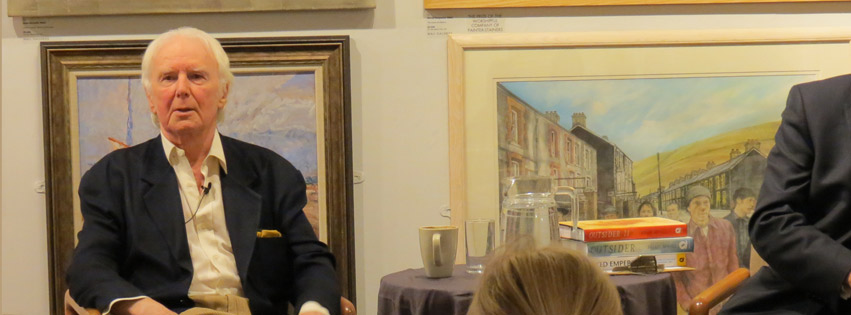
Brian Sewell at the Mall Galleries in 2012
I've regularly highlighted Brian Sewell on this blog and I've got his signature on his biography.

I've even drawn him despite also having a video of him being painted by three different people to constant comments from Brian! (see below for an excerpt on YouTube - which reminds us of that wonderful plummy voice!)

I, for one, shall really miss his wonderfully acerbic critiques when he said the words others were thinking.

Many is the time I've ridden home on the tube enjoying Brian's latest contribution to the arts in my copy of the Evening Standard.

I think the Evening Standard have got it right with their headline - he was a real legend!

He could very definitely be self-important and terribly OTT at times but he did help to get people reading about art and more importantly really looking at it.

Brian Sewell Obituaries

Brian Sewell - The Outsiderat a book launch/signing at the Mall Galleries
Here are some of the obituaries about his death and appreciations of his life. Interestingly Sewell titled his biography "The Outsider"
He called Emin “trivial”, Hirst “f*cking dreadful”, David Hockney “a vulgar prankster” and once claimed graffiti artist Banksy “should have been put down at birth”. (That's my * - no expletives on this blog!)

Brian Sewell on Video


Here's a video of him sitting for his portrait....


Here's the ING Discerning Eye interview with Brian Sewell - he was a selector twice in 1990 and 2011.

Brian Sewell on Art


ING Discerning Eye 2011: One of the walls in Brian Sewell's section of the show
These are some of my blog posts which have featured Brian
At last we got to see what sort of art Brian would choose if left to his own devices in a room full of art!
Here's an extract from one of my posts reflecting on his critiques 
By way of balance - Brian Sewell, art critic of the Evening Standard is renowned for being waspish generally and acerbic about the Tate Modern and conceptual art. He was a judge of the Portrait Prize in 2005 - but has been less than complimentary about it ever since. These are his very barbed comments on:
  • BP Portrait Award 2008 Portrait Award is a Mug's Game - Personally I'd prefer to read rather more analysis and rather less mud-slinging! His points are often sound but for me are spoilt by the rhetoric - I'm often left with the impact of the rhetoric rather than memory of the points being made.
  • BP Portrait Award in 2007 How ugly can the faces get? - I do think he has a very sound point about the risks associated with a sponsor having a representative on the the judging panel. This should be a portrait competition - not a marketing exercise. However, I'm in two minds. He says the sponsor expresses concerns during the judging process about how pictures chosen reflect on the sponsor - and, to my mind, this really should not be a consideration - sponsorship of the arts should be freely given without fear nor favour
 (I'll probably add to this section and/or revise as right now I need to go and pick up some artwork from an exhibition!)

Wednesday, October 16, 2013

Essential Listening: Democracy Has Bad Taste

Democracy Has Bad Taste is the first of this year's Reith Lectures by Grayson Perry.  

It is essential listening for all artists and those involved in viewing art, curating art, selling art and collecting art.

It's now available to listen to on the BBC Radio Player
I want to talk about the issue of quality because I think this is one of the most burning issues around art – how do we tell if something is good?
Grayson Perry
I love Grayson Perry.  He's my kind of contemporary artist - accessible and subversive at one and the same time!  That's subversive as in saying what everybody's thinking - even if they daren't say it out loud in case it harms their careers. One could describe him as an intellectual, articulate and highly visible version of Banksy.
To deliver an original thesis which develops across four lectures, have them subjected to cross-questioning from audiences of hundreds and broadcast to millions beyond that, takes intellectual rigour, a deal of wisdom and (always a bonus) a dollop of wit. Grayson has these qualities in spades.Sue Lawley
I like the fact that:
  • he creates art in what are commonly seen as unfashionable art media - ceramics and tapestries
  • he exists and his art is popular despite and not because of the art establishment
  • he became a member of the Royal Academy of Arts and won the Turner Prize  despite being in his own words nothing more than a "transvest*ite potter from Essex"
  • he still resorts to a pencil and paper and drawing in order to get an idea worked out
  • he unsettles all the chaps with his cross-dressing.  I find that females almost universally love him!
  • and finally.....he's one of the most articulate people talking today about art. He makes art accessible for very many people.
For me he slices through the cr*p and astutely finds new ways of making his point - in ways which nobody else seems to be able to replicate - which can only be a good thing!
I'm quite surprised to be here tonight, because two days ago I had a phone call asking if I would be a judge for the Not the Turner Prize. And two years ago I was asked by the Stuckists to dress as a clown and come and be on the steps outside, so I am thrilled and slightly surprised to be here.
Grayson Perry - Winner of the Turner Prize (2003)

Reith Lectures & Grayson Perry - links to related websites

Tuesday, August 07, 2012

Robert Hughes (1938 - 2012) will be missed

The art world is really going to miss Australian art critic and "national living treasure" Robert Hughes who died yesterday in New York aged 74.

I'm in no way an expert on Robert Hughes however I do like a man who knows his own mind when it comes to art and is uncompromising in stating his views - and he was certainly that.  I loved all his art programmes on TV - it was art for those who don't want it "dumbed down"!

He wrote extremely well and is undoubtedly one of those people who made art more accessible to many people - notably through his book The Shock of the New which must rank as one of the most seminal books on the art of the twentieth century that has ever been written.  (His TV series of the same name is available as a DVD set).

Here he is speaking about the work of Anselm Kiefer


At the same time he was apt to criticise those he considered to be corrupting or devaluing art.
Slamming the dead shark and diamond skull as 'absurd', outspoken Australian Robert Hughes says such commercial pieces have made art meaningless - apart from its price tag

In 1987 he published The Fatal Shore, his best selling account British penal colonies and the early European settlement of Australia.

For those, like me, who valued Robert Hughes I am providing below something you won't find in any of the other obituaries - and that's a compendium of links to:
  • his articles about art and Australia and 
  • accounts of him as an individual who had a very significant impact on the art world

Saturday, January 14, 2012

A 5 minute interview with Brian Sewell

Brian Sewell seems to be becoming increasingly self-revelatory of late.  Maybe it's about getting to 80?  Maybe it's because he's recently published his autobiography - Outsider

This is a BBC video of a five minute interview with Brian Sewell on 6 January 2012.


For those outside the UK who don't know who Brian Sewell is, here's some "bits and bobs" about Brian
  • he's been the art critic for the Evening Standard since 1984 and has won several awards for his writing:
    • British Press Awards: 
    • Critic of the Year1988, 
    • Arts Journalist of the Year 1994; 
    • Hawthornden Prize for ArtCriticism 1995, 
    • Foreign Press Award (Arts) 2000
  • He's been described by some as Britain's most famous and controversial art critic
  • He's not fond of conceptual art - and consequently he's very popular with rather a lot of the ordinary public who consider he says what they think
  • He can always be relied upon for an interesting review - and his tendency to be acerbic means he'll never leave us in any doubt what he thinks about an artist (e.g. Stop it, Damien Hirst, you're embarrassing yourself).
  • Once heard never forgotten - his diction and received pronunciation are both memorable!  
  • Sewell is renowned for unsettling people due to both his personal views and his very forthright style.  There was something of a storm in the art world in 1994 when 35 art world signatories decided to write a letter to the Evening Standard attacking Sewell for "homophobia", "misogyny", "demagogy", "hypocrisy", "artistic prejudice", "formulaic insults and predictable scurrility".  Sewell responded with comments on each of his detractors.  A letter supporting Sewell from 20 other art world signatories accused the writers of attempted censorship to promote "a relentless programme of neo-conceptual art in all the main London venues". 
  • The voice plus what has been described as his is "pithily phrased disdain" and general contempt for the type of art which doesn't find popular support seem to me to be what has made him famous on television in the UK
  • I've got a very good portraiture video about Brian Sewell being painted by three different artists - but don't seem to be able to find it online.
  • he recently displayed his own taste in art (that doesn't include the Old Masters) for the first time at the ING Discerning Eye.  I was particularly struck by the lack of colour - until I found it! (see Review: ING Discerning Eye Exhibition 2011 12 Nov 2011 and in particular the 3rd photo below).  However he obviously also enjoys people who can draw and portray people in paint.


Three pictures illustrating Brian Sewell's selection for the ING Discerning Eye
  • He doesn't have his own website.  I tend to think Brian probably uses a typewriter and hasn't yet heard of Twitter.  He does however have his very own fan website - probably not a good idea to enter it though!
Things I never knew until writing this post
I'm just about to finish the biography of Steve Jobs and I've got the recently published biographies of both Brian Sewell and David Hockney in the queue for the next bedtime read.  Should be interesting!

Tuesday, February 16, 2010

The Most Wanted Paintings on the Web

The Most Wanted Painting in the USA
(dishwasher size)
Komar and Malamid - survey results

A project begun in 1995 by the Russian emigrant artist team Vitaly Komar and Alex Melamid identified the most wanted and least wanted paintings on the web. See Komar & Melamid: The Most Wanted Paintings on the Web
This project, created by the dissident Russian artists Vitaly Komar and Alex Melamid, attempts to discover what a true "people's" art would look like. Through a professional marketing firm, a survey was conducted to determine what Americans prefer in a painting; the results were used to create the painting America's Most Wanted. This project was expanded in both scope and audience through the Internet at Dia's website, allowing visitors to see the paintings based on completed polls of over a dozen countries
The project website describes its purpose as follows
Komar and Melamid's project poses relevant questions that an art-interested public, and society in general often fail to ask: What would art look like if it were to please the greatest number of people? Or conversely: What kind of culture is produced by a society that lives and governs itself by opinion polls?
This is a link to the Most Wanted and Least Wanted paintings by country. They're actually a composite based on the answers to the survey questions

This a link to the survey results - which analyse responses to each survey question by country. Click the x to see a pie chart of the percentage responses to the different options offered.

Here's what the majority of people who were surveyed in France, Germany, Holland, Italy, the USA and on the web said in response to the first set of questions.

(a small sample of)
The Survey Results
Please note that the surveys
differed slightly from country to country.
As a result, not every question
has a result for each country.
France
Germany
Holland
Italy
USA
World
wide
web
Favorite color?BlueBlueBlueBlueblueOther
2nd favorite color?GreenBlueBlueBlue/
Green
greenblue
Prefer modern or traditional art?trad.trad.
classical
trad.trad.trad.both
Preferred type of art?

europeanitalianamericaneuropean
Art to fit decor or art you like?
decorlikelikelikelike
Prefer older or newer objects for home?
older/bothmixedmixedolder
(even split)
Prefer wild animals or domestic?bothbothneitherneitherwild
wild
Prefer outdoor or indoor scenes?outdoorbothoutdoorsoutdoorsoutdoorsboth
Preferred type of outdoor scenes?lakes
rivers
oceans
no pref.lakes,
rivers
oceans
lakes,
rivers,
oceans
lakes,
rivers,
oceans
city
Preferred season?fallno pref.springspringfallfall

It's interesting to see the extent to which there is agreement and divergence of views depending on the question asked and the country responding. I think we can clearly see that blue is a very popular colour.

For more background on the project you can read a couple of articles posted on the project website:
The web's LEAST wanted painting
(paper back book size)

Different critiques of the project - on its website - identified the following issues with the survey:
  • the survey is constructed so that responses are pre-determined by the artists (in terms of options provided)
  • I couldn't find my preference in the options identified
  • the survey was too long
  • the survey is too simplistic
  • the survey did not seem to address levels of enjoyment to be derived from art
  • the project is a clever parlor trick
The project was sponsored by the Chase Manhattan Bank. I'd be intrigued to see the report which proposed the sponorship of such a project!

I'd never heard about this project before and came across it while reading Landscape and Western Art (Oxford History of Art) by: Professor Malcolm Andrews for my Art of the Landscape project. It's a very good book!

I'm now wondering what the answers would be like if the same questions were asked 15 years later.

What do you think of the responses? How do you think they might vary if updated?

(Postcript: BTW folks - this survey says landscapes are popular! If you;re interested in developing your knowledge about and skills in landscape painting you might like to check out The Art of the Landscape Blog!)

The Art of the Landscape

Wednesday, February 03, 2010

How to critique art

A reader has written to me and asked about links to sites which provide helpful advice about how to critique artwork.

It's a jolly good question! It also made me realise it was a topic which I'd not researched - although I already knew of some links.

So much so that I've decided to employ the "wisdom of crowds" and invite you all to contribute to an exercise to identify useful links and suggest what you think is important.

I'll produce a revised summary of advice, tips and techniques after you've all had a chance to respond.

How to Critique Art - links to sites providing advice

First of all here are some links to advice which can be found on the Internet.  These are included in my new 'resources for artists' information site - How to Critique Art - Resources for Artists
In order “properly” to critique any given artwork (in a way that is acceptable by any institution assigning four-digit numbers to its classes), you need only remember the acronym “DAIJ.” It stands for “Description, Analysis, Interpretation, Judgment,” or as a clever student in my highschool art class once said, “Dem Apples Is Juicy.”
A couple of other tools

First ArtLex Art Dictionary which provides a useful resource for art terms

Let's also not forget the The Instant Art Critique Phrase Generator which is always good for a laugh if the 'high falutin'' language we often read in critiques gets too much for you! This was its response after entering a family members birth date
I find this work menacing/playful because of the way the sublime beauty of the purity of line makes resonant the larger carcass.
The wisdom of crowds - what are your suggestions?

Three questions:
  1. Do you have any personal advice as to approaches to adopt when critiquing art?
    • for those providing the critique
    • for those whose work is the subject of the critique
  2. Do you have any suggestions as to any additional websites which provide useful advice?
  3. Which of the sites listed above do you think provided the best advice?
I'm looking forward to seeing your responses.

Additional References

A number of the sites assume familiarity with technical aspects of how an artwork is out together. Below are more of my 'resources for artists' sites which some people might find helpful.


Composition and design for artists
  • Composition and Design - Resources for Artists You can use composition and design to help to make your artwork more more pleasing to the eye. This lens contains links to - information and advice about composition and design for artists. - various books concerned with composition and design.
  • The Best Art Books - Composition and Design This site identifies leading art books about composition and design and includes reviews of art books about composition and design. It's linked to Composition and Design - Resources for Artists
Colour: What is colour and how can you use it
  • Colour - Resources for Artists What is colour? Do you know or do you want to learn more about colour and its use as an artist? This site provides links to information and advice about colour and how to understand and analyse it - and then use it as an artist.
  • Colour science, systems and models - Resources for Artists If you want to understand more about the science of colour, how it works and how people think (or thought) it works then this is the site for you.
  • The Best Art Books - Colour This site identifies leading art books about colour and includes art book reviews - for books about understanding colour, using colour, mixing colour. It was created out of The Colour Project on Making A Mark which involved book reviews by various artists.