Showing posts with label drawing buildings. Show all posts

Sunday, October 13, 2024

The Trinity Buoy Wharf Drawing Prize 2024 to tour UK

The Trinity Buoy Wharf Drawing Prize 2024 is currently on show at Trinity Buoy Wharf, London E14 0JY. All the shortlisted and award-winning drawings can be seen at the exhibition - which finishes on Wednesday 16 October 2024 - prior to the exhibition touring to Salisbury, Falmouth, Dundee, and Manchester - until October 2025.

View of The Trinity Buoy Wharf Drawing Prize 2024 exhibition
first prize winner on extreme right

The Exhibition

The exhibition at Trinity Buoy Wharf is free to visit from 11am to 6pm. 

Another view of The Trinity Buoy Wharf Drawing Prize 2024 exhibition

Future Venues

From a worldwide submission of contemporary drawings

  • 94 drawings by 88 artists were shortlisted for the Trinity Buoy Wharf Drawing Prize 2024 exhibition.
  • 21 drawings by 20 practitioners were shortlisted for the Working Drawing Award. 

The selected artists include an ex-teacher of mine! They are:

Max L Adams / Elisa Alaluusua / Lucy Algar / Thomas Allen / Tim Allen / Allou / Jeanette Barnes / Geoff Bartholomew / Sophie Bartlett / Akash Bhatt / Chris Blackburn /Jane Bottery / Eric Butcher / Ruth Chambers / Sarah Chapman / Sara Choudhrey / Hyeyeon Chung / Sara Clark / Gary Clough / David Conway / Aleksandra Czuja / Gerry Davies / Gary Dennis / Emma Douglas / Sarah Duyshart / Jamie Eade / Roy Eastland / Sian Ellis Tillott / Mark John Evans / Kristian Evju / Jonathan Farr / Nicolas Feldmeyer / Celu Ferreira / Charlie Ford / Todd Fuller / Stefan Gant / Ann Gillies / Adam Gray / Christopher Green / Catherine Greenwood / Richard Gregory / Susie Hamilton / Simon Head / Jessica Heywood / Roland Hicks / Fiona Hingston / Ciaran Hughes / Melinda Hunt / Julia Hutton /Owen Johnson / Janette Kerr / Jen Wei Kuo / Tomasz Lacy / Gary Lawrence / Bridget Lesly / Cheryl Lewis / Jo Lewis / Shihui Li / Edward Liddle / Yutong Liu / Juliette Losq / Peter Matthews / Janet Melrose / Jamie Mills / Jilly Morris / Justine Moss / David Mumby / Hannah Naify / Simon Page / Camilo Parra/ Esteban Peña Para / Ben Platts-Mills / Keira Rathbone / Jane Reid / Abbie Schug / Charlene
Scott / Brian Shields / Ilona Skladzien / Jake Spicer / David Symonds / Emma Tabor / Sally Dee Trewartha / Marika Tyler-Clark / Felicity Warbrick / Lynda Whitehouse / Phill Wilson-Perkin/ Hamish Young / Martha Zmpounou

View of The Trinity Buoy Wharf Drawing Prize 2024 exhibition

I personally found the artwork in the exhibition to be of a high quality with a lot of impressive drawings - which varied a lot in terms of media and size and techniques employed. Many of the drawings are large. Many do not employ conventional display methods. The hang is also very good.

It's certainly well worth a visit.

In my opinion it's also better than the one held last year. (see Two Drawing Awards: Winners & Future Exhibitions).

Tomorrow I'll be uploading my photographs of the exhibition to an album on my Making A Mark Facebook Page - and will be highlighting there those artworks which caught my eye.

Awards and Prizes


This 3D work won The Trinity Buoy Wharf Drawing Prize
(see below for more details)

All the artworks submitted were reviewed by the Judging Panel who then selected the shortlisted drawings and award-winners. The Panel was:

  • Mary Evans, Artist & Director of UCL Slade School of Fine Art, 
  • Gary Sangster, Curator & Writer, Co-Director of Drawing Projects UK, and 
  • Jennifer Scott, Director of Dulwich Picture Gallery in London - reviewed 

The four award winning drawings, collectively received £17,000.  The prizes awarded were as follows...
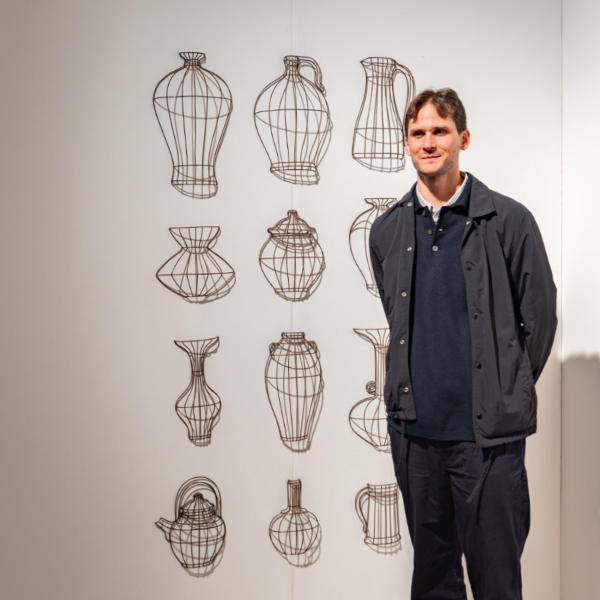
First Prize (£8,000) 
Out of Round: An Abbreviated Outline of British Studio Pottery
2024, steel wire, 170 x 100 x 8cm
by Max L Adams

Max L Adams' award-winning drawing references the Studio Pottery Movement, which in art history marked a shift towards fine art within the craft of ceramics, highlighting the tension between artistic freedom and traditional norms. 

‘My drawings, Out of Round, provide an outline of the Studio Pottery Movement and the subsequent flattening of its forms into icons of regional identity, anti-industrial labour, and domesticity,’’ 

Max L Adams was born in 1992 in Michigan, USA, and is now based in London. He holds an MFA in Arts & Humanities from the Royal College of Art (2023-24) and a BFA in Studio Art from Wheaton College, USA (2011-15). His work has been featured in group exhibitions such as Completion in Motion in Peckham, London (2024) and Finding Place in Crawley, West Sussex (2024). 

Second Prize (£5,000) 
(Left above): The 5th Arch, 2023
graffiti markers, drafting pencil on Bristol paper, 145 x 106cm 
by Owen Johnson. 

Owen Johnson’s award-winning drawing, The 5th Arch, represents a repeated gothic cathedral door motif. Taken from a geometric circular checkerboard arrangement, the motif is organised in a diamond structure, with the shadows of a late summer evening employed to create depth. 
‘The 5th Arch” is a drawing about a space created from memory and through repetition. The drawing is part of a series I have been developing for sometime exploring architecture, pattern and colour
Born in Melbourne, Australia in 1976, Owen Johnson has exhibited widely across the globe and has become well known for his glasswork. He holds a BA in Visual Arts from the Australian National University, Honours in Fine Arts from Monash University, Melbourne, and a PhD from the Royal College of Art in London.  He's currently a Professor at Sheridan's Faculty of Animation, Arts & Design (FAAD) which is Canada's largest art school.

Student Award (£2,000)
Window, 2024
ink on linen (diptych), 120 x 15cm
by Hyeyeon Chung. 

Student Award Winner, Hyeyeon Chung was born in Seoul, South Korea in 1992. She holds a BA in Korean traditional painting from Chung-Ang University and an MA in Fine Art: Drawing from the University of the Arts London.

‘I weave monochrome worlds, fusing scenery and memories. My creative process is marked by meticulous, almost compulsive repetition; a ritual of craftsmanship and dedication. Grounded in intuition, it possesses the precision of a printer's hand,’’

Her award-winning drawing is inspired by contemporary landscape and diasporic experiences, with a focus on cultivating awareness and fostering new perspectives with drawing a pivotal aspect of her practice. 


Working Drawing Award (£2,000)
Plan for Cato Mural, Year 8, Spa Fields, 2023,
watercolour on watercolour paper, 76 x 58cm
by Emma Douglas
‘‘It represents his 8th Year. Since his death, my work has evolved into a project of recording the marks he made during his life, the places that we visited and the images that linger after someone has left,’’ 

Born in London in 1965, Emma Douglas holds a BA in Fine Art from Middlesex Polytechnic and an MA in Printmaking from the Royal College of Art. She has exhibited in both group and solo shows across the UK including The Jerwood Drawing Prize, Flowers Gallery, Arusha Gallery and Norwich Cathedral. She currently lives in London. 

This drawing is the plan for a mural the artist installed in Spa Fields, Skinner Street, London. It is the 11th work in a series of 22 murals she is doing in memory of her son Cato who died in 2010 aged 21 years. 

Her instagram account records the prolific and various ways in which she records the life of her son Cato Heath. Each of the squares in her coloured square murals is colour coded to represent one activity - such as physiotherapy, hydrotherapy, speech therapy or Doctors appointments.  

Winner of the Working Drawing Award: Emma Douglas

The Working Drawing Award celebrates the role of drawing within architecture, design and making processes and was chosen by 
  • Benjamin Derbyshire, Chair of HTA Design LLP, a leading multidisciplinary design practice, 
  • Andrew Grant, Landscape Architect, Founder & Director of Grant Associates, and 
  • Caroline Grewar, Director of Programme at V&A Dundee.

About the Drawing Prize

The Trinity Buoy Wharf Drawing Prize is supported by the Trinity Buoy Wharf Trust, and widely regarded as the foremost open exhibition dedicated to drawing in the United Kingdom. The 2024 edition marks the 7th year of generous support from the Trinity Buoy Wharf Trust and is the 30th edition of the annual open drawing exhibition.

NOTE The Drawing Prize has had a number of names in its career - usually influenced by whoever its current sponsor is. It was founded founded in 1994 by Anita Taylor and Paul Thomas as the Rexel Derwent Open Drawing Exhibition. From 2001-2017 it became known as the Jerwood Drawing Prize from 2001 to 2017 and was delivered in partnership with Jerwood Charitable Foundation. The present sponsor is the Trinity Buoy Wharf Trust who became the principal benefactor in 2018. The constant throughout is Anita Taylor.

Wednesday, October 18, 2023

Two Drawing Awards: Winners & Future Exhibitions

This post is about
  • The Trinity Buoy Drawing Prize and highlights
    • its background
    • details about the 2023 Exhibition and Artists
    • the award winners in 2023 - plus as much as I can glean from what they've revealed about themselves online!
    • future exhibitions around the UK in 2024
  • the Biennial Evelyn Williams Drawing Award £10,000 - selected from artists exhibiting as part of the Trinity Buoy Wharf Drawing Prize Exhibition.

First of all - mea culpa. I completely forgot to go down to Trinity Buoy Wharf (not the easiest of places to get to) for the exhibition of the Trinity Buoy Wharf Drawing Prize.

The exhibition in London closed on Sunday but is now going on tour around the UK in 2024 to:
It's very sad that there's no online exhibition - which is almost standard practice for all art competitions these days. There is apparently a fully illustrated exhibition publication - although I'm not sure how people can get hold of this.

The Trinity Buoy Wharf Drawing Prize


Basically this is a Drawing Prize created in 1994 by Professor Anita Taylor who is currently the Dean of Duncan of Jordanstone College of Art and Design at the University of Dundee and Director of Drawing Projects UK.

Over the years, it has been known by various different names as she has been involved in founding and judging a drawing prizes using various different titles/names over a number of years with various sponsors and held in various places - while she moved around the country in various art academic roles. 

None of the prizes in previous incarnations continue to exist - and yet there's a notion they are all the same prize despite the names of different sponsors. It's not a notion that I've seen previously referenced but there's no doubt that the underlying continuity is essentially that one person invented the prize and is involved with them all.  I've never been quote able to understand why it's not called the Anita Taylor Drawing Prize plus the name of whoever is the current sponsor.  (A bit like the Lynn Painter Stainers Prize operated)

Apparently her listing of research output identifies a number of the drawing exhibitions as just that "non-textual research outputs" - which surprised me - and then it didn't.

I'm not a fan of this individual for a very specific reason relating to a different competition - which some of you may remember - but let's just leave it at that.


The Trinity Buoy Wharf Drawing Prize 2023


The Trinity Buoy Wharf Drawing Prize is supported by the Trinity Buoy Wharf Trust.

In 2023, there were
  • over 3,000 submissions
  • from 1,450 candidates
  • representing 40 countries.
123 drawings by 111 practitioners were shortlisted for inclusion in the Trinity Buoy Wharf Drawing Prize 2023 exhibition were selected for the Trinity Buoy Wharf Drawing Prize 2023 exhibition

The Awards in 2023 with a total value of £27,000 in 2023 - being in two parts:
  • £15,000 for the Trinity Buoy Wharf Drawing Prize 
    • First Prize of £8,000,
    • Second Prize of £5,000,
    • Student Award of £2,000
  • Judged by:
    • Laura Hoptman, Executive Director of The Drawing Center, New York;
    • Dennis Scholl AM, Collector, Arts Patron, President & CEO of Oolite Arts;
    • Barbara Walker MBE RA, British Artist (and first winner of the Evelyn Williams Drawing Award 2017)

The Trinity Buoy Wharf Prizewinners 2023


Interestingly, three of the four prizewinners drew buildings. The prizewinners were announced at a Launch and Awards Announcement on 28 September 2023
 

First Prize £8,000


Jeanette Barnes won the first Prize of £8,000.

Her drawing, as always, is a charcoal drawing of a buildings which is huge - as both subject and drawing - and is also associated with a major new development in London. In this instance the drawing is related to the development of the new Battersea Tube Station and the surrounding area.
Jeanette Barnes' award-winning work is a dizzyingly immersive and dynamic portrayal of Battersea's development in London, anchored by the new underground station. Battersea power station’s iconic chimneys only just edge into the picture, which focuses on the rise of newer buildings, and the ebb and flow of people. The work’s scale, 1.50 metres by 2.13 metres, invites viewers to step inside the drawing, feeling the vibrant and chaotic energy of the bustling city. The Trinity Buoy Wharf Drawing Prize Announces 2023 Winners

New Battersea Tube Station & Developments (2023) by Jeanette Barnes
Compressed charcoal on paper, 150 x 213cm.

Thursday, June 07, 2018

Camilla Dowse: the practice of period house portraiture on commission

Recently I read a post by very popular and award-winning painter Camilla Dowse on Facebook. It was a snippet about her practice when commissioned to paint a portrait of a house. I was intrigued and asked her to talk about her practice of working on commission to paint buildings - and below you can read what she had to say.

The images below include recent past and current commissions - demonstrating the different stages of sketching, studies and final painting she creates when executing a commission.
___________________________________

My work has always featured period buildings and so from very early on in my career I’ve been approached about painting to commission. 

Past Commission (2017) - acrylic on gesso, 41 x 41cm
copyright Camilla Dowse

Past commissions have included everything from small cottages and townhouses to large country homes. One corporate client even flew me to America to complete a series of paintings of the historic buildings found along the Freedom Trail in Boston.

For me, painting to commission is an almost entirely different process to painting for exhibition. There is an additional logistical and administrative responsibility. It’s a commercial process and I think it’s important to remember that I’m being hired by a client who has expectations.

For most people the experience of buying an artwork is simply to pay for a completed piece. But commissioning a painting of a building requires a visit to the location and preliminary work for client approval, so I’ve found it’s useful to break the process down into stages and to charge fairly for each stage.

Whatever the size of the commission the process is the same. I start by visiting the location and collecting reference to work from, then I make some drawings and a small study painting to determine the best composition.

Current Commission - sketches on location
copyright Camilla Dowse

Past Commission (2016) - watercolour sketch
copyright Camilla Dowse
Part of my process is to work from photographs, but only for logistical reasons. It isn’t always possible to tell from my paintings, but often the best angle on a location is found by standing in the middle of the road. Unfortunately with traffic these days that isn’t a practical place to sit and paint.

For this first stage I charge a small fee to cover my time and travel expenses, which is payable even if a final painting isn’t commissioned.

Current Commission: Sketch and Study painting
copyright Camilla Dowse
Past Commission(2017): Study Painting - gouache, 18 x 18cm
copyright Camilla Dowse
Past Commission (2016) : Study painting
copyright Camilla Dowse
Once the client approves the drawings and small study painting I ask them to sign a simple contract and pay a non-refundable deposit before I start work on the final painting. The remaining fee is payable on the client’s approval of the final piece.

Mostly people commission a painting of a building because they have a sentimental attachment it, and it’s great to see faces light up when you present them with a painting they love.

Past commission (2016) - Completed painting (76cm x 76cm)
copyright Camilla Dowse
But commissioning a painting is, for most people, something they do once in a lifetime, so it’s my job to help them through the process and to make them feel as confident and in control of the process as I can, to minimise the chance of them being surprised by something they’re not keen on.

My goal is always to complete the commission to their absolute satisfaction.

____________________________________

Camilla Dowse is opening her studio to visitors as part of the Bucks Art Weeks from 9-24 June 

Thursday, April 19, 2018

Review: Monet and Architecture at the National Gallery

I highly recommend, if you're in London this summer, that you go and see Monet and Architecture at the National Gallery - until 29th July. 

The 75 paintings in the exhibition spans 1860 - 1912 and includes series paintings of Rouen, London and Venice and wonderful paintings of places he knew well in Normandy, Paris, the Netherlands and Italy.

Some 25% of the paintings are ones in private collections - making this probably the only time you will ever see them.

While I'm not 100% behind the curator's analysis of what the exhibition is about, I'm absolutely delighted that there are so many excellent paintings on display - including some of my all time favourites!

The thing is Monet did not paint architecture per se - not like those who simply love architecture. He didn't even paint "things". What he was painting was the light and colour around rather large equivalents of squares and oblongs - as per the famous quotation below.
Try to forget what objects you have before you - a tree, a house, a field, or whatever. Merely think, 'Here is a little square of blue, here an oblong of pink, here a streak of yellow,' and paint it just as it looks to you, the exact colour and shape, until it gives you your own impression of the scene before you.
Rouen Cathedral series - dawn on the right (east) and sunset on the left (west)
It was an absolute joy to be able to see the Rouen series from a decent distance so you could admire  them all together.

However I doubt if you'll be able to do that once the hordes arrive - unless you make a point of going late in the day and waiting until almost everybody has left!

That's because I'm very sure this is going to be a very popular exhibition. The National Gallery has been able to assemble some world class paintings from public and private collections from all over the world. Some I have never seen before in exhibitions or books.

What follows is an introduction to the exhibition - with images to give you a sense of what it looks like - and a note of how the exhibition works

I must emphasise that no book and certainly no blog post can ever emulate the way these paintings when viewed face to canvas. Some of them are quite extraordinary.

The structure of the exhibition


The exhibition is in the galleries in the basement of the Sainsbury Wing - which always seems to be the favoured location for any exhibitions which have enormously valuable paintings! It's very secure.

There are three sections to the exhibition
  • The Village and the Picturesque (3 rooms)
  • The City and Modern (2 rooms)
  • The Monument and the Mysterious ( 2 rooms)

Tuesday, September 22, 2015

The Big Draw - October 2015


This is the 16th year of The Big Draw - which takes place throughout October in various countries across the world as well as across the UK

Last year 414,000 people attended over 1800 events by more than 1000 organisers across 26 countries! Now that's BIG!


The theme is announced via drawing

Key facts for anybody interested in drawing 


....or knows children, young people, adults or older people who like to draw

Big Draw Map of  Events across the UK
Plus allied to the Big Draw is the Ruskin Prize art competition - which I've written about previously. See The John Ruskin Prize 2015: Call for Entries - Making a Mark (29 Jun 2015) Overview of the Call for Entries for the John Ruskin Prize 2015 - on a theme of 'Recording Britain Now: Society'. Deadline: 23 November 2015


Monday, September 30, 2013

The Big Draw 2013 in 15 countries

More than 200,000 people in 15 different countries are expected to get involved in The 2013 Big Draw which this year runs from 1 October to 3 November.

You too can be part of the world's biggest drawing festival!

These events are for those who love to draw, and those who think they can't.

This is the 14th year of the Big Draw. Since it started in 2000, The Big Draw has:
  • encouraged over 1,000,000 people to get back to drawing
  • created the longest drawing in the world (the world record was set at 1 kilometre)
  • organised the greatest number of people drawing simultaneously (c.7,000)
  • created enjoyable drawing spaces in national museums, Trafalgar Square, Somerset House - and the underground tunnel which runs between the museums in South Kensington!
  • created hundreds of new and enjoyable drawing activities that connect people of all ages with museums, outdoor spaces, artists - and each other.
There's lots of kids involved - but it's NOT just about children. This post is going to be about what's happening this year for you, your children and your grandchildren OR your Mum and Dad and grandparents!

Drawing faces at the National Portrait Gallery in 2012
Image courtesy of The Big Draw

What is The Big Draw?

The Big Draw is run by the Campaign for Drawing - set up by Quentin Blake.  The original inspiration came from visionary Victorian artist and writer John Ruskin, whose mission was to teach people how to see through drawing.
The Campaign for Drawing aims to get everyone drawing. It raises drawing’s profile as a powerful tool for thinking, creating and communicating. Its long-term ambition is to change the way drawing is perceived and used by the public and professionals. 
The Campaign’s annual flagship, The Big Draw, proves that drawing can be a public activity as well as a private passion.

The Campaign also demonstrates that drawing can also connect communities. Over 1000 organisations in the UK and fifteen other countries participate - including India, Pakistan, Hong Kong, New Zealand and Brazil.  They all offer events for all ages and abilities.
Drawing is important for happiness and a sense of complete humanity.Andrew Marr, Campaign Patron
This is the 14th Big Draw and there will be events in over 750 venues across the UK in October.
With the Big Draw we seem to have struck something in the national consciousness - it's as though everybody had just been waiting to be told that they are allowed to draw. Perhaps it isn't surprising - we live under a bombardment of manufactured images, and in the face of that we need to be able to draw as a way of discovering the reality of the world about us, as well as the life in ourselves. Sir Quentin Blake, Campaign Patron

Friday, July 05, 2013

Who painted this? #34

Who painted this? #34
Not your average subject matter! I have a feeling people will get identify this painting by recognising the style of painting and the palette - although I could be wrong.  I know the painter well but have never seen this image before today.

How to participate in "Who painted this? #33"


PLEASE make sure you read the rules before posting a comment - and ONLY POST ON THIS BLOG what you think is the answer.

Friday, June 28, 2013

Who painted this? #33

This week I've been looking at cityscapes.  A review of landscape painters from all over the world reveals that most painters do NOT paint urban landscapes with people!  Maybe LS Lowry ought to be revered a bit more for being a painter who unhesitatingly filled his paintings of the industrial north west with people!

Here's another painter who's not averse to peopling his cityscapes.  I've had to remove the signature.

Who painted this? #33

How to participate in "Who painted this? #33"


PLEASE make sure you read the rules before posting a comment - and ONLY POST ON THIS BLOG what you think is the answer.

Tuesday, November 13, 2012

10 x 10 Drawing the West End of London

I only found out about 10 x 10 a couple of days ago.  This is a project which enables 100 (ie 10 x 10) of the world's best artists, architects and designers to draw the City of London in order to raise funds for Article 25 - a charity which promotes shelter solutions for those without homes
The 25th article of the Universal Declaration of Human Rights asserts that adequate shelter and housing are fundamental to our human rights.

Article 25, the UK organisation, works to enable this right by building solutions to global problems.

Article 25 is an operational UK registered charity that designs, builds, and manages projects to provide better shelter wherever there is disaster, poverty, or need.
This is the second year that they have drawn London - this year they've focused on the West End - which was split into a 10 x 10 grid of squares. (Last year they drew the City of London)
The project focuses on a different area of the city each year, with a grid of 100 squares laid over the chosen area. The resulting squares are then allocated to the participants who create an original artwork based on the buildings and public space within it. These pieces of artwork form a collective snapshot of London from one-hundred personal view points, forming a unique showcase of British architectural heritage.
The Drawing Weekend - which happened this year on 15th September - is when the drawing takes place.  Here's a video of what happened.


These are the participants - I spotted two artists who I recently featured in 'Built" : recording and responding to the construction process - Patricia Cain, ("Soho Construction") Jeanette Barnes (No. 66 Lincoln’s Inn Field).

Jeanette Barnes drawing 66 Lincolns Inn Fields and cranes
Others include
They've been having a public exhibition of the drawings at Somerset House which finished today. I had intended to go and see this but unfortunately missed as my (very wonky) right foot started misbehaving in a major way this morning and it was a struggle just to stay on my feet without falling over!

However you can still see:
PS I was rather pleased to see that some of the people taking part tend to draw in a way which is not too dissimilar to Urban Sketchers (and Urban Sketchers London)!

Wednesday, October 10, 2012

Review: Cotman in Normandy - at Dulwich Picture Gallery

Yesterday I went to see Cotman in Normandy - the new exhibition of watercolour paintings, drawings and etchings by John Sell Cotman at Dulwich Picture Gallery.  The exhibition opens to the public today and continues until mid-January.

Cotman in Normandy - the coloured watercolour paintings done in the studio on his return
In summary, it an exhibition which is going to be of interest to those who like Early English watercolours and drawings.  However it has to be said that the bulk of the exhibition - apart from the first and last rooms are mainly drawings and etchings and mainly monochromatic paintings.  Those coming hoping to see a lot of watercolour paintings will be disappointed - however the ones you do see are good - although not all are by Cotman!

Who is John Cotman?

I sometimes forget that not everybody shares my enthusiasm for English Watercolour Painters around 1800!  So here's a bit about Cotman

John Sell Cotman (1782-1842) was a leading member of the Norwich school of Artists - which was the first provincial art movement in the UK.  (Note:  I learned that the Museum in Norwich has a huge bequest of Cotman works - with the stipulation that they should never ever be loaned out.  So if you want to see good early works by Cotman you need to pay a visit to Norwich Museum.  Not that one can tell this by looking at their website - the most I could find was a booklist for the Norwich School of Painters!).

Prior to that he had been born in Norwich and educated in painting in London where he was very much influenced by Thomas Girtin and joined a sketching club founded by Girtin.

He's mainly known as a landscape painter and etcher plus he produced illustrations for books.  At the time of the paintings produced for this exhibition he was being paid some £200pa to be a painting tutor to the wife and children of a gentleman known as Dawson Turner.

Other artists in the exhibition

Besides Cotman, there are also a few examples of drawings and paintings of Normandy which were being executed by other watercolour artists at the same time - including:
  • JMW Turner - the exhibition includes three very nice small watercolour sketches - including one which was a direct comparison with a painting by Cotman  
  • Richard Parkes Bonington (who died age 26) - whose drawings I loved and 
  • a couple of artists I'd never heard of:
Cotman in Normandy

It's an interesting exhibition and focuses on one particular stage in Cotman's life when he had two ambitions:
  • to resolve some questions about the origins of English architecture - and its relationship with French Norman architecture.  Apparently architecture was described as going from Anglo Saxon to Early English without any reference to the Norman influence!  Cotman had painted most of the churches in Norfolk - and he had a theory!
  • to make money (what's new!) by creating portfolios of etchings from a series of drawings of buildings in Normandy.
The context for both of these aims is the fact the Napoleonic wars (1803-1815) were over and the English could again travel in France.  However  I gather that the British public did not find a great need for drawings of buildings in Normandy and hence in the end he didn't achieve the favour or fortune that he'd hoped for.

New Bridge, Durham 1806-7 by John Sell Cotman
Watercolour on paper
Private Collection

Exhibition Rooms

The exhibition starts with drawings, etchings and watercolours of England by Cotman from around the time the Norwich School of Artists was founded in 1803 - within the context of the "golden age of English watercolour painting"

(See The 
Golden 
Age 
of
 British
Watercolor 
in 
the
 18th 
and 
19th 
Centuries
 By
 Dr. Patricia
 Crown)

If I'm honest these are the ones I prefer.  I'm a big fan of Cotman's early paintings in the first decade of the nineteenth century.

The New Bridge, Durham (left) is a junior relation of the very famous Greta Bridge which is in the British Museum

The hub of the exhibition revolves around three journeys that Cotman made to Normandy in 1817, 1818 and 1820.  The artwork he produced is referred to as "later work" to distinguish it from some of the very popular earlier work.

This is a YouTube video of the Curator explaining the exhibition


I found the curator and the catalogue to be rather heavy on the history and the story and somewhat lightweight on the painting and technical aspects of producing the works.  It's very often the case these days that exhibitions of paintings focus in part on the processes adopted by an artist - but here we have no sketchbooks and no tools of the trade of the time which help explain how his work was produced.

It would be good if galleries could balance out art historians with the valuable perspective of practitioners who can talk and write rather more know about how works were produced and their resonance as works of art as opposed to records of places.   As it is, it's rather as if the exhibition is designed to appeal rather more to antiquarians than artists or art lovers!

So for example, I went through the whole introduction at the preview by the Curator yesterday without once realising that not one single drawing or painting in the exhibition was produced by Cotman 'on site' while working 'plein air'.  I also only found that out when I asked where his sketchbooks were.  Apparently there are no sketchbooks or any original drawings.  All the works in existence are studio works made from the original drawings.  Which explains why a lot of his works appear to have been made while he was suspended in the air!

Given the contrast with the practice of other artists working at the same time I'd have thought rather more weight could have been made of this and the processes adopted by Cotman for making art.

For example, one of the summaries on the wall references  a Graphic Telescope - which was used to project an image from which the outline could be drawn on to a piece of paper - but that's it.  I had  no picture or further explanation of what it looks like or what it did.  However if we go to the V&A we can see a whole article about Drawing techniques using the camera lucida & Varley graphic telescope

To my mind the use of such a tool explains why Cotman's 'style' for his later works looks even flatter than his earlier works where more use was made of tonal values and gradated washes.

In the later works he gets more involved with the detail  and the a heavy punch of a 3D effect rather than the big shapes and judicious and subtle use of tonal values to get recession which is seen in the earlier works.  There's also a certain sense of colouring between the lines in these later works.  That said it's one way of doing watercolour!

In essence for me, this exhibition confirms John Sell Cotman's strengths as being a graphic rather than a romantic artist - such as Bonington.  The contrast between their drawing styles  which is evident in the exhibition is very marked.  Maybe his aim of producing a set of etchings led him to be much more graphic - it's hard to say.

Cotman is good at composition and the graphic representation of a place.  This exhibition suggests that in his later works he's rather less interested in the colouration and the tonal washes with careful colouration which are more evident his earlier work.

John Sell Cotman, Alencon, 1823, watercolour, 432 x 584 mm, Birmingham Museum and Art Gallery
Alencon (1823) by John Sell Cotman
watercolour, 432 x 584 mm, 
Birmingham Museum and Art Gallery

However he does produce an excellent monochromatic watercolour drawing - and there are some excellent paintings - just not a lot!

[Note:  If you want to see more images from the exhibition please bookmark this post as I'll be back to add in some more images from the exhibition later - I've got to go to an Awards Dinner!]

...and the rest

Catalogue

There's a catalogue if you can't get to the exhibition - but although the quality of its reproductions are good, those interested need to realise it's heavy on the history rather than the art.  The catalogue and various other products are available from the excellent gallery shop.

Events

There are some related events

Accessibility

I love the look of the exhibition - the sepia ink and monochomatic works on old paper works look particularly good on the Farrow and Ball Dix Blue walls.

However I do think the labelling is going to present some people with problems if they have less than very good eyesight.  The issue is essentially the lack of contrast between the white text and the mid blue label.

I suggest Dulwich PG might want to reflect on the right balance between accessibility and aesthetics for future exhibitions.

Sunday, July 15, 2012

Urban Sketches - printed, matted, framed, and hung!

Sketches by Katherine Tyrrell hung in The Art of Urban Sketching Exhibition at Foyles
Who's made a mark this week is going to be published tomorrow.  I've been a bit busy yesterday and today converting sketches in sketchbooks into prints, matted and framed and then transported from my kitchen floor - see below - to the wall of The Art of Urban Sketching Exhibition which opens at Foyles tomorrow.

Sketches of London by Katherine Tyrrell
for The Art of Urban Sketching Exhibition at Foyles Bookshop
16-22 July 2012
This exhibition is being held this next week - 16-22 July 2012 in The Gallery at Foyles, Third Floor, 113-119 Charing Cross Road. Foyles is an independent bookseller who won the prestigious National Bookseller of the Year 2012.  The Charing Cross store is its original and flagship store.

The exhibition is part of:


See:
Exhibition Poster - in Foyles window fronting Charing Cross Road
There will be a post on Urban Sketchers London with photos of exhibition - including each set of sketches and the correspondent who produced them.

How to produce prints of sketches for an exhibition

Here's the process I used for getting sketches framed for an exhibition
  1. First I selected those pen and ink and coloured pencil sketches which looked like they might read across a room 
  2. I chose two themes - art galleries and a favourite sketching location - Kew Gardens
  3. I scanned or photographed the double page spreads
  4. Then converted the image file into a tiff file (lossless compression) - to improve the quality of the printing.
  5. I produced a printed version of the image on an A4 page of Somerset Enhanced Velvet (which is a matt paper with some tooth)
  6. I had to restate the coloured pencil to get back to the colours and values of the sketches in my sketchbook.  Fortunately the paper is very accepting of coloured pencils
  7. I then matted - using Daler Rowney Mountboard in Antique White - and framed them in frames which were either A3 size or 30cm x 40cm
  8. They were given a glass clean inside and out before my better half applied the brass mirror plates for screwing the works to the wall of the gallery.
  9. Finally many thanks to Nathan Brenville (Tinmouse) who helped me by screwing the frames to the wall. (My right hand doesn't grip too well!)
I'd be interested to know if anybody else has ever tried converting sketchbooks to prints - I'm still umming and erring about the authenticity of the centre fold in my double page spread sketches!

PS Anybody notice the consistent theme to my sketches?

Tuesday, June 26, 2012

'Built" : recording and responding to the construction process

I've had my braincells stretched and given a good workout today.  That's because I've been at the 'Construction: Knowing through making' symposium which accompanies the current 'Built' exhibition at the Mall Galleries - which opened yesterday and continues until 7th July

It's really refreshing to attend an intellectually stimulating event linked to an exhibition of contemporary art which makes you really think about how people work and what is actually going on.  I can think of a few people who know me who would have loved to attend this event and see this exhibition.  One chap at the end commented that it had completely changed his life!

Built - in the Threadneedle Space at the Mall Galleries
So this post is about:
  • 'Built' the exhibition
  • 'Construction: Knowing through making' - a symposium which addressed the very special challenges facing the four artists in the exhibition