Showing posts with label art funding. Show all posts

Tuesday, May 10, 2022

Nearly the end of the Sackler name on art buildings?

This is an update on how the Sackler name is being stripped from very many public institutions, art galleries and museums.

Two more art galleries have quietly removed the name - without announcement 

  • the Guggenheim in New York and 
  • the National Gallery in London

Photo: Wikimedia Commons courtesy Jean-Christophe BENOIST

I've written before about how the Sackler name on buildings which house art has become total anathema to very many people - both artists and art fans. For an explanation as to why if you're totally unaware of the furore over and fallout from the Opioid Crisis - see

The removal of the Sackler Name


You and I used to see the Sackler name everywhere. It verged on ubiquitous if the arts were involved.

Then artists started to get involved in highlighting why it was wrong.  See An astounding list of artists helped persuade the Met to remove the Sackler name | New Yorker

Very slowly - starting with the Louvre back in 2019 - the name has come down from various instutions of the art world

One cannot help but think that lawyers have been poring over the legal bequest documentation and should by now have now come up with clauses about "doing nothing to bring the name of the institution into disrepute" i.e. if you're naughty, all bets are off and the name comes down - and we don't have to give the money back!

There again..... I wonder how many institutions are combing through their bequest records to identify how much they've received from the now disgraced Russian oligarchs?

Art Galleries and Museums removing the Sackler Name


For the most part, those which had received significant funding leading to the naming of spaces waited until the legal situation was clear. Ties started to be cut in 2020 after the family company Purdue Pharma pleaded guilty to criminal charges connected to marketing of addictive painkiller OxyContin.
Purdue Pharma reached an $8bn settlement and pleaded guilty to criminal charges in 2020 over its marketing of the painkiller, which played a key role in the emergence of the opioid epidemic. The Sackler family won immunity from further litigation in September this year and have given up control of the company.
Museums Association
Here are the places that no longer boast a space or a building using the name "Sackler".

Thursday, July 22, 2021

Funding for Art and Design Education in England is cut

This is about news about:
  • 50% cuts in funding subsidy for art and design courses
  • a new campaigning organisation for the arts
  • the potential impact on students and those offering them courses 
  • what might happen as a result - including new digital courses accessible worldwide

The Art Newspaper is reporting a 50% cut in funding for arts and design courses in higher education across England - see UK government approves 50% funding cut for arts and design courses. Specifically:

  • the subsidy for each full-time student on an arts course will be cut from £243 to £121.50 next academic year (2021/22).
  • this cut in subsidy will save about £20 million
Apparently the government's thinking behind the cut to art and design courses is the need to reprioritise funding and divert it towards the provision of high-cost, high-value subjects that support the NHS... high-cost STEM subjects [science, technology, engineering and mathematics].

But where is the information on authoritative websites?

I can find the information in The Guardian's 

The problem I had initially is that I went to all the relevant websites - and couldn't find a single item of information about this on:

Until I found this OfS confirms funding reforms (20th July 2021)

So is this going to make a dramatic different to art education in England? Simple answer is I don't know.

What is true is that
  • most funding comes via tuition fees and not through public subsidy.
  • HOWEVER, if you cut funding this means either
    • a decrease in tuition places
    • an increase tuition fees
    • a reduction in places offering courses
    • you have a major rethink about how to cut costs and maintain education (eg focus on course delivery and not the buildings which house education - see below for one example)
i.e. you can't carry on at the same levels if you cut half the subsidy.

Public Campaign for the Arts

Monday, May 03, 2021

Are art galleries and museums a target for "cancel culture" or mob rule?

There appears to be a new "cancel culture" being applied to art galleries and museums.

Incidents and events promoting change

Last week the Museum of Modern Art in New York became the target of a group who want to protest about the influence of very rich people on the systems and values of art museums.

Specifically the Strike MOMA campaign were upset about a number of aspects - including:

  • the existence of MOMA as a monument to the acquisition by the wealthy few at the expense of the dispossessed
  • the fact that the Museum had allegedly said nothing about the financial ties between (the recently replaced) Leon Black, Chair of the Board of MOMA and Jeffrey Epstein
  • alleged ties between specific board members and systems of power and exclusion
  • disparities in the way employees are treated and the huge differentials between those at the top and those at the frontline

A protest took place and people got hurt - on both sides.

I think it's safe to say this might be a recurrent theme for many art galleries and museums in the future

The museum, citing safety concerns, closed its doors to the protesters who say MoMA caters too much to the interests of its wealthy donors. (New York Times)


The doors of the Museum of Modern Art
when they reopened - on 21st October 2019 (the day after I flew out!)
following a very extensive extension and refurbishment of MOMA
to create a reimagined presentation of modern and contemporary art.


This is what MOMA has to say about itself

At The Museum of Modern Art and MoMA PS1, we celebrate creativity, openness, tolerance, and generosity. We aim to be inclusive places—both onsite and online—where diverse cultural, artistic, social, and political positions are welcome. We’re committed to sharing the most thought-provoking modern and contemporary art, and hope you will join us in exploring the art, ideas, and issues of our time. MOMA - About us

My view

 
Is rejecting philanthropy and insisting that public collections should be oriented towards social justice the best way forward for all major art galleries and museums? 
 
My views on this topic are as follows

Thursday, June 06, 2019

Arts + All Museums Salary Transparency 2019 - a spreadsheet reveals all

A spreadsheet Arts + All Museums Salary Transparency 2019 was put online and started circulating amongst staff in art museums and galleries last Friday morning (31 May 2019). 

It seeks to record the salaries of different workers in art galleries and museums around the world.

It has taken off and is now approaching warp speed! On June 3 Hyperallergic said it had 660 entries. I looked this morning and checked how many had completed it and it now has over 1800 entries meaning it has tripled in size in less than 3 days - suggesting future growth, as it goes intercontinental, will be exponential.

The data it provides includes
  • name of gallery or museum
  • role
  • Department
  • City
  • Country
  • Starting Salary
  • Year of Starting Salary
  • Current (2019) or Ending Salary
  • Hourly / permanent / or contingent employment
  • In part time how many hours per week
  • Benefits?
  • Year this salary was current
  • Years of experience at time of current salary listed
  • parental leave 
and these are some of the people who are recording their salaries

National Gallery of Art, Washington DC

Tate in the UK

Most of the data to date currently comes from the USA - but is expanding to include people in other countries - and will continue to do so long as it is shared within personal networks.

Also note that some museums are named by type and broad location whereas others are completely transparent and name their employer.

It's now locked in terms of inputting data BUT can be updated
We've locked the Excel sheet below so that the data remains intact. New entries are still very welcome, using the Google Form link above. These are always anonymous. They will be uploaded to the sheet below once every 24 hrs.
If you have any Qs or concerns, email checkthenameinthespreadsheet@gmail.com
Being locked means that the frozen pane does not seem to work - meaning that the row containing the column headings disappears off screen which is somewhat irritating - but I'm sure they'll fix that when they work out how to lock cells rather than the whole sheet.

Who started it

Here's some of the news coverage so far and some of the reasons why it came about
Michelle Millar Fisher—an assistant curator of European decorative arts and design at PMA and previously a staffer at MoMA, the Met, and the Guggenheim—created the document and posted it to her Instagram page, where she wrote: “A few years ago, thinking about transparency and the multi-vectored gaps in pay, I started sharing my salaries for each job I’ve had, from nannying to curating, every time I give a career talk. . . . Please contribute if you can.” Fisher told Artnews that she was inspired to make the spreadsheet after writer-curator Kimberly Drew disclosed previous salaries she earned at the Met, the Studio Museum in Harlem, and other institutions. Art Workers Circulate Public Spreadsheet to Promote SalaryTransparency, Reveal pay gaps | Art Forum

Fisher said she and her colleagues had been inspired to discuss their salaries after hearing Kimberly Drew describe how much she was paid when she held positions at the Met, the Studio Museum in Harlem, and other institutions, and that their survey comes in advance of a similar one to be conducted by POWarts later this year. “I disclosed [my salary] to my colleagues who are of different salary levels, in different institutions,” Fisher said. “In disclosing it, they said it was a really useful thing to share.” ‘It’s Helpful to Know All Scales’: Online Spreadsheet Discloses Museum Workers’ Salaries - References to Museum Salary Surveys and further information and guides | Art News


I think the response it is getting is very likely to be instigated by those who have also looked at some of the salaries quoted for some of the top people in the organisation (see TAB 2: Top Staff Salaries) and then become outraged at the massive differentials between the top and lower down the organisation
The pay for these prestigious positions may be lower than you expectMuseum Workers Share Their Salaries and Urge Industry-Wide Reform | Hyperallergic
PS Somebody from Hyperallergic participated and indicated it's $100 per article!
Fisher added, in an email to artnet News, that the contributors are from beyond art museums, and are weighing in from science and other museums, as well as from commercial galleries. That was the intention all along, she says, adding “it is completely open to all who identify with this field,” including some international participants who have already contributed. How Much Do Museum Employees Actually Make? A Tell-All Google Spreadsheet Is Now Making the Rounds - Can a new salary spreadsheet be used as a bargaining chip? artnet news

References to further Museum Salary Surveys and other relevant information


Interestingly one of the tabs provides links to other resources related to Salaries in Museums and I'm copying them below

Saturday, October 07, 2017

What's the biggest question facing artists today?

The Guardian ran an article on Thursday called What's the biggest question facing artists today? The article makes for interesting reading - as do the comments

I liked Tacita Dean's intelligent comment and Maria Balshaw also nailed it. However the best one for me came from Touria El Glaoui - and apparently I discerned a key theme of the comments without realising it and before I read them.
It’s a question of security in your career: how to be true to yourself while surviving in a commercial market. 
To which one commenter responded - and got the most "likes"
If you can't earn enough to live on, it's not a career, it's a hobby. Most of us don't expect taxpayers to fund their hobbies, so why should artists?
For those who'd like to make a serious comment - out of the limelight - you can respond via the Guardian's survey form - Calling all artists: what are the biggest issues that concern you?

An analysis of the comments


Leaving aside the comments from "the names" in the article, below you can find my analysis of the comments on the article FROM ARTISTS

Auguste Rodin, Le Penseur,
plaster on wood platform
Musée d'art moderne
et contemporain de Strasbourg
Some points as to how I tackled my summary as a preamble:
  • I've left out most of the grumpiness and whining about why somebody has not made it and have focused on the people who actually attempted to answer the question. 
  • I've also left out the posturing and pseuds' corner stuff
  • Some people were totally incapable of answering this particular question - by providing a question - so I had to paraphrase quite a few. Those people may not agree with how I paraphrased.
  • The comments also provide an insight into the inability of some artists to actually focus on a topic and their total self-obsession with themselves. The ability of some to wax on about the small scale/parochial or global/political - and especially themselves - beggars belief.
I clicked on this article hoping to read something about their ideas. Most talked about how to get paid.
I think as a result of reading through all the comments, my question might be "When are artists going to get their act together?

Or the same point from another perspective - another person put it like this
The biggest 'problem' facing those who (generally) self-define at 'artists' is relevance to the rest of humanity. Not 'what's in it for me?', but 'what's in it for everyone else?'.

 What's the biggest question facing artists today?

I've tried to categorise the comments - literal and paraphrased - in order to try and highlight what are the major concerns of artists.

Without a doubt the main concerns that occupies many artists are

  • how to get paid for their art so they can go on being an artist
  • how to produce art that is authentic and persuade people that what they are doing is good - and should be supported.
  • how to break into the circle of elite artists/galleries/funders
What appeared to concern some of those who are maybe not artists is.....
  • why should artists assume the world owes them a living?


The oldies are the goodies


  • "What is art?" is a perennial (but didn't get asked a lot)
  • As is "What the hell is that meant to be?"
  • The biggest question for any artist - after the obvious ones of how do I pay the rent and feed myself etc. - is " Am I being true to myself?"
  • How to have enough money if (your) art is not immediately popular?
  • How to be true to yourself and produce authentic art at the same time as being able to eat and have a roof over your head?
  • How can we use our work to help create a new economy for the common good?'
  • Will my art last?
  • The biggest question facing artists today is the same as it ever was - what is my work worth, and will the buyers who snapped it up yesterday still do so tomorrow.

Being an Artist


  • How much more would this world be enriched if those that are starving have enough to eat, and to produce art for everyone to enjoy?
  • How do you reconcile the statement "everyone is an artist" and the purported push from the left for democracy, inclusivity and diversity, with the special social (and funding) designation for 'artist' and 'art'? How do reconcile the lack of any real parameters around art (aesthetics, content, skill) and your assertion that artists are 'special' and think in a different way? What would you be measuring this 'difference' against, given that the doors to 'anything goes' have been open for fifty years? 
  • Why are only the rich making art, filling art institutions, becoming musicians, acting?
  • For most artists, it's 'How on earth you scrape together any kind of living?'
  • What is wrong with supporting your art with the work that real people must do?
  • How to keep getting away with it?

Art Patrons / Collectors


  • If everybody can quite readily declare themselves an artist (which they can and do), who are the patrons? 
  • Why does it seem the audience for art is getting smaller?

Art Education


  • Why is art education is being neglected by universities?

Art Funding


  • Why does funding for the arts flow to the chosen few?
  • Why not ask the 99% of artists that are shut out of the "art market", shut out from funding, shut out from galleries, both private and public?

Marketing Art


  • When are artists other than the exalted and chosen few that dominate the market going to get access to the limelight?
  • Why have we lost faith in the current art gallery system?
  • How not to be robbed by the art world? (the answer to that is, keep them guessing).
  • Why has "craving attention at all costs" replaced appreciation of aesthetic beauty?
  • When you're "on the outside looking in" what's the best way to get your art seen?
  • "Which dumb brainteaser am I going to sell as art this year to people who wouldn't know real art if it bit them on the ass but have impressive collections of modern money?"

The best comment? Well this one in my opinion is worth a reread.
All the anguish seems to be about squaring the circle between 'authenticity' and commercial necessity as an artist. But you don't need to be an Artist to do art. You can be a plumber, a pediatrician, a park ranger, and do art. Plenty of people always have and still do. But they are 'amateur' - one of the most corrupted words in the lexicon - and do not count. 
and this is also the reality for some people
Show me an artist who isn't concerned about getting paid, and I'll show you a hobbyist with a private pension.
_______________________________________________________

For those artists wanting to get their act together and sell some art so they can keep on making art can I refer you to my website Art Business Info for Artists. It certainly does NOT have all the answers (for one thing I'm still building it!) - however I've now been told by a number of both professional and aspiring artists that it does provide some very useful insights into the process of moving from creating art to creating an art career.

Tuesday, September 12, 2017

Should artists use prize money to protest against the sponsor of an art competition?

Here's an ethical conundrum for artists.
  • Can you protest against those sponsoring art competitions - after you've taken the prize money? 
  • Or should you not enter in the first place if you object to the sponsor?

Henry Christian-Slane collecting his award and his cheque for £7,000 from Bob Dudley, CEO of BP
In June, Henry Christian-Slane won the BP Young Artist Award and received a cheque for £7,000.

Last Friday The Guardian:
These follow on from a Greenpeace interview with him This artist is donating part of his BP prize money to fight climate change that includes very specific criticism of a number of issues including a new proposal by BP to drill near to a newly discovered coral reef.
Last month, at London’s National Portrait Gallery, I was presented with the BP Young Artist Award, by BP’s CEO, Bob Dudley. It’s a prestigious award, and I was happy to receive it, but I’m not happy about being part of BP’s PR strategy. And so as a symbolic act I am donating £1000 of their prize money directly to Greenpeace projects that aim to protest BP’s further extraction of fossil fuels from the Earth. I hope this action will help keep the issue of BP’s role in climate change from being overshadowed by their contribution to the arts.

I think it is an important role of artists to represent and be critical of the context they find themselves in, regardless of where funding comes from. Art should not be a passive PR tool used by corporations to carry their name and logo. I feel it is my responsibility as an artist involved with the portrait award to voice my criticism of BP and I hope the other exhibitors and award winners agree with me.
Apparently he likes having the title of  "Young Artist of the Year", which doubtless will do his career no harm, but he doesn't like the actions of the sponsor of the awards

I was genuinely puzzled when I read this - it seemed to me to be very odd.

I would have thought that anybody who felt that strongly about the actions of BP would never have entered the competition in the first place - on principle.

I came up with a number of explanations
  • Maybe this sentiment only arose after criticism from family and/or friends and/or the public - and that's why he now needs to make this announcement?
  • Maybe it's being photographed next to Bob Dudley with an award with the BP logo on it that caused the change of mind?
  • Maybe it's BP's latest proposal to drill next to the coral reef? (Incidentally, this is the Greenpeace link to Join the campaign to protect the Amazon Reef from BP drilling.)
I did a little bit of digging on his Facebook and Instagram accounts and it turns out there is no question Henry Christian-Slane really is an eco-warrior (see Instagram post below).  His other Instagram posts suggest he cares a very great deal about reef systems - so maybe the last suggested explanation was in fact the trigger for his donation.


The question his actions poses for me is "Do other artists who entered or were selected for the BP Portrait Award agree with him and his actions? "

I don't suppose any of the artists who entered are great proponents of global warming.

If that's the case, why did they enter the competition?


Sponsorship of the Arts - and BP


Demonstration against BP's funding of the BP Portrait Award
outside the National Portrait Gallery 22 June 2010
I've written about BP's sponsorship of the Arts and the various views taken about it on a number of occasions:
The major difference between when I started writing about art funding generally and now is the huge cut in public funding for the arts in general and art in particular over the past few years (it must be at least 25% if not more)

We're now living in an age where sponsorship by major corporate bodies or very rich individuals (and how did they get their money?) is absolutely essential to the well-being of art collections, art galleries and museums and art competitions.

My view is clear - as stated back in 2015.
I'll state my case up front. I really am not in the least bit bothered by BP's sponsorship of art galleries and museums. I'm far more concerned about:
  • fossil fuel companies behaving in a social responsible manner 
  • those trying to repair their reputation paying a fair price to society for the privilege of being associated with a prestigious art gallery or museum which only exists due to generous state support.
Of course I'd rather that energy sources came from renewable sources. However until somebody makes energy consumption from non-fossil fuel a cost effective and efficient proposition for most of the companies and families in the UK (and elsewhere) I don't see much alternative to the continued use of fossil fuels.

That in turn means oil companies will be looking for ways of sanitising their image - and offers a wonderful opportunity for sponsorship - so long as this is at the right price.


What do you think

Are all artists eco-warriors? Should they be?

Do other artists who entered (or thought about entering) or were selected for the BP Portrait Award agree with Henry Christian-Slane and his actions?
I'll also restate the questions I asked back in 2014
here's some questions to ponder on:
  • Should BP be sponsoring the Arts in this country - and why (or why not)?
  • Do you think exhibitions/competitions etc would suffer if BP funding was no longer available?
  • Do you think another company would fill the gap if BP no longer funded art?
  • Do you think any substitute sponsor would be better or worse than BP?
It's worth thinking about what the alternative might be. For example - supposing a Russian Oligarch whose money was generated by the oil industry were to invest in improving his profile in this country, might we be back at where we came in - or worse?
Let me know what you think by leaving a comment below. I'm really interested - and it's a question which is not going to go away....

This is what Jonathan Jones thinks - after reminding us all that the first sponsor of the Portrait award was John Player - the tobacco company!
It seems it’s always the controversial businesses that spend on the arts – the saintly ones don’t crave the publicity. Today it would be unimaginable for museums to take tobacco money. Perhaps museums need to find the next sponsors who need to clean up a dodgy image – soft drinks giants, maybe?

About Henry Christian-Slane

Tuesday, May 12, 2015

A major overhaul for the Royal Academy of Arts campus

In 2018 the Royal Academy of Arts will celebrate its 250th anniversary by opening up the campus of the Royal Academy between Piccadilly and Burlington Gardens.

The overall aim is to create a place that people want to come to - and not just a place where people come to see exhibition. The idea is to have an animated campus of cultural activity in the centre of London throughout the year. A place to visit even if, like right now, there is no major exhibition in the main galleries.

The design solutions for the Redeveloping the RA project have been created by the internationally-acclaimed architect David Chipperfield RA.

The two RA buildings occupy a site which is the same size as that occupied by the British Museum i.e. huge!

However they are currently separated by 15 metres of land. The new project will unite the two buildings using a new link bridge and overhauling a spinal route through the buildings which bisects the two.

A slice through the centre of the two buildings - along the spine - looking west
Burlington House on the left (and Piccadilly off screen further left) and Burlington Gardens on the right
RIGHT CLICK to see a larger version
The RA has twice had a go at connecting the two buildings prior to this and didn't succeed in finding an acceptable and affordable solution.

This time they have - although it's taken seven years to get this far!  Part of which involved an application for a £12.5 Heritage Lottery grant - which they got - and part of which involved yet more fund-raising. However the contract has now been left and works are starting on site.

Below is David Chipperfield explaining the link in his presentation.

The pink areas are the public spaces affected by the changes to make the link.
RIGHT CLICK to see a larger version
This is the design for the new bridge - which will form the link between the two buildings - and a new School Yard underneath for the RA Schools students.

RA School Yard underneath link bridge
Below is what the space looks like at present - which makes this new development a huge improvement!

This is THE CURRENT GAP between the two buildings
David Chipperfield explains the context for the new School Yard and Link Bridge
The movement though Burlington House will use the existing corridor which leads down to the Schools - which currently looks like this (see below). It's actually a fine vaulted brick lined corridor which can, with removal of all the pipework and cabling be brought back to something which will be a pleasure to walk down - AND provide another place where artwork can be shown

The steps down to the spine of Burlington House
which leads down to the RA Schools and the Cast Corridor.

The Cast Corridor in the RA Schools area 
This will be bisected by the new spinal route - but will be visible behind a glass door
This will also make the RA Schools a much more visible presence within the building.
One of the bonuses from my perspective is that the changes will give the RA Schools a much higher profile within the overall campus.

At the moment they are completely hidden away and most people don't know or even think about them. This is despite the fact that:
  • the RA Schools provide the only 3 year education in art within higher eduction in the UK which is entirely FREE to the students
  • the revenue derived from the Summer Exhibition each year is used to provide the free education provided within the RA Schools.
The educational aspects of the RA will also get a much higher profile. There will be:
  • a new Clore Learning Centre, providing space for the RA’s ambitious learning programmes
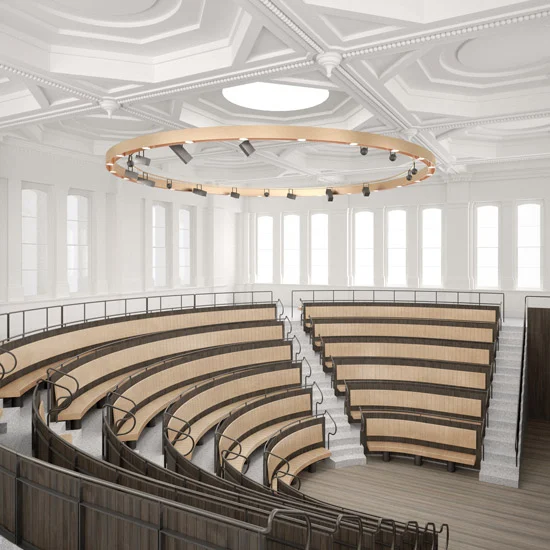
  • a double-height lecture theatre with over 260 seats - which I'm sure will provide much better accommodation for the programme of lectures and talks given by the RA throughout the year
  • new spaces for the RA Schools, including a permanent project space for the public display of work by students
Design for a Clore Learning Centre for educational activity with children
The new Lecture Theatre on the Burlington Gardens side
It has a capacity of between 250-300 for lectures and talks.
As well as creating much better movement between the two buildings the RA is also taking the opportunity to create much improved facilities for learning and exhibitions ! There will also be new and dedicated spaces for contemporary art projects and new work by Royal Academicians

This gallery is capable of being top lit.
Finally the front of house activities get a thorough overhaul and the new front of house facilities will inhabit a much bigger space.  Basically everything gets pushed back to create a much large front foyer in the Burlington House side and the ticketing and the loos and the cloakroom are all moved back and stop feeling like they were squeezed in. No longer will there be endless queues in tiny places for "the facilities"!

People visiting the RA in the next three years are going to notice that work is happening but the good news is that both the exhibitions programme and the learning programme are going to be running "at full tilt" during the works. That's because virtually all the work is about infrastructure rather than exhibition space.

At the end of it, there will also be another front door into the RA - this time from the Mayfair side.

The new entrance from the north and Burlington Gardens
You can walk up the steps and walk right the way through the building.
The gatekeeping to the ticketed exhibition areas will be different levels to the main spine route through.
I think it's a very exciting project and will result in a great deal more activity within the site all year round.

Monday, January 26, 2015

Tate's BP funding figures revealed - less than expected

Today the Tate was forced to reveal the extent of its sponsorship by BP. Some, like me, were left thinking that its reluctance to reveal the figures was due to fact it was so very much less than people had anticipated.  How cheaply a prestige venue has been bought!

Below I explore the case for sponsorship and why it happens, why there has been an issue about BP's sponsorship

Tate Britain

Sponsorship of the Arts


Sponsorship of the Arts occurs because:
  • individuals genuinely have an enthusiasm for the arts and are well endowed enough to pass on some of their wealth
  • some people like the arts but they like having their name on things even more
  • companies know that their brand is enhanced if it is associated with a prestigious name.
My personal position is that I am all for the sponsorship of the arts so long as the organisations being sponsored extract as much as possible from those who know that their association with an art gallery or museum will enhance their brand and business.

Indeed I regard it as essential that any Director of an art gallery or museum knows the value of its brand and does not give away the chance to be associated with it too easily or too cheaply!

Why is there an issue about BP's sponsorship of the Arts


I'll state my case up front. I really am not in the least bit bothered by BP's sponsorship of art galleries and museums. I'm far more concerned about:
  • fossil fuel companies behaving in a social responsible manner 
  • those trying to repair their reputation paying a fair price to society for the privilege of being associated with a prestigious art gallery or museum which only exists due to generous state support.
Of course I'd rather that energy sources came from renewable sources. However until somebody makes energy consumption from non-fossil fuel a cost effective and efficient proposition for most of the companies and families in the UK (and elsewhere) I don't see much alternative to the continued use of fossil fuels.

That in turn means oil companies will be looking for ways of sanitising their image - and offers a wonderful opportunity for sponsorship - so long as this is at the right price.
Tate is driven by our charitable mission to promote public understanding and enjoyment of British, modern and contemporary art. We could not achieve this without corporate support.  Corporate social responsibility page of the Tate website
In seeking to attract corporate donations and funding agreements, the Tate has to act in the context of its Ethics Policy which means that it needs to consider whether it should accept funds if they
  • Harm Tate’s relationship with other benefactors, partners, visitors or stakeholders;
  • Create unacceptable conflicts of interest;
  • Materially damage the reputation of Tate; or,
  • Detrimentally affect the ability of Tate to fulfil its mission in any other way than is mentioned above.  
I do wonder just how many people are genuinely concerned about BP's sponsorship of the Museum. I recognise the activists are but if the gallery visiting general public were offered better accessibility to art vs give up the sponsorship I wonder which they would choose.


The Freedom of Information Request

An application was made in 2012 by Glen Tarman, an environmental campaigner and an art collective called Liberate Tate using the Freedom of Information Act for the disclosure of the annual
amounts of BP’s sponsorship of Tate over the 23-year period preceding 2012.
Liberate Tate is a network dedicated to taking creative disobedience against Tate until it drops its oil company funding. The network was founded during a workshop in January 2010 on art and activism, commissioned by Tate.
Tate dragged its feet and came up with all sorts of reasons why it should not be made to disclose the figures. It ended up in court.
Tate also admitted to the court that it feared “protests might intensify” if the raw facts of the deal were revealed and that this would present a risk to health and safety, but the Tribunal were “wholly unpersuaded” by this argument. 
Arts Professional - Tate ordered to disclose details of BP sponsorship
On 22nd December the Information Tribunal ruled that the Tate must disclose the BP sponsorship figures from 1990 to 2006 inclusive in the next 35 days - and today was the deadline.  (This is a copy of the Information Tribunal's decision)

Why any public relations function thinks that releasing the figures on the very last day it has to makes an institution look good is quite beyond me! It speaks of 'dragging feet' and 'recalcitrant schoolboys'.

Ar last - the figures!


Anyway, what the figures revealed (and here I have to rely on newspaper reports as the Tate has not deigned to issue a press release!) was that corporate sponsorship funding from BP was
  • c.£150k pa prior to 2000 
  • around £330k pa between 2002 and 2007
  • I took a look at the published Annual Accounts and the latter figures represent approximately 1.8% of the current Annual Income in 2013/14 relating to Consolidated Funds of £178 million (Annual Accounts 2013-14)
I think most people, including me, were expecting rather more given the fuss made about the sponsorship.

There again maybe the fuss about the sponsorship has imbued it with far more importance and status than in fact it was due. It needs to be recognised that the Tate has a very wide ranging set of partnerships and collaborations with corporate sponsors and Patrons - and BP just happens to be one of them.

I also think it's possible that maybe Art Gallery Directors would do well to research the funding figures involved in other sponsorship deals involving other areas of the economy and other prestigious venues. As it happens I used to know know the level of figures involved in some of them and they are way in excess of what BP has been providing to the Tate - although I do understand the BP strategic approach to funding the Arts has been to spread its largesse around.

Comment in the news


Below are the articles which highlighted the issues relating to BP's sponsorship of the Tate published today and previously.

My vote is with The Art Newspaper!

The objective of the release of the information today should not be to say how easy it would be to give up. Quite the reverse - it makes the case for saying there should be an awful lot more funding required to get a corporate sponsor's name on exhibition banners outside a prestige gallery.  

I want Nicholas Serota, Director of the Tate to explain how come BP has provided so little funding for the Tate. Far from the Tate giving it up - I want to see the exposure of the funding provided to provide a stimulus to upping the ante and him going back for more!

Also I think it art museums and galleries need to think very carefully about making corporate sponsorship funding completely open and transparent in their accounts. I don't think this is appropriate for private individuals - but I do think corporate sponsorship of state funded galleries and museums by major corporations and banks should be completely open.

Today's articles

Note that other than the Art Press only one national newspaper picked up the story.

Previous articles


Postscript

Part of the demonstration outside the National Portrait Gallery
22 June 2010

I witnessed part of the demonstration which took place outside the National Portrait Gallery on the evening of the BP Portrait Award ceremony in June 2010. This came after right after the awful disaster in the Deep Water Horison Spill in the Gulf of Mexico in April 2010

I much prefer the National Portrait Gallery's approach which has seen BP's sponsorship of the Portrait Award, based at the gallery, contribute very significantly to the stimulation of overall visitor numbers over the period of the exhibition (over a period of some 3 months in the summer) and the resulting elevation of the status of the NPG on the world stage.

That seems to me to be a very intelligent use of sponsorship.

At the end of the day, in relation to the Tate, I keep being reminded of the old adage "no publicity is bad publicity" and wonder whether the protestors have rather shot themselves in the foot.  Far from making a case for BP's sponsorship to be eliminated, I think they may well have made a much better case for it to be increased.

Thursday, January 22, 2015

5 tips for artists trying to get a grant

This post is for grant virgins and all those who would like to get better at making grant applications.

A friend asked me to help with a grant application today. She had been made aware of it at very short notice but decided to give it a go. The deadline was 5pm today. As it happened there was far too much to do within the time available. This reminded me of all the very many things you need to do before making a grant application. It struck me that as the deadline passed it might be worth writing down what I know about grant applications.  Plus pass on some links to helpful advice and information online (included after my five tips)

By way of an introduction, I should probably disclose that in my career, for a number of years, I was responsible for assessing many hundreds of grant applications for many £millions of public funding.

I was in fact one of those people that applications have to get past before recommendations are made to the "official body" as to whether a grant application should be granted or not.

This was a long time ago but the basic rules of how to satisfy somebody who hands out public funds never go away.

Much of what I highlight below is targeted at making it to the shortlist.  After all at the end of the day, those who are awarded grants should be those with the best proposals in terms of content. The key is to avoid tripping yourself up and falling over before the final hurdle.

Today, when I was looking at the information provided to applicants for the Visual Arts Grant the first thing I did was look for the answers to the first three tips below.

Tuesday, December 23, 2014

Tate must release details of BP sponsorship

The ethics and sponsorship of art debate took a step forward on Monday. A campaign by a pressure group to force national art museums in the UK to give up sponsorship funding from BP took an interesting turn.

A Tribunal hearing an Appeal of a Freedom of Information Act case against the Tate brought by environmental campaigner Brendan Montague (supported by the arts and activism charity Platform) upheld part of his Appeal.

Tate Britain
The Tate Museum now has 35 days to disclose certain detailed information relating to BP Sponsorship Funding between 1990 and 2006 - but not from 2007 onwards.

You can read the Judgement online.

The lawyer for Mr Montague stated
“The long standing relationship between BP and the Tate is controversial. Only when the public are fully informed about how much money Tate actually receives from the company, can a properly informed debate take place about whether BP is an appropriate sponsor for the art gallery and its work.” 
The Museum had previously claimed exemption from disclosure citing the Freedom of Information Act exemption clauses
  • s41 (information provided in confidence) and 
  • s43(2) (prejudice to commercial interests) - which is subject to a public interest text
The Appeal has two parts as follows

  • by Mr Montague was against the continuing redaction of some of the information previously supplied. 
  • by the Tate was against supplying any of the redacted information

The Tribunal upheld some of the redactions and have allowed others to be unredacted "in the public interest".

The campaign group focuses on the social, economic and environmental impacts of the global oil industry.  I'm unclear whether it's associated with the Liberate Tate websites related to Tate Funding and its relationship with oil. These are
One of the issues about such campaign groups is whether their perspective represents a large enough constituency within the community at large to make oil really unpopular.  However, unlike tobacco, a lot of people use oil and oil based products on a daily basis.

Below is my summary of what seems to be the gist of the argument and responses by BP and the Tribunal - plus some comments on related matters.

Platform / Brendan Montague

  • oil money is tainted since the oil companies are responsible for damage to the ecosystems and climate change
  • when the figures are released it will be seen that the amount of sponsorship by BP is so small as to be easy to dispense with
  • then the debate about the value of the sponsorship in an ethical context can properly commence
  • An aside! The pressure group has developed one of the most inaccessible 'so-called' infographic I've ever seen! It purports to show how much the sponsorship money represents as a percentage of total funding. In reality the infographic is either far too small or far too big and in either case it's impossible to see the point they're trying to make. Which is rather odd given that in all other respects, this is a campaign group that has a surprisingly smart and sophisticated website.
I wondered who is funding the Campaign Group so took a look at their Funding Page.  Interestingly one of their sponsors is the Arts Council! Oddly enough, they don't say how much each of their sponsors actually provides by way of funding.......

    Tate

    • Tate considered that it ought to prevent BP having its sponsorship placed under scrutiny because:
      • the current sponsorship agreement contains a confidentiality clause
      • they don't want to prejudice their relationship with BP and hence jeopardise the relationship
    • “protests might intensify” which might then create a risk to public safety and wellbeing.

    Tribunal

    The Tribunal considered that
    • BP are perfectly capable of understanding the nature of the controversy generated by their activities in the public domain - and do not need to be protected by the Tate
    • the Tate's interpretation of some aspects of Freedom of Information Act have been :
      • “mistaken” - about the need for Tate to disclose information as a publicly funded FOI Act organisation; and 
      • “somewhat fanciful”- particularly with respect to health and safety issues associated with protests.
    • the nature of the relationship between Tate and BP was essentially a "win-win" situation since both stood to gain in the context of a purely commercial transaction
    We accept Mr Montague’s evidence that arts sponsorship can legitimately be understood as a means of maintaining BP’s ‘social licence’ to operate and of enhancing, maintaining or repairing BP’s brand. This was confirmed for us by Mr Aydon’s evidence. Mr Aydon’s explanations of how the sponsorship system operates show that it is understood on both sides as an essentially commercial relationship. In our view it was clear from the evidence that Tate needs financial support, that BP needs ways of enhancing, maintaining or repairing its brand, and that sponsorship brings these two needs together, via a commercial negotiation.
    • the exemption relating to disclosure of sums relating to 2007 onwards would be maintained - partly because "public curiosity" does not equate to "public good" and a lot is already known
    the extent to which disclosure would be in the public interest must be judged in the context of what is already publicly known, ie, that BP’s sponsorship is important to Tate, and that Tate is one of four cultural institutions which are together receiving £10 million from BP over a five year period. Weighing the limited contributions to the public interest that would be made by disclosure on one side and the potential importance to Tate of maintaining the exemption on the other side, we conclude that the Commissioner was correct to find that the balance was in favour of maintaining the exemption. 
    • more information needs to be disclosed - but not as much as Mr Montague would like. Tate have 35 days to provide details of sponsorship between 1990 and 2006

    What do you think?

    I don't see why we should let a little detail like the sums of money involved get in the way of starting a debate so here's some questions to ponder on:
    • Should BP be sponsoring the Arts in this country - and why (or why not)?
    • Do you think exhibitions/competitions etc would suffer if BP funding was no longer available?
    • Do you think another company would fill the gap if BP no longer funded art?
    • Do you think any substitute sponsor would be better or worse than BP?
    It's worth thinking about what the alternative might be. For example - supposing a Russian Oligarch whose money was generated by the oil industry were to invest in improving his profile in this country, might we back at where we came in - or worse?


    Wednesday, October 31, 2012

    New structure for Arts Council & an Interactive Map

    The result of the spending review at the Arts Council has been announced. The Government required the Arts Council England (ACE) to reduce its administrative costs by some 50% as part of the 2010 Spending Review.

    The report and explanation of what is happening
    available as a pdf file
    It was a foregone conclusion that this could not be a death by a thousand cuts exercises.  Radical changes had to be made to the way the Arts Council worked.

    Structural change

    Art Council England - New areas and the offices that survived
    The main points are:

    • changes come into effect from 1 July 2013
    • 21% reduction in numbers of staff
    • top jobs halved
    • property costs to be halved by 50%
    • offices to close and regions to be cut from 9 to 5 and merge.  
    • The new areas are London, the South East, the South West, the Midlands and the North
    The explanation of their Final operating model and organisation structure is available as a pdf file
    we will have to do things differently, through more streamlined investment processes and a more focused set of priorities - we will do less and do it differently

    National Portfolio - interactive map

    I took a look at the interactive map which seeks to explain where the funding is now going and what sort of level of funding goes on what type of activity

    Two things you need to do to get the map to work properly
    • Tick the filters on the left in order to sort and highlight organisations by artform, region or funding amount and then click the search tab.  (Thus you can identify all visual arts organisations in London (or any other region) receiving funding of any amount (or a specific funding level)
    • Click the pink map pins to find out more about the visual arts organisations who are receiving funding.
    I was wholly underwhelmed by the visual arts organisations in London getting in excess of £1million pa. You can also View these results as a list

    At the end of the day this is an organisation which is going to be judged by the quality of organisation which it supports on the ground.

    How is it for you in your area?