Showing posts with label Goya. Show all posts

Friday, February 15, 2008

The Art of Spain - and Goya

Oil on canvas, 266 х 345 cm.
Museo del Prado Madrid (wikimedia -
Museo del Prado)

I keep feeling like I need to understand much more about Spanish Art. I wasn't planning to blog about it but last night I learned a lot more by watching the third and last episode of Graham Dixon Wright's BBC series on The Art of Spain and a documentary called Goya: Crazy like a Genius.

The Art Of Spain

In the last three weeks BBC4 (which is the BBC's Arts/Culture channel) has broadcast three 60-minute programmes broadcast on The Art of Spain celebrating the astonishing influence of Spain on European art (hence why I wanted to know more!).

Andrew Graham Dixon, the chief art critic of the Sunday Telegraph, started with an overview of the stunning and unique Muslim contribution in the medieval south, in Seville, Cordoba and Granada; followed up with the The Dark Heart of Spain and the golden age of Spanish painting which included El Greco and Velaquez, and then travelled to The Mystical North last night to cover Goya, Picasso, Miro and Dali. (scroll to the bottom of the page on all the links!)
Spain has produced some of the most startling and original art ever created... the art we need to know about, because it holds the key to understanding all of Europe and its culture
Andrew Graham-Dixon
You can read some of the viewer's comments on the programme. I agree with quite a lot of them. The pictures were absolutely wonderful - however the BBC has a tendency to sugar coat its 'art pills' at times and I could have done with less of Mr Dixon obscuring the scene. When will presenters of art programmes learn that we want to see the art and its context and not them? That said, I'd still like to have the three programmes on DVD but it doesn't look like the BBC agrees.

Goya, Crazy like Genius

I've never known much about Goya before other than that his etchings are stunning although the subject matter can be rather difficult to stomach at time (for example - see The Disasters of War).

Anyway, I finished watching the repeat version of episode 3 last night very late and noticed that even later there was a documentary by Robert Hughes (who wrote "The Shock of the New" about the development of modern art since the Impressionists) on Goya called Goya, Crazy like a Genius.

Long story short, after a little debate with myself I stayed up! It was a stunning programme - one of those where even at that time in the early morning you just watch with eyes popping out of your head and an urge to press the rewind button when it gets to the end so you can watch it all through again.

The film was made by Oxford Film and Television (check the factual singles) and was originally broadcast on the opening night of BBC4. I couldn't find it in the BBC shop but have found it elsewhere with defined geographic distribution - UK (Amazon); US and Canada (Films Media Group) and Australia (enhance). It's also on Yahoo Movies (which I've not used so I don't know what it's like as a service). I think I'll be ordering a DVD copy asap.

Just in case you think I'm over-egging it a tad, here's the Sunday Telegraph review of the film quoted by Amazon - and I'm glad to see they agreed with me! (My only concern being that although it's widely quoted I can't find the original online!)
Written and presented by renowned art critic Robert Hughes, Crazy Like A Genius explores the world of Francisco Goya: charting his achievements as a court painter, satirist and war reporter, as well as a topographer of the inner self - of madness, fear and despair.

This program offers a detailed visual and intellectual analysis of Goya masterpieces, including Witches in the Air, The Third of May and The Dream of Reason, as well as examples of his early work and portraiture such as The Duchess of Alba, The Nude Maja and The Clothed Maja.

Hughes gives an insight into the enormous changes that took place in Goya s work in the course of his life: the shift from light to dark.

In Spain, he travels to Goya s native Aragon and in Madrid he is seen visiting galleries, palaces and churches where Goya s works are on display. In New York Hughes calls on the American painter, Leon Golub, who shares his fascination for Goya, and elicits a contemporary artist s perspective on the Spanish master s work.

Hughes professes himself incapable of summing up Goya s achievements neatly, but concludes that to meet Goya is still to meet ourselves.

One of those rare programs where you feel afterwards as if a layer of dead skin has been stripped from your eyeballs and your powers of perception have shot up accordingly
Sunday Telegraph
You get a little bit of a sense of what it was all about and why Goya changed art forever in this Guardian Books article which Hughes wrote round about the time his own book on Goya was published. I've listed a link to the book below (which contains a long review by the Washington Post). You can also read other reviews of the book on reviewofbooks.com. At the time it was rated as one of the best art biographies.

Anyway, I was so impressed I started to look for more information, came up with lots of sites and decided I better start a new information site which I've done - Goya - Resources for Artists. I've got a lot to go through and I think I might be getting a book too!

Not bad for one night's late night viewing?!!!

Links:

Monday, October 08, 2007

The Drawing Book - into the vivid heart of drawing

I've attended two lectures on drawing by Dr. Sarah Simblet in the last 10 weeks. She is an excellent lecturer as well as a practising artist - very knowledgeable and thoughtful with a very bright and energetic approach to providing an insight into the language of drawing.

Her style is reflected in her book The Drawing Book which is described as 'an innovative, practical approach to drawing the world around you'. It is published by Dorling Kindersley (2005) who always seem to produce marvellous looking books and this one is no exception.
For me personally, drawing is the immediate expression of seeing, thinking and feeling. It is a tool for investigating ideas and recording knowledge, and is a reflector of experience. Drawing is a mirror through which I understand my place in the world and through which I engage with and anchor myself if life. It makes me feel excited to be alive
A Drawing Book - Foreword (Sarah Simblet)
I think the The Drawing Book has four main components which I'll attempt to describe below as its 264 pages are jam packed with information and images. Quotations are from the book.
  1. The main structure of the book is a series of chapters covering: animals; plants and gardens; architecture; objects and instruments; the body; portraiture; costume; gatherings; earth and the elements; abstract lines and gods and monsters.
  2. Interspersed within these are illustrated summaries of drawing materials - drawing books and paper; pens and inks; graphite and erasers; silver or metal point (excellent); coloured materials (pigments, pastels, pencils, felt-tip pens); disposable pens; charcoal; collage and brushes (including Japanese and sword liners)
  3. Similarly interspersed are instruction and tips about some basic techniques and some not so basic - posture and grip (how to hold a pencil or pastel); drawing in pen and ink and capturing character; drawing your dog; use of negative space; single point perspective, creating an imaginary space, further aspects of perspective; light and illusions; further illusions; how to draw ellipses; tonality; drawing with wire; measurement and foreshortening; tips for quick poses in life class; hands and feet (how to gauge proportion); head and neck (how to frame and generalise, essential observations); drawing portraits; study and design; the structure of costume; textures and patterns (drawing fabrics); dressing character and posture carving (with examples from Goya); drawing from masterworks and in museums; the travel journal; catching the moment; drawing landscapes; drawing in the round; being 'just' (or 'rightness') in relation to an image; semi-abstract drawing; brush marks.
  4. All of the above are illustrated using:
    • 200 examples of Simblet's own drawings, pages from her sketchbooks and doodles. Although her PhD specialism is drawing in relation to human anatomy (see The Anatomy Book ), my personal view is that her best work relates to the natural landscape and elements - forces of water, shapes and texture of clouds.
    • images of drawing across the ages with examples of the many different approaches to drawing found in archeology and used by various Old and Modern Masters and well-known illustrators - such as Basquiat, Bauer, Bellini, Beuys, Blake, Bosch, Daumier, Durer, van Eyck, Gericault, Gaudi, Giacometti, Goya, 'Grandville', Hawksmoor, Holbein, Hokusai, Klee, Kollwitz, Liebeskind, Lautrec, Lorrain, Man Ray, Matisse, Michelangelo, Modrian, Moore, Mucha, Mughal painters - Bishndas and Nanha, Picasso, Piranesi, Rackham, Raphael, Redon, Rembrandt, Rodin, Schongauer, Seurat, Shoshone School, Stubbs, Turner, Twombly, Da Vinci, Van Dyke, Van Gogh
This book is authoritative but accessible. It's important to note that the language used is thoughtful but 'plain English'. There is nothing highbrow about this book even though much of it relates to a conceptual approach to drawing. Instruction is also well explained - and I found she included bits very often missed out in other art books. It also finishes with a glossary of terms relevant to drawing - something which is essential to but missing from many books about drawing. If you're familiar with Dorling Kindersley books you'll be familiar with the sort of level of detail and overall tone they employ - and this book fits well with that.
Drawing is a living language that over millennia has grown and changed, adapting its forms and occupation, and enfolding new media. The chapters of this book present 90 different artists ways of seeing and many more reasons for drawing the world. To these I have added my own drawings to explain elementary materials and techniques and offer introductory approaches....in the total wealth of these pages we still only glimpse a corner of the magnitude of this subject and the infinity of what can be achieved. This practical journey will take you through the door into the vivid heart of drawing
A Drawing Book - The Thinking Eye (Sarah Simblet)
The book includes almost the equivalent of an extremely well illustrated lecture about the language of drawing across the ages. The range of styles of drawing - the grammar and the vocabulary - is absolutely tremendous - you can feel your eyes widening as you page through this book just looking at the images. The reproduction quality of art history images and drawings used as illustrations in the book is also really excellent. One of the really fantastic things about this book is the extent to which the art editor has designed it so that a double page spread can open up to complete drawings from edge to edge - that's 11"x17" - with detailed macros as well as complete drawings. The extent to which one can see light feathery first drawing marks is amazing. You can see and review examples of double page spreads here.

The traditional Dorling Kindersley approach of using annotation next to an image is employed and this enables you to to identify easily what are the key features of the style and approach used in each drawing. As with the Pen and Ink Book yesterday credits are also thorough.

Those preferring traditional realistic drawing may not initially feel interested. However can I suggest you go and take a look at this book in a book shop and see the very many different ways in which artists draw. To say it's enlightening is a complete understatement. My view is that it will fire people up to want to try to do more if people are keen to develop and experiment - but I recognise that it might also intimidate others. I'm not really sure who the book is aimed at. I could imagine it being used with a very wide variety of groups in class in a sensible way which breaks it out into manageable chunks. However, taken in one sitting, this book can leave one feeling as if you've read your way through an overview of drawing across the ages while an art gallery provides you with a gargantuan visual feast. It's very much a book to come back to and study again in small doses!

Pencil rating: If you feel you are most comfortable with traditional rendering/realism then this is probably not the book for you. However it emphatically earns in my view a five pencil rating for those keen to develop their drawing skills beyond technically correct rendering and/or are interested in drawing in art history and/or those who just want to develop their drawing generally. This book is a 'must buy' - I guarantee you will be blown away by it.

Note about the Author:

Sarah Simblet has taught drawing and anatomy primarily at the Ruskin School of Drawing and Fine Art, University of Oxford and at the Royal College of Art in London. She has studied and worked in Oxford, Cheltenham, Heidelberg, and Madrid, and was awarded her PhD by the University of Bristol.

Her work is centred upon and directed by the act of drawing. She uses it to invent imagined scenarios and to create a visual understanding of her physical and mental world. A main source of inspiration is the study of Human Anatomy, including its social and scientific history.

Her drawings are in national and private collections, including the Royal Academy of Art in London and the Ashmolean in Oxford. Sarah is the author of the highly acclaimed Anatomy for the Artist and has had three solo shows of her large-scale work. She has given interviews on BBC Radio 4 and has acted as a consultant for Watchmaker and for Discovery Channel's Art-Science documentaries.

Her studio base is in Oxford, where she is also a member of Wolfson College. In 2001, she wrote and illustrated Anatomy for the Artist for Dorling Kindersley.

Links:

Wednesday, January 03, 2007

John Singer Sargent - the works

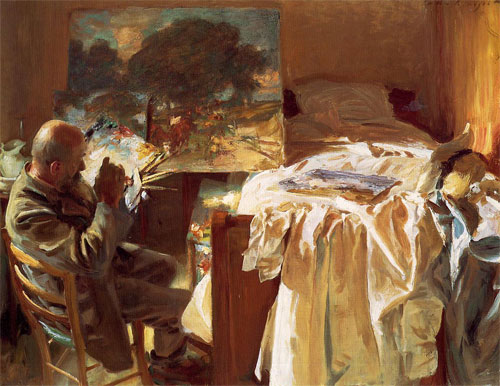
An Artist in his studio
John Singer Sargent

This post is basically going to download quite a bit of information about JSS for anybody who wants to know more about Sargent and/or participate in the project. I'll then blog a bit more information in each of the new few days - but after this post I'm going to get going on deciding what to do for my Sargent artwork

It covers:
  • Process: what I'm doing
  • Summary: a summary of what I've found out so far
  • Books: a note of books about JSS
  • John Singer Sargent Links: a list of useful website links for researching JSS (see the end).
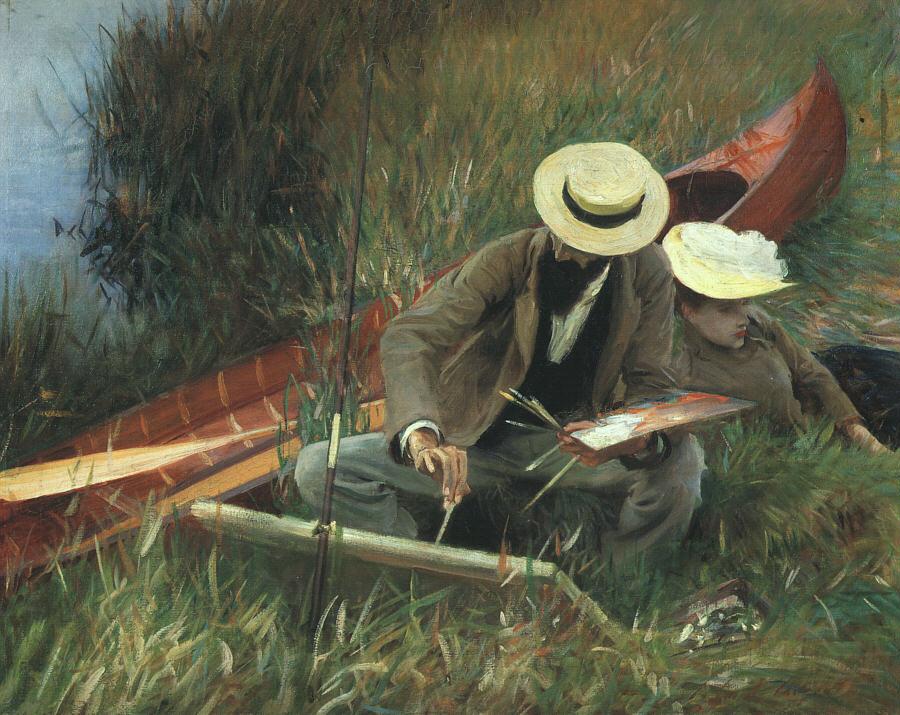
I've also included some of the lesser know works by JSS. He liked sketching and painting other artists - which is something I've like doing too.

Process
I want to find out more about why I feel drawn to the works of John Singer Sargent. I know he has a thing or two to teach me - but am not sure what as yet.
This is what I'm doing:
  • study works he produced
  • work out why he is so good / what makes him different
  • work out how he works (process being important to the emulation process)
  • study his compositions
  • study his colours and saturation levels
  • decide how much is media specific and how much is generic to all art
  • try to emulate. I've not yet decided whether this is about trying to reproduce one his works in my media or trying his techniques with a subject of my choice. More discussion on this one in future posts!
Summary
I'm going to start with a few brief details about his background - and will annotate with my notes in italics

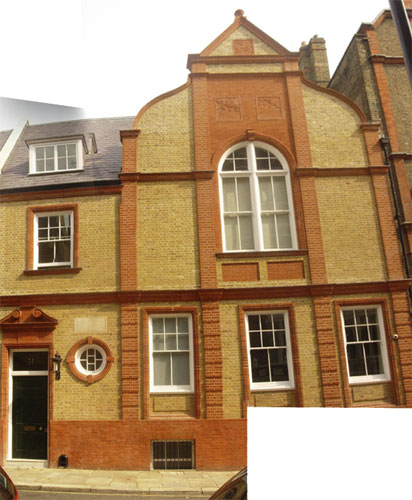
Home: He was born in Florence, Italy (in 1856) to American parents and did not visit the USA until he was 21. He lived for most of life in Western Europe. In London he had a large house and studio (previously used by Whistler) at 13 Tite Street in Chelsea where he lived until he died in 1925. You can read about the 'artists colony' that developed in Tite Street here. and a second studio at 12-14 Fulham Road (Thanks to Shirley of Paper and Threads for the photographs of his second home in Tite Street - cannibalised me into a merged crop)
Travel
: He travelled a lot as a child and led a nomadic existence from being a small child.
Observation: His mother taught him how to see and encouraged constant study of the landscape (good observation is a critical faculty which all artists working from life need to develop)
Education: He had a formal and traditional art schooling. He
  • copied teacher's watercolours (there's a prompt if ever there was one!)
  • drew from plaster casts (I may well have a go at this at the V&A)
  • studied old Masters in situ (I very much endorse this approach where possible. Images in a book on the internet never ever do justice to the real thing - hence why I visit art museums and galleries so much. It's a good habit to get into. I'll probably blog about this aspect - I saw my first Singer Sargents at the Americans in paris exhibition)
  • his tutor, Carolus Duran, his tutor preached to him about the value of studying Diego Velaquez (I've not yet visited the Velaquez exhibition at the National Gallery and will be doing that next week). Other artists favoured by Duran included Hals, El Greco, Goya and Degas
Photos and Chronology: If you go to this link on Natash Wallace's JSS Virtual Gallery site, you can see photographs of JSS at different ages. If you then click on the associated link for that year you can see what sort of art he was producing - for example:

Books

I've not yet done the full search for all likely looking book but have looked at a couple.

Those who enjoy sketching and/or watercolours will find The Watercolors of John Singer Sargent by Carl Little to be a delightful read. The reproductions of the watercolours are well done and a very good size. All in all an excellent book - available as both hardback and paperback.

Anybody interested in portraits and portrait drawing would do well to try and get hold of a copy of Portrait Drawings (Dover Art Library)

A book I don't have is American Drawings and Watercolors in the Metropolitan Museum of Art: John Singer Sargent. Very difficult to get hold of - has anybody read it and is it worth getting?

Natasha Wallace of the JSS Gallery provides an overview of various books about Sargent. These are the ones currently available at Amazon.

Books I still don't know I need to read comes later...... ;) Do let us know if you any recommendations for books about Sargent. Please leave a note in the comments or link to your blog post if you'd like to explain your recommendation.

John Singer Sargent Links:
These are split between websites which specialise in providing access to galleries of images and threads from other art forums where people comment on his work and/or try to reproduce it. Those wanting to participate in this project through producing a painting or sketch may find these useful.
Update on other project participants

Nicole Caulfield has posted her first Sargent post. She's focusing on the value design and composition aspects of JSS's work.

JSS Project Links:

Technorati tags:

Sunday, November 12, 2006

Simon Schama at the National Gallery of Art, Washington

Simon Schama starts the Fifty-fifth A. W. Mellon Lectures in the Fine Arts 2006 at the National Gallery of Art in Washington D.C. today on Really Old Masters: Age, Infirmity, and Reinvention

Lectures are:

  • held in the East Building Auditorium (eba) at 2:00 p.m.
  • free and open to the public.
  • Seating is available on a first-come, first-served basis.
  • Registration is not required.

November 12
To Start with: Finito?

November 19
The Elixir? Jacques-Louis David and Revolutionary Rejuvenation; Goya and Infirmity

December 3
Indistinct Vision: Turner and Monet

December 10
Picasso and Matisse: The Endgames of the Avant-Garde

December 17
Losing It: The Case of Willem de Kooning

I'm currently watching Simon Schama deliver "The Power of Art" on BBC2 on Friday nights. It covers a similar group of artists (Caravaggio, Benini, Rembrandt, David, Turner, Van Gogh, Picasso, Rothko) and focuses on turning points in the artists' life. Besides being a great story teller, Schama is the University Professor of Art History and History at Columbia University in New York. Since 1995, he has been art and culture critic for The New Yorker and essayist for the Guardian.

Links:
Technorati tags: , ,