Showing posts with label still life. Show all posts

Sunday, May 29, 2022

Who Painted This #67

The art history challenge this week is to work out what all the answers are from ONLY HALF A PAINTING - and where I might have seen it in 2018.

The image is slightly larger than usual - which you can see if you open it in a new tab

Who Painted This #67? - and the rest (see below)

Below you can find 

  • The details of how to participate in this art history challenge  
  • the rules of the challenge 
  • the answer to last week re. Who Painted this #66
  • the names of all the people who got most or all of the answer correct
  • who provided the best answer last week - which gives you an idea of what a good answer looks like
Your answers will be published next Sunday - before the next challenge.

How to participate in "Who painted this? #67

Sunday, April 03, 2022

The most expensive still life painting ever sold?

"The Basket of Strawberries"  (Le panier de fraise des bois) by Jean-Siméon Chardin (1699-1779) was sold at auction in Paris on 23rd March 2022 for €24,381,400. (That's $26.9 million or £20.5 million).

The predicted sale price was between €12-15 million - so the owner and auctioneers must have been very pleased by the final outcome!

Jean-Siméon CHARDIN Paris, 1699-1779
The Basket of Wild Strawberries
oil on canvas, h: 38 w: 46 cm
signed, by J. S. Chardin

This is a video by the auction house about the painting. If you have captions switched on in YouTube then you get the English version of the commentary in French by the French curators and auctioneers.


The painting was sold to a US Dealer and The Art Newspaper now reports that the Louvre suspends sale of Chardin's record-breaking strawberries. 
The French museum is now seeking funds to buy the still-life painting, which was sold last week by Artcurial to a US dealer for €24.3m 
This is an article about the painting Chardin, a Proto-Impressionist 18th-Century Painter

The most expensive still life painting ever sold?


The question it prompted for me was "Is this one of the most expensive still life paintings ever sold?"

It's certainly not the most valuable still life painting. I can think of several which might fulfil that criteria - but then they've been in art galleries and museums for quite a while and have not been sold of late. 

I started to look up "most expensive paintings sold at auction" and noted that none of them included a still life painting.

Wikipedia maintains a List of most expensive paintings - which is ordered by consumer price index inflation-adjusted value (in bold) in millions of United States dollars in 2020.[note 1]

This identifies Vase with Fifteen Sunflowers by Van Gogh as being the most expensive still life / floral painting ever auctioned - on March 30, 1987 for $39.7 million (£24.75 million) which equated uib 2020 to $90.4 million

....and that's about it.

So maybe the basket of strawberries is the second most expensive still life painting ever sold?

The Still Life Genre


For more about the Still Life genre see my 2007 post What is a still life? which is a VERY LONG post which attempts an overview of the genre. 

Although I eventually concluded I'd barely scraped the surface!

Jean-Siméon Chardin (1699-1779)


For those like me who love paintings by Chardin (back in 2009, I spent a long time in the Louvre photographing all their paintings by Chardin!) you may well be interested in the details of his story, training and approach to painting the Internet Archive digital version(s) of "Chardin" (1969), the Catalogue Raisonné, and commentary by Georges Wildenstein and Daniel Wildenstein. 

It comes in various formats and can be read online and/or downloaded.
In fact the still-life was by no means a monopoly of Chardin, and this makes it ail the more interesting to note how he imposed his per- sonality on it to such effect that he was often thought to be its inventor, or at least renovator. And it is here that the opinions of his contemporaries are enlightening.

Chardin made numerous variants or replicas of the pictures which he regarded as his most successful. Thus we fmd whole sériés of works with cauldrons, kitchen tables, baskets of plums, peaches or grapes, eut melons, hares and a game-bag, game hung from a nail in a kitchen and the like. Some household utensils which figure several times belong presumably to the same period: a teapot, a mortar, a bowl, a jug.

Saturday, July 03, 2021

Saturday Sketch Club at the Royal Academy of Arts

The Royal Academy of Arts has been running a FREE ONLINE Saturday Sketch Club for a while. I'm not sure how many people know about this (I didn't!) because there's not a lot of visits to their videos.

Below are the LINKS to the YouTube videos of various sessions. Most last an hour or thereabouts.

(NOTE: the links do NOT work on the RA website - you need to go to the links listed below)


Saturday Sketch Club: still life (10 May 2021) - still life drawing with Mark Hampson, Head of Fine Art Processes at the Royal Academy Schools.

Saturday Sketch Club: collage
(26th May 2021) - Grab any paper you have lying around (newspapers, magazines, leaflets or receipts), a pair of scissors and something sticky (an old glue stick or some tape will do).

Saturday Sketch Club: anatomy drawing (1 June 2021) - Artist Adele Wagstaff leads a session on the anatomy of the human form; from the deep landmarks of the skeletal system, to the musculature which is evident on the surface of the body. Observe the structure and movement of the body as you practice drawing the model in a series of short and long poses.

Saturday Sketch Club: botanical drawing (7 June 2021) a session on botanical drawing with Laxmi Hussain. Laxmi will introduce you to techniques involved in mark making, to discover drawing as an everyday activity. Laxmi explores minimalism in her work through continuous line and will demonstrate how to approach and use these techniques.

( I'm going to jump in here and say if you want to know more about drawing plants do take a look at the Scientific Botanical Illustration on my Botanical Art and Artists website - which also discusses What is Botanical Art?

Saturday Sketch Club: drawing as exploration
(14 June 2021) - Discover repetition and transformation in this workshop with Elinor Stanley, exploring the power of your drawing through multiple versions. Inspired by Picasso’s cut-outs, this session investigates how simple shapes can be crystallised into expressions and motifs for future

Saturday Sketch Club: experimenting with the figure
(21 June 2021) - oin artist Jake Garfield for this fun and informal life drawing session. Working directly from a clothed model, you will break drawing down to its essential ingredients. Expect to explore formal qualities including “line”, “mark-making” and “tone” through a series of short activities, before combining these different aspects over an extended pose. This practical drawing session is perfect for beginners and experienced artists alike.

Saturday Sketch Club: drawing into the abstract
(28 June 2021) - Emyr Williams for a workshop which will explore and challenge our perceptions of ‘realistic’ drawing and abstract art. Emyr will introduce us to new ways of seeing, building confidence in our drawing. 

This is the Link to ALL THE VIDEOS


Monday, December 07, 2020

Call for Entries: Jackson's Painting Prize 2021


This post looks at Jackson’s Painting Prize 2021
and
  • who can enter
  • what sort of artwork you can enter
  • why enter
  • how to enter (registration / timeline / digital images etc) 
The deadline for entries is 2nd March 2020 (5pm).
Jackson’s Painting Prize exists to recognise and appreciate original, 2-dimensional fine art works in any painting or drawing media.

So that's a painting prize in any drawing media? How about calling it an art prize?


Call for Entries for Jackson's Painting Prize

Who can enter

Any artist can enter this competition who is 
  • any age 
  • all abilities
  • any experience / educational qualifications 
  • who lives anywhere in the world
(but you or an immediate family member cannot be an employee of Jackson’s Art Supplies)
Jackson’s Painting Prize is open internationally to all artists of all abilities and at all ages.

What sort of artwork can you enter


Bear in mind this competition calls itself a PAINTING PRIZE but also allows drawing media!

You can submit up to 5 paintings
.

You can submit a collaborative artwork - but MUST make this clear on the entry form

Artworks for the competition MUST be:
  • submitted by the artist who created it (i.e. no entries by your gallery, your best friend or your mother who thinks your painting is wonderful!)
  • like the digital photo submission
  • your own intellectual property. i.e. do NOT submit any artwork that
    • either directly copies other people’s work (this does not include artistic interpretations)
    • or works that are made from a tutorial.
We take each submission and the information regarding it in good faith. We will not conduct any background checks unless we believe there are grounds for disqualification or we have been alerted by an additional party. Disclaimer
TIP: Don't be silly. I've alerted competitions before now when I know an artwork has copied the work of other people - and I know others have done so too.  Being selected is not the same as being hung - if your artwork does not meet the rules. I've known prizewinners lose prizes - and nobody needs public humiliation - so just stick to the rules and you'll be OK.

What's NOT eligible for entry to the competition


The following are not eligible for selection - even if you enter them
  • Media: Printmaking, pure photography, computer generated or manipulated artwork and 3D sculptural works 
  • Content: Drawings or paintings of an inappropriate or offensive subject matter will be removed from the competition.
  • Prizewinners: artwork that has previously won a major competition
  • Exhibited work: artwork that has been extensively exhibited in any established galleries.
  • Sold: artwork that has been sold i.e. you must have access to the original / it must be in your possession
Jackson’s Art Supplies may ask for 
  • artworks to be sent for further inspection and consideration before or outside of longlist / shortlist / prize winning selection. 
  • a physical viewing of the winning work to be available for viewing which MUST be like the digital photo submission.
  • a photograph of you standing next to your painting.
If you want to gauge whether or not your artwork is suitable for this painting competition......

Wednesday, April 08, 2020

Jackson's Painting Prize 2020 - time to vote

The shortlist for the £5,000 Jackson's Painting Prize was announced yesterday.

The Longlist


The Jackson's Painting Prize received 5,634 entries. 
  • Jacksons then created a longlist which comprised 445 artworks.
  • It was interesting to see how the number of works split between the different categories
Jacksons's Painting Prize 2020:
Number of artworks longlisted within each category of entries

Competition between entries is particularly intense within paintings of 'scapes and figures - both of which numbers over a 100 longlisted entries.

Timeline for Voting and Prizes


  • Category Winners are announced on 14th April
  • Voting for the People's Award (£1,000) - see below - closes in a week's time at 3pm on 15th April 
  • Emerging Artist and People's Choice Award announced on 17th April 
  • Jackson's Painting Prize Winner (£5,000) announced on 21st April

The Shortlist


36 of the 42 works shortlisted

The shortlist is chosen by the six Judges and this year I was one.
All 6 of our expert judges are leading figures in the contemporary art world. Each judge will bring a unique perspective and opinion to the judging, this will cultivate a varied selection of work that showcases the very best of the entrants 

We each contributed six artworks to the shortlist - working in isolation from the other Judges.  As you can see from the above tabulation, there are six categories and there was no requirement to choose one from each category.

I was particularly interested when the shortlist was published yesterday to see whether any of the works which made it to my personal longlist of 15 got through in the works shortlisted by others - and they did!

My feedback to Jacksons was as follows
I was a lot happier at 15 paintings. It was horrible turfing the last ones to get down to six. I'd suggest you ask Judges to select 20 and then take the top 50.

The People's Award


You can now vote - as a member of the public - for the entries you like best for the £1,000 People's Choice Award.

Unlike the Judges you have no constraint on how many you can "heart" (see instructions below) but you can only vote once for any one painting.
To vote, all you need to do is click the small heart symbol under your favourite paintings and your vote will be saved.
You can vote for as many art works as you like.
You can only vote once for each painting.
If you change your mind, your vote can be revoked.
By voting, you will go into the draw to win a £50 Jackson's Art Supplies Voucher.
If you want to see what it's like to be a Judge why not try choosing just six and see how that comes out!

TIPS:
  • Look through all the entries in each category before you start to vote
  • Look at the big image when reviewing entries - it makes a difference. So click on the thumbnail and you can see an image which is the bigger than the thumbnail. If you click it again you can see an even bigger image
  • Use the arrows at the top of the category to move to the next image in the category
  • Jot down which ones you like
  • Heart the six you like the best if you'd like to try and vote like one of the Judges
  • Heart as many as you like if you find it too difficult to choose! :)

Saturday, August 18, 2018

William Nicholson: Lilian Browse vs Patricia Reed and my opinion on that glass jug

The outcome of the Fake and Fortune programme past week almost caused a Twitter meltdown

So I decided to take a look at
  • the relative credentials of the two authors of the two very different catalogue raisonnes for William Nicholson - one that included the painting of the Glass Jug (in handwriting) and one which did not.
  • the rationale for the painting not being by Nicholson - given the weight of evidence about the board - by inspection of other Nicholson paintings involving jugs and/or pears

Two authors of a catalogue raisonne of the paintings of William Nicholson


The two authors are Lillian Browse - author of William Nicholson - published by R. Hart-Davis, 1956. The glass jug was included in her own handwriting at the back of her own personal copy of her book.

Cover of Lillian Browse's book about William Nicholson / Catalogue Raisonne

The second is Patrica Read - author of William Nicholson: A Catalogue Raisonne of the Oil Paintings | 672 pages: 284 x 264 x 45mm | 640 colour illustrations + 90 black & white illustrations


    Lillian Browse C.B.E. (1906- 2005)


    Lilian Browse was extremely well known. She was referred to as the Queen of Cork Street (the road in London where most of the prestigious art galleries can be found).
    • born in London and educated in South Africa, Lillian Browse returned to London in the 1920s with the idea of becoming a ballet dancer - but art intervened
    • she was an active London art dealer for over 50 years - from two galleries 
    • an art historian
    • her entry to the art world involved working as the equivalent of an intern, without pay, for Harold Leger of the well-known Leger Galleries in Bond Street. She was rapidly promoted from intern to secretary to manager.
    • She was involved in organising exhibitions by William Scott, Stanley Spencer, Charles Ginner, Jack Yeats, Edward Ardizzone and 'many more up and coming artists' of that time. 
    • she organised a number of exhibitions at the National Gallery during the second world war - while the permanent collection was evacuated to Wales
    • she helped to revive interest in such neglected figures as Rodin, Degas, William Nicholson, Augustus John and Walter Sickert, of whom she wrote a biography in 1960.
    She put on Edward Ardizzone's inaugural show and became friends with many other figurative artists of the period, including Jack Yeats, William Nicholson and Stanley Spencer. Telegraph Obituary
    • the "Christmas present" exhibition owes its origins to Lillian Browse and her perception that comparatively modestly-priced pieces of work would sell well prior to Christmas
    • after the war, n 1945 she began her partnership with Roland and Delbanco at 19 Cork Street, Mayfair - and got William Nicholson to join the gallery
    William Nicholson was one of the first contemporary painters to join the gallery and Lillian published a catalogue raisonné of his work in 1955. She discovered that one of his habits was collecting truant hairpins which he picked up from the pavement and which he would then use when he felt that a picture needed "improvement", leaving visible scratches. As a result she never let him see his pictures alone. Telegraph Obituary
    But, of all the painters she came to know, she reminisced in 1985, ‘the man I really loved was William Nicholson.’ The memory of his ‘delightful courtesy and charm’ during their first meeting at his Apple Tree Studio in the 1930s left a lasting impression, and - despite the considerable difference in their age (34 years) - they became ‘devoted friends.’ She particularly admired this painting and the ‘controlled freedom’ of Nicholson’s paint handling, which she felt showed the touch ‘not of a virtuoso, but of a master. 
    • she opened Browse and Darby at the same premises in Cork Street in 1977.
    • in 1960, she organised the Sickert centenary exhibition at the Tate in 1960, 
    • in 1983, she gave the greater part of her own collection of late 19th and early 20th-century paintings, drawings and sculpture to the Courtauld Institute.
    • in 1998, she was appointed CBE for services to the visual arts
    • in 1999,  her autobiography was published titled "Duchess of Cork Street" - a nickname given to her by her neighbour Rex Nan Kivell, the founder of the Redfern Galley.
    • she also wore legendary hats!

    She died, agee 99 in 2005.

    In short, this is a person who knew William Nicholson very well, probably visited his studio more than once and, after his death, wrote a book about him.
    BUT

    • The glass jug was not mentioned in the book - but was later added in her own handwriting to the end of her copy of her book.
    • The weakness in the argument for her being the greater authority is that she never got the opportunity to check any of the paintings she did not know at the time of writing the book with the artist himself.

    Patricia Reed


    I can find no information about this woman. Absolutely and precisely nothing. Nada.

    It's very odd.

    Even the OFFICIAL publisher statement about her as the author of the most recent Catalogue Raisonne states merely
    Patricia Reed is an independent art historian and the principal scholar on the oil paintings of William Nicholson.
    I'd just note that I have NEVER ever found such a lack of information about an author of note online - particularly when that individual is supposed to be the acknowledged expert on an artist.

    The reviews of her book indicate that people have a high regard for her academic approach and the thorough nature of her catalogue.

    However the book has attracted this review on Amazon
    We are used to catalogue raisonnes having a selection of full page reproductions but with most images, by the limitations of space, reduced to a small size, often many to a page. I have several particularly good ones, Picasso's graphic works and Fairfield Porter. It is a trade off we understand for the complete works in one volume. However, the sheer waste of white space in this book is diabolical. If this book has given itself the luxury of spreading images out one or two to a page, why are they reproduced so small when the accompanying text often leaves half the page completely empty. You just know some graphic designer has entirely priveleged his/her layout over the actual content, or the editors have been so preoccupied about including the minutest details of provenance that their personal familiarity with the actual paintings, or good reproductions of them, has blinded them to the inadequacy of the reproductions here.

    Many paintings have been reproduced better in other books on Nicholson and not just for scale. Many look too desaturated. It is a feature of his work that very subtle tonal and colour relationships radiate slowly from the painting. A good reproduction should seek to capture something of this sensation before the work and not take an 'honest' snap that bears no relation to our perception. Some are reproduced well but the quality is very inconsistent.

    Review of the rationale for the painting not being by Nicholson


    I should explain this section by saying my initial reaction when viewing the painting in advance of the programme was that it would be found that the painting was not by Nicholson.

    However my "evidence" was entirely to do with "eye" and nothing whatsoever to do with science. My rationale was entirely to do with the draughtsmanship relating to the curves of the jug.

    I think the scientific evidence produced by the programme established without doubt that
    • the board had been in Nicholson's studio at some point 
    • the paint on the back was almost certainly from it having been placed in his paintbox at some point
    • the painting underneath may well have been a wiped off painting of Freesias by Nicholson

    However that only means he may have once painted freesias, put the board in his box and then subsequently scraped/wiped it and had the board in his studio for a while.

    It did not establish that the painting of the jug was by Nicholson.

    I decided to look at other paintings of jugs by Nicholson - and work on the basis that although a painter may change their style over time, there are some things that rarely change.

    So below we have the painting of the glass jug and some other paintings by Nicholson.

    See what you think!

    First the painting in question. I agree with Patricia Read that the drawing of the jug handle and the ellipse of the mouth of the vase are both wrong.  Evidence of his other paintings strongly suggests this is not something he would do - even when he is painting in a less precise style.


    and to give a sense of size....


    Next other pears he painted

    Pears (1938) by William Nicholson
    oil on panel
    Leeds Art Gallery, Leeds Museums and Galleries

    then another sort of fruit - an apple

    Still Life, apple and knives

    Then other jugs with handles...

    First the glass jug in Canada
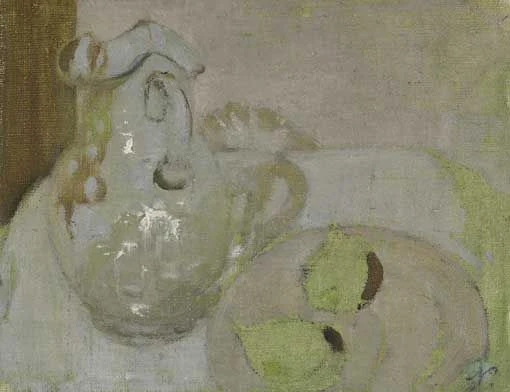
    Glass and Fruit (1938) by Sir William Nicholson (1938)
    (also known as Glass Jug and Fruit)
    National Gallery of Canada - Ottawa
    Next a glass jug on its own

    The trailed jug (Painted in 1917) by Sir William Nicholson (1872-1949)
    with inscription 'Painted August 7th 1917, at 11 Regent Terrace Edinburth,
    by William Nicholson when on a visit to Arthur Kay.
    The glass is a trailed jug in the collection of A.K., Arthur Kay, 8/7/17' (on the reverse)
    oil on canvas laid on board
    13¼ x 10¼ in. (33.7 x 26 cm.)
    Another glass jug

    Red Roses (1903) by Sir William Nicholson
    Painting - oil on panel | Private collection
    signed with initial and dated 1903
    Sold at Sotheby's October 24, 2005
    Though dated 1903, the subject matter, handling and palate of Red Roses clearly places it towards the end of Nicholson's painting career. The description in Browse of Red Roses in Glass Jug undoubtedly refers to the present work but the dating remains incongruous. No clear explanation exists for the signature and date given by the artist.

    Another (opaque) jug viewed from behind - at a similar angle

    Vase and Bowl on the Table by Sir William Nicholson
    Oil on board, Signed. 60X53 cm
    Lord Israel sieff
    and another - he really seemed to like looking at a jug from the most difficult angle. The year is comparable if the train timetable is to be believed.
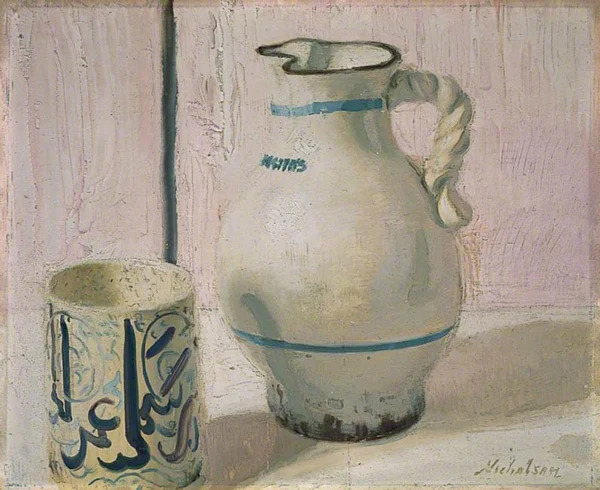
    Pink still life with jug (1936) by William Nicholson
    oil on panel, Height: 35.5 cm (13.98 in.), Width: 43 cm (16.93 in.)
    Birmingham Museum and Art Gallery 
    This one looks as if might be the same glass jug - just treated rather differently - although painted round about the same time

    Sunflowers (1933) signed 'Nicholson.' (lower right),
    signed with initials and inscribed 'Sunflowers/WN' (on the reverse)
    oil on panel 16 x 12½ in. (40.8 x 31.7 cm.)
    Painted circa 1933. | Sold by Christie's 16 November 2011
    This is a different sort of jug

    Sunflower in ivory vase, a Nocturne
    Another sort of jug

    Pink Lustre with Carnations (also known as The Lustre Jug) (1936)
     by Sir William Nicholson
    Painting - oil on panel
    Private collection
    You may have noticed by now that he paints ellipses which are pretty near perfect - and his handles are very fine.

    Hence the concern expressed by Patrica Read over the painting on Fake or Fortune.......

    The Lowestoft Bowl (1911) by William Nicholson
    Tate
    I rest my case....

    UPDATE: I was sent this photo of a bubble glass jug - the lipe of which seems to make more sense of the Canadian painting. I've reviewed "glass bubble jug" as a query on Google Images - and there are an awful lot of them - and some have the curious wavy top lip.

    a glass bubble jug

    Reference


    My first blog post last weekend - Art on Television #1: Fake or Fortune returns

    William Nicholson

    Lillian Browse

    Sunday, August 12, 2018

    Art on Television #1: Fake or Fortune returns

    BBC has two new series starting this week

    Fake or Fortune

    The team for Series 7 is the same as the last series - Fiona Bruce and Philip Mould
    What's changed is that it now occupies a prime time slot of 9pm on BBC1 (albeit in  dead month TV wise).

    There are 5 episodes in this series programmes but we only know the artists involved in the first two episodes so far. What we know so far is.....

    Episode 1 - British artist William Nicholson

    The subject of Episode 1 of Series 7 - and those pears look a bit suspect to me...
    Can the team prove that a beautiful still life of a glass jug and pears is the work of celebrated British artist William Nicholson? 
    Portrait of William Nicholson
    Normally the first episode is a cracker - but I confess I've never heard of the artist, although had worked out it was likely that William Nicholson had a connection to Ben Nicholson (he's the father) !  I'm wondering if this one is a very good example of techniques used in a case.

    The problem with the painting is it cost £165,000 to buy - and Patricia Read, the expert on Nicholson, left it out of the Catalogue raisonne - which effectively reduces the painting to the value of a decorative item.

    If you want to do your homework and get acquainted with him before tonight.....

    REFERENCE:
    Nicholson's wife, the painter Mabel Pryde, is standing by the door. Sitting at the table from left to right are the Nicholson children: Nancy, who married the writer Robert Graves; Tony, who died during the war in 1918; and Ben, who would become Britain's foremost abstract artist. Standing in the foreground is Christopher or 'Kit'

    'A Bloomsbury Family' depicts the artist William Nicholson and his family.

    Episode 2 - Toulouse Lautrec

    Friday, April 06, 2018

    How to get | print | use Pascal Anson's lined papers for a still life collage

    If you want to download those tonal lined papers used by Pascal Anson for the Big "Cut Out a Still Life" challenge this is the blog post to go to - DRAWING IS DIFFICULT! Perspective, Still Life, Lids and Bananas - they're at the bottom and available to download.

    Lined sheets of paper by Pascal Anson - for constructing still life collages
    You can then print on plain or coloured paper

    RECOMMENDED: Plus he has a video showing you how to use them - definitely worth watching


    Subscribe and receive every post from Making A Mark via email. 
    Your subscription is only activated after you verify the link in the email you will receive

    Wednesday, April 04, 2018

    Review: Still Life - Big Painting Challenge 2018

    This post is about the First Episode of The Big Painting Challenge - Still Life which was nominally focused on Still Life.

    It follows on from my first post about The Big Painting Challenge (2018) - The Issues which highlighted my niggles about this BBC programme - specifically whether this was a talent show or Edutainment - and why it should be better than it is.

    This episode is available to watch on BBC iPlayer for the next 27 days.

    To recap, what the episode was actually about was:
    • introducing us to the new contestants for the third series of this very popular programme
    • getting them started with nominally their "signature bake"
    • a couple of exercises (the "technical challenge") with the mentors focused on how to portray volume and tone
    • finally, the Big 4 hour Challenge - the outcome of which was assessed by the two Judges
    The Still Life Episode
    all 10 participants - and their two mentors - up for the big challenge

    The Contestants / Participants


    See my first post:
    • they're contestants if this is a knock-out Talent Show
    • they're participants if this is an Edutainment show
    We got the introductions to throughout the course of the first episode. I'm going to have to make a note of who they are here because the BBC has "forgotten/neglected" to include the profiles of the contestants on the series website.

    How you can have a programme about real people artists and forget to say who they are? 
    • It's as bad as Sky Arts neglecting to put up the names of the artists as they are introduced on their programme - and excluding them from the list of who appeared on the programme. 
    • If we're going to have members of the public appearing can we please at least let them appear in the credits. After all THERE IS NO PROGRAMME WITHOUT THEM!
    The programme makes clear that they "have very different experience levels, they were selected for their potential to learn"

    Links in their names below are to either their website or Facebook account or Page (where public).

    I can even tell you the name of their upcoming Group Show! (see below)

    If past participants are anything to go by, I'm sure they'll be posting their paintings and comments as the weeks go by! :) (Note: Anybody who'd like me to remove the link please say and I'll do so immediately - just leave a comment)
    1. 90-year-old Raymond Halliday, a former auditor from Gateshead - who loves watercolour and didn't take up painting until he was 73. 
    2. Callum Stephen (#interestingbutweird)- who is a 23-year-old Welsh bricklayer who loves photorealism and painting packets of sweeties. His story of how he came to be involved is interesting. Apparently the programme staff saw his Instagram and invited him for an audition and before he knew it he was one of the final 10! (Article in local paper). He now lives in the South of France. Read all about it on his Facebook - given he spent time filming for several weeks I take it he doesn't go soon despite the problems (not looking) in this first episode.
    3. Bokani Tshidzu, (art website) a 30 year old Zimbabwe-born tech entrepreneur who lost both parents to Aids and was adopted by her aunt and brought to the UK. 
    4. Oliver Freeston -  BA (Hons) in Professional Dance and Performance from the Central Ballet School. Has travelled the world performing in classical and contemporary ballet companies and latterly in musicals. He and his partner live in Texas with two rescue dogs. He began painting while on a tourist visa in the USA. He now does Canine Commissions.  See the article in his home town newspaper A Hertford ballet dancer will be competing in the Big Painting Challenge on TV this weekend
    5. Chris Davies - the chap who has a vision impairment (ocular albinism) and uses indoor binoculars to see the still life. On his website he indicates that he loves doing very large paintings.
    6. Elizabeth (Tilly) Farnham - the one who's afraid of Daphne and who got the Grrr! She's a self-taught artist living in the Cotswolds.
    7. Jane Voss the Life Skills Coach who now owns and is the Creative Director of an Ice Cream parlour called Silly Moos making artisan ice cream in Lytham St Annes. She seems to have a real enjoyment of colour.
    8. Susan Farrell - The lady with contemporary and colourful glasses and earrings (love them!) - who started painting as an occupation after having treatment for breast cancer. I've got a hunch she's going to be interesting.
    9. Surjit Kali Rai - a Pharmacy Technician from Solihull in the West Midlands - the one who sat to sketch and stood to paint.
    10. Anil Patel (Facebook) - a graphic designer who lives in Leicester and is a big supporter of the local footie team, and who won my "fastest painter of the episode" award. I think it's possible he's both got a lot more experience than the others and has maybe practiced painting to a time constraint. 
    Their Chapter Ten "after the show" show of paintings - done without the pressure of cameras -will be at 112 St. Martin's LaneLondon, WC2N 4BD next month (May 2018)

    The Still Life Challenge


    Before we start, for those who want to learn about "Still Life" try my 2007 blog post on What is a still life? in which I examined what the still life is all about and the different types of still life in art history.

    The thing is this programme wasn't actually about Still life. It was actually about learning how to see and record shapes, volumes and tonal values accurately.  In fact I do believe we actually heard some of the Elements and Principles of Design discussed very briefly during the course of the programme - without actually mentioning that this is what they are.
    See:
    I predict we'll be hearing more about these in the coming weeks!

    The contestants were asked to bring an item that was meaningful to them. The mentors then created a still life setup out of five completely unrelated items.

    To say that the still lifes looked like the artistic equivalent of a really bad car crash is an understatement. They were so bad that Mariella Frostrup even started making jokes about them.

    Speaking personally I have NEVER ever seen a worse set-up for a still life. I cannot believe that the BBC believes that this has educational content!  It was almost as if the mentors were willing their students to fail!

    All the meaning that would normally add value to a still life painting of objects chosen by an artist was smashed to smithereens by the diabolical arrangement. Plus where were the shadow boxes or screens behind to make it easier to isolate the items

    ...and what was that blue material all about???  TOTAL CAR CRASH!

    Monday, February 13, 2017

    Review: The Big Painting Challenge - Episode 1

    I'm going to be doing a review of each episode of BBC's second series of The Big Painting Challenge.  I did this last time with the first series and tried to focus on learning points from what I observed. The aim of my blog posts will be to try and draw out the themes of the episode and identify the things I noticed.
    The aim of the series is to help the artists - and by implication the watching audience at home -
    • Learn
    • Improve and
    • Grow as an artist.
    I'll also be introducing comments from social media - although frankly I think maybe this programme appeals to an audience that doesn't tweet!  They were certainly very quiet last night.

    First episode, first explanation of what happens next!

    First Impressions


    My first impressions were favourable. They've certainly addressed a number of niggles associated with the last series
    • the artists are allowed to use whatever media they choose - and can bring their own media and kit from home. That gets round some of the nonsense of the last series which was to do with people having to get to grips with an entirely new medium in pretty short order
    • there's more instruction and guidance. This series is going to very obviously have a much higher educational component delivered by the two mentors. There seems to be some sort of conscious effort to replicate the atelier system with a view to 
      • encouraging contestants
      • coaching the artists in fundamental skills - which also provides a more direct benefit to any amateur artists watching
      • pushing them out of their comfort zones in order to realise their inner artist and true potential. (I think it actually takes quite a lot longer than this - but the idea is on the right lines!)
    • the programme is being much more explicit about the criteria that would be used to judge each challenge - this can only be a good thing as that also provides a basis for the audience to develop their ability to make judgements according to those criteria. However judging by last night they could have done with a big card with the criteria stated on it somewhere prominent within each room where the artists were painting!
    • They've changed the format for the challenges. Using the classic three different challenges format as used for the other challenge programmes meant that the last challenge always got squeezed for time. This time the format seems to be:
      • signature challenge
      • mentor tips and techniques session 
      • the painting equivalent of the "showstopper" which now seems to have much more time
    Plus
    • The artists seem a good mix.  This is their profiles page on the BBC website. There are variable levels of experience and formal art education and tend towards the serious amateur who'd like to do better and the 'just out of art school'. 
      • There appears to be no scope for the series to be won by somebody who had been a professional artist who had become a stay at home Dad as happened rather predictably last time. 
      • I'm not quite sure why television needs to have such an overwhelming obsession with "interesting back stories". It always leaves me thinking that people get chosen for their back story rather than their enthusiasm for art and skill and competence. 
      • One of the contestants, Ruaridh Lever-Hogg is deaf - he has a "voice" who reads his signing and who we never see (which I rather like). He made the very interesting point that losing one of your faculties means the others become more enhanced.  
      • Others have a different perspective about the mix of artists - wanting to see the best of those who applied.
    • I like the introduction of "The Public Gallery" which enables one artist to get a 'pass' to the next round. 
    • They've borrowed the warehouse overlooking the Thames at Wapping - as used by The Great British Sewing Bee.  That should help keep costs under control in contrast to the last programme where every episode was located at a different site around the country

      The First Still Life Challenge


      Quite why this programme insists on having such an odd assortment of totally unrelated objects as a still life is beyond me. It would have been good to see a more considered approach to the objects which could have still offered a challenge in relation to size, shape, colour, texture etc.

      Thursday, February 18, 2016

      Short Courses at Ruskin School of Art

      If you've ever fancied improving your drawing knowledge and skills at a leading art school in the UK, I recommend you take a look at the 2016 Short Courses offered out of term time by the Ruskin School of Art at Oxford University.

      The courses are not cheap and there's a limit of 16 places on each course however I expect some of them - particularly those taught by Sarah Simblet - will be booked up fast.


      Three drawing topics with Sarah Simblet


      Courses offered include three with Sarah Simblet, a renowned artist and author. I've attended her lectures and done courses with her in the past and she's excellent! See, for example. my blog posts
      My sketch from A 'Day to Draw' at the National Gallery
      done while listening to Sarah Simblet talk about 
      the anatomy and skeletal features and muscle groups
      She's very good and her books are also highly rated and best sellers! 

      Sarah is doing one course related to each of her books:

      Other tutors

      Two other tutors also offer courses:
      More details for each in the links in the titles.

      Practical matters


      • If you want to book, then you need to use Oxford University’s Online Store.
      • If you need a room to attend then you can try University Rooms to access one in a college at the University

      Monday, February 15, 2016

      How to create a still life painting

      Last night I discovered that I'd missed an excellent BBC programme called Apples, Pears and Paint: How To Make a Still Life Painting which was broadcast last month. It provides a history of what has historically been the least popular genre of painting - and the depiction of fruit, flowers and domestic objects - from the still life painting in Egypt and Pompeii to Cezanne and Picasso via Caravaggio.
      It promoted me to revisit my lengthy post back in 2007 in which I collated the different definitions of What is a Still Life? I hugely enjoyed researching it at the time - across cultures, time periods and different art movements - and I've just enjoyed finding out how much better the images are that are available now compared to then! Consequently I've updated as many as I could. Plus I updated some links - but do shout if you find any duds!
      If you missed it too, I hope you enjoy the 90 minute programme originally broadcast on BBC4 - it has lots of expert comment and some fabulous still life artworks. It's a real put your feet up and don't answer the phone programme - and you've got 23 days left to view it!  (If you watched it first time round, I've got a feeling it's a programme that's worth revisiting!)

      I particularly loved seeing the size of the first ever official still life - a basket of fruit by Caravaggio - in the Pinacoteca Ambrosiana in Milan

      Canestra di frutta / Basket of Fruit (1596) by Michelangelo Merisi da Caravaggio (1571–1610)
      Oil on canvas, 45.92 cm x 64.46 cm Pinacoteca Ambrosiana, Milan, Italy

      Apples, Pears and Paint: How to Make a Still Life Painting
      BBC4 / BBCiPlayer
      Don't miss the surprise at the beginning!
      These are the links related to the programme