Saturday, November 20, 2010

Axis Art Map - Cardiff

The Axis Art Map of Cardiff showing the actual map page. 
Other pages provide more information about art in Cardiff
A new, interactive art map of Cardiff has been launched by Axis, giving residents and visitors a unique insight into the city’s contemporary art scene and the work of artists who live and work there.

Axis Art Map: Cardiff incorporates a Google map, information about the major contemporary art venues, an overview of the city’s main artists’ groups and guidance about public transport.

Introduced by writer and curator Emma Geliot who gives a general overview of Cardiff’s geography, history, art venues and visitor amenities, Axis Art Map: Cardiff also features film interviews with nine Cardiff-based artists.

The map is not only about the place, but also about the influence of artists and their practice on the city’s contemporary art scene.  Sheila McGregor, Axis Chief Executive, says:
We like the idea of the one-stop-online-shop that not only tells you where to go, but also allows you to ‘meet’ significant artists. One of the internet’s greatest benefits is that you can promote the local and regional to a national and, indeed, international audience. That’s what we hope this Axis Art Map will do for Cardiff.
View the Axis Art Map: Cardiff mini-site at: Axisweb.org/artmaps/Cardiff

Axis Art Map: Cardiff is a pilot project, funded by the Arts Council of Wales, designed by Kiosk and built by Woom.

Axis hopes to develop Axis Art Maps in other UK cities and regions - let's hope that happens. 


Thursday, November 18, 2010

REVIEW: The ING Discerning Eye Exhibition 2010

The winner of the £5,000 ING Discerning Eye Purchase Prize 2010 is Charlotte Harris for her painting of Strawberries and Cream.
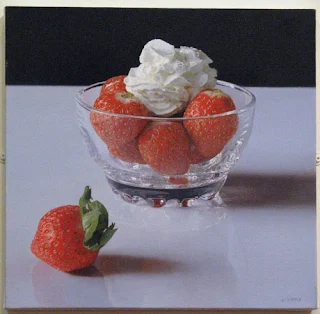
ING Purchase Prize (£5,000): 
Strawberries and Cream by Charlotte Harris

oil on canvas, 38 x 39.5cm
Exhibition at the Mall Galleries in London.  What makes the iNG Discerning Eye different is that:
  • this is a show of small works - you can see from some of the larger photos what that means
  • the works are independently selected by six prominent figures from different areas of the art world: two artists, two collectors and two critics.
  • Work is selected from open submission and also from artists invited by the individual selectors. 
The best thing about the exhibition is that each selector's choice of works is hung separately.  This means you can see a coherent picture of the taste of an individual curator as well as the range of works submitted - or not as the case may be.

One of the things I hate about seeing exhibitions in November is the weather.  Last week when the ING Discerning Eye Exhibition opened at the Mall galleries it was absolutely appalling squally type which looked likely to become worse - so I stayed at home!  All my resolutions about getting there sooner rather than later got hijacked and so I ended up visiting a week late.

The exhibition closes this Sunday but is worth getting to see if you are in London.

Features of the exhibition

I very much enjoy the fact that the selectors are not attempting to reach any sort of consensus as to which works should be included. 

I did however spot one artist this year who looks as if he was popular acoss the board - and that's Peter Lennertz who had work chosen by three different selectors.  In 2007 he was voted toymaker of the year by the British Toymaker's Guild.  It's good to see that automata can be recognised as art as well as toys!

Going Green by Peter Lennertz


The artists' selection

a small section of the monochrome wall
Last year Robbie Wraith won the Discerning Eye Founder's Purchase Prize.  This year he was one of the artist selectors.  I very much enjoyed his choice of 91 paintings, drawing and prints and I would have been happy to just tour up and down his wall.
 
I always do a quick scoot round to see what atttacts my eye straight away and then come back again to look more closely.

I absolutely loved his wall of monochrome drawings and prints at the top of the stairs (see above photo for just a small selection).  It was a strong and coherent statement by somebody who knows what sort of art he likes. 

Collections by Robbie Wraith (left) and Nina Campbell (right)
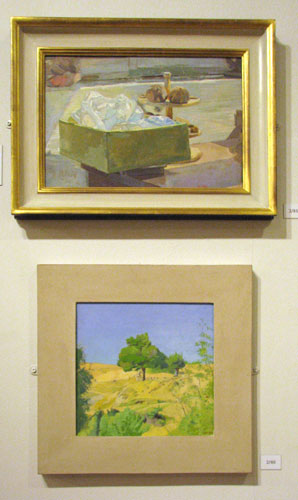
I was fascinated to find that much of what attracted me were paintings by artists I've begun to know well - such as Diana Armfield, Felicity House and, somewhat surprisingly, this year's BP Portrait Prize winner Daphne Todd's small paintings - of a still life and a landscape - particularly the latter (see below).  I also found that most of the paintings which I wanted were on his wall - as were a number of the prizes!

works by Daphne Todd
Ishbel Myerscough, who selected 81 pieces, said she selected on the basis of clarity of vision rather than clarity of execution.   I found the flow of work didn't always work for me - maybe because overall the wall represented so many different eyes and so many different visions?

However within that there were some work which stood out. Notably Paul Newland's watercolours, Ohla Pryymak's two interiors and Henrietta Labouchere's figures (see right).

The collectors selection

I liked most of Nina Campbell's selection (71 pieces in section 5 at the west end of the gallery) and felt it hung together well. 

This was my second favourite collection.  Her selection also included a number of works which won prizes.

One artwork I loved was Study in red and white by Atsuko FujiiPeter Haslam Fox's figurative works in watercolour were also eye-catching - Particularly Individual 1 which won the Benton Purchase Prize.  You can see many more of his paintings of individual figures on his website.

Part of Nina Campbell's selection
Part of Judith Collins' selection

Judith Collins selection - 61 pieces in section 6 in the east gallery - had a style of its own suggesting this lady has a very clear idea of what she likes and dislikes.  Not surprising given that she is a Writer and former Senior Curator, Tate Britain.  However, with a few exceptions most of it wasn't to my own personal taste.  Nice to see Fay Ballard's monochrome drawing of a root though and Jeanette Barnes working small for a change! 

Ms Collins made an interesting comment about the choice on offer to the selectors.
I expected nudes and portraits, but not many appeared and these were outnumbered by arrangements of vegetables and fruit.
The models are of course cheaper when you do a still life! ;)

The critics selection


To be honest neither of the selections by the two critics (Timothy Barber Arts editor, City AM and Mark Rappolt Editor, Art Review) made a huge impression on me.  Weird I know - but there you go.

It was honest of Timothy Barber to say that he had no idea what his chosen pieces would like when hung.  Again there was an issue for me of pieces which were good but a collection which didn't seem to flow.  Maybe I couldn't see wood for trees?

I think Mark Rappolt had the fewest artists in his selection of 60 pieces. 

I really did not like the north gallery this year.  It felt very disjointed - possibly because the choices made were also ones which featured variety at the expense of coherence.  Also because I couldn't tell where the Discerning Eye competition finished and where the exhibition for the Drawing Bursary started.  I think there was an attempt at a transition which, for me, frankly did not work.

I also expected to be able to tell which artist won the David Gluck Drawing Bursary but was left rather in the dark on that one.

Overall it's interesting to note that this year I seem to have focused much more on how the individual curator's choices of work presented as a whole.  I think l like the people who have picked more artists and more work - but who have also grouped work in a way which makes sense to me and enables all the work to be appreciated. 

I'd really love to know the proportion of selected artists to invited artists in each curator's selection.  I rather suspect that I also like those who have more artists who have come through the selection process!
    Award winners

    You can find a table of award winners below.

    I must confess I was somewhat surprised by the choice of painting for the ING purchase prize.  It's certainly been the case that the prize has typically gone to an artist who paints in a very realistic way - and Strawberries and Cream is an excellent painting in the hyper-realistic vein.  However as always with such paintings I end up wondering 'why?'.  It's an interesting technical challenge and it is exceptionally well painted how I've found other paintings in the past which have won this prize to be far more absorbing in terms of content.

    I'd love to see an analysis of who won the prizes - selected artists or invited artists - as I think this is important feedback for all those artists who participate in a competitive entry.

    I'd say the invited artists had the edge - certainly the winner of the Purchase Prize is not on the list of selected artists.  You can compare the list with the list of selected artists ING Discerning Eye 2010 - selected artists.


    ING Purchase Prize£5,000 Charlotte HarrisStrawberries and cream3/43
    Discerning Eye Founder's Purchase Prize £2,500 David Caldwell
    Roxanna Halls
    Self Portrait
    Emma
    2/18
    2/42
    Discerning Eye Chairman's Purchase Prize £1,000 Kathy Little River, late afternoon 2/59
    The Meynell Fenton Prize £1,000 Tony Noble Spring tide: study 5 2/2
    The Benton Purchase Prize £1,000 Peter Haslam Fox Individual 1 5/19
    The Carole Nicholl Purchase Prize£1,000Jo FoxSpeech day3/30
    The Humphreys Purchase Prize£750Felix le BroxEvening, The Plateau2/58
    The V&A Acquisition Prize
    Tania Kovats Untitled6
    East Anglia £250 Susan Taylor Yew tree on ruined wall 2/128
    London & South East £250Paul NewlandEvening: London1/59
    Midlands £250 Kathy LittleRiver, late afternoon2/59
    North of England £250 Judith CainLaos - the small pools 3/9
    Wales £250Coyan CardenasSheep Skull2/20
    West Country £250Rose SandersonHarlequin Beetle6/50


    The Exhibition continues until Sunday 21 November. Entrance is free and the galleries are open daily between 10 am and 5pm.

    Links:

    Wednesday, November 17, 2010

    Call for Entries: RA Summer Exhibition 2011

    This post is about how to enter the 2011 Summer Exhibition of the Royal Academy of Arts:
    • for those who have not submitted before - and 
    • for those who have just forgotten how and need a reminder!
    Installation in Gallery IV - Summer Exhibition 2010
    Foreground: Gary Webb, Flashy
    Photo: John Bodkin (courtesy of the Royal Academy of Arts)
    The Royal Academy's Annual Summer Exhibition started in 1768.  It has been held every year since and in 2011 it will be held between 7th June  and 15th August.
    One of the founding principles of the Royal Academy of Arts was to 'mount an annual exhibition open to all artists of distinguished merit' to finance the training of young artists in the RA Schools. Now known as the Summer Exhibition and held every year without interruption since 1769, the exhibition attracts around 10,000 works, the selection being carried out by Academicians chaired by the President.
    The Summer Exhibition has two main functions.
    1. The Royal Academicians can display their work - in just the same way you might do at the Annual Exhibition of an Art Society - except their work can often be large and imposing and comes with price tags running into several thousand pounds!
    2. It's an open exhibition and a showcase for contemporary art of all styles and media.  It includes paintings, sculpture, photography, prints, architectural models, film, and artist's books.
    The exhibition is curated each year by an annually rotating committee of Royal Academicians who are all practicing artists and architects.

    For 2011, the Selection and Hanging Committee are: Nicholas Grimshaw (President), Tony Bevan, Olwyn Bowey, Maurice Cockrill, Michael Craig-Martin, Stephen Farthing, Piers Gough, Michael Sandle, Alan Stanton, John Wragg, Norman Foster, Chris Orr, Christopher Le Brun.

    Who can enter the RA's Summer Exhibition?

    Any artist - living anywhere in the world - may enter work for selection.  Over 12,000 works are submitted for consideration every year of which about 1,200 are exhibited.

    The RA also aims to include well over 100 artists every year who have not previously exhibited in the Summer Exhibition.

    Why enter the Summer Exhibition

    It looks great on your CV if you're the sort of artist who is trying to impress galleries which like that sort of thing or are impressed by such achievements.

    The show provides an excellent opportunity to sell your art work.  During the three months that the exhibition is on display it will be seen by around 200,000 visitors.  All artists are strongly encouraged to enter work that is available for sale. (That's called a hint!)

    What are the Prizes like?  

    The Summer Exhibition is probably more notable for the overall size of the prize pot rather than the size of individual prizes.  There are other exhibitions and art competitions in London which can match the top prize money.

    In total, over £65,000 will be given in prizes.  All exhibited works are eligible for the relevant prizes and the awards include 
    • The Charles Wollaston Award for the most distinguished work (£25,000), 
    • The Jack Goldhill Award for a sculpture (£10,000), 
    • The Hugh Casson Drawing Prize (£3000), 
    • The British Institution Awards for students (4 prizes of £1000), 
    • The Rose Award for Photography (£1000), 
    • The Sunny Dupree Family Award for a Woman Artist (£3500) and 
    • The Bovis Lend Lease/Architects Journal Awards for Architecture (£15,000 in total). 
    How to submit work for the Summer Exhibition

    You can download a list of Frequently asked questions (FAQs) (Word doc 104KB) and are recommened by me to do that NOW.

    An artist may enter a maximum of two works for the consideration of the judges, for a handling charge of £25.00 per work.

    There are basically three stages involved in submitting work for consideration
    1. Complete the Call for Entries (registration form) and send it to the RA with the correct fee In sterling). An entry form will be sent to you after payment is taken.
    2. Complete the Entry Form and return it to the royal Academy by 15th March 2011 by 4pm.
    3. Deliver the work on the specific submission days.
    Entry Forms will be available to purchase on the Royal Academy website from 10 January until early March 2011. Which means you can't do anything right now other than ponder the answers to all the other freequently askled questions.

    There's lots of encouragement every year to get your entry form  EARLY and ONLINE and to avoid the telephone which can get very busy. The FAQs document gives you all the details you need to know about how do this and how to pay.

    Note that you can only pay in sterling.  You can however pay :
    • On-line or over the phone: by credit card or debit card (please do NOT e-mail your card details) 
    • By post: credit card / cheque / postal order (please do NOT send cash). Payment must be received by 15 March 2011
    • by credit card / cheque 
    The RA prefer your work to be for sale (since the exhibition helps finance the RA Schools) but does not need to be - so long as it is marked NFS on the form.

    Delivery Days 2011
    • Deadline for photographs of sculpture: 15 March
    • Sculpture invited from photographs: 27 April
    • Deliveries by transport agents only : 28 March
    • Glazed works (watercolours, prints, drawings, etc): 28 and 29 March
    • Unglazed works (oils, acrylics, etc): 30 and 31 March
    • Architecture: 28 April
    "Glazed works" means works framed behind glass.  These are usually prints, photographs, drawings, and watercolours.

    You can send in unframed canvases but the RA will NOT accept liability for such works.

    You can submit video works however all film-based works must be submitted on a DVD in QuickTime file format together with associated Entry Forms by 15th March 2011.

    There are no receipts given for work submitted due to the fact they are accepting 12,000 works in a short space of time.  They do however scan the work on arrival.

    If you have an enquiry, please email summerexhibition@royalacademy.org.uk

    Theme

    The Summer Exhibition Committee has decided that there will be no theme for 2011.

    If you've got a query you'd rather ask somebody else before you trouble the RA you can try indicating what it is as a comment to this post as a lot of people who enter work read this post.

    Links:

    An Interview with Lauren Archer

    This is an interview with Lauren Archer, who won the Lynn Painter-Stainer Young Artist Award (£2,500) at the awards ceremony at Painters Hall on Monday night.


    The Chase by Lauren Archer
    What's your background and art education to date? 

    I am a 21 year old student from Staffordshire studying in my final year of a BA Honours at Loughborough University in Fine Art

    Tell me about your artwork. What's it about and how does it evolve?

    In ‘The chase’ I aim to evoke the emotion’s one would have when being hunted by something or on the contrary the sensations you would experience when actually pursuing something with the intent to kill.

    As a painter, photography is a part of my process.  The imagery has come from my own documentation of a local drag hunt which gave me an insider’s view to the thrill of a chase. The movement of the paint adds to a sense of unease.

    Being an experienced rider, artworks such as Maurizio Cattelan's piece of a life size stuffed horse have influenced my work greatly, along with Hollywood blockbuster films such as ‘The hunted’. These simulate in the extreme, the basic instincts experienced when caught up in a situation where something or someone’s life is at risk. As a consequence my paintings attempt to question notions of beauty and what is natural.

    Do you enter a lot of art competitions? Why did you enter LPS?

    I was told to enter this competition by my brother Nicholas Archer who is also a painter so that I could start networking my work, but never even dreamed of getting into the exhibition.

    I then received a letter saying my painting had been accepted into the exhibition and thought that it was a brilliant opportunity.

    What does it feel like to hear you won a major prize?

    I was completely blown away by winning this award.   To have won the Young Artist Prize is a massive bonus and a real honour. I can't stop smiling especially because its my very first competition.

    Lauren Archer being presented with the Young Artist Award
    What are you going to be doing when you graduate? 

    I see this now as a great chance for my work to be publicised and that it will hopefully open more doors for me in the future.

    I really would like to do an MA in painting next year at one of the London schools if I am lucky enough to be accepted, because I feel I would like to further my skills and that I need more experience within the industry of art. Hopefully someday soon I can be a successful working artist.

    What are you going to spend the prize money on?

    I am going to reinvest some of my money into my course to help with my BA degree show and then use the rest to help me next year if I am successful in getting a place at a London MA course.

    The Lynn Painter-Stainer Prize Exhibition is at Painters Hall, 9 Little Trinity Lane, London EC4V 2AD between 15 November – 26 November 2010 (Open Monday to Saturday 10am to 4pm; Admission free). There are a number of events - see Events - Lynn Painter-Stainer Prize Exhibition 2010. The exhibition will then tour to W. H. Patterson Gallery, 19 Albemarle Street, London W1S 4BB (29 November – 3 December 2010)

    Tuesday, November 16, 2010

    An interview with Rachel Levitas

    Rachel Levitas, winner of the Lynn Painter-Stainer Prize 2010 with Urban Foxes III
    This is an interview with Rachel Levitas, who last night won the Lynn Painter-Stainer Prize 2010.

    What's your background? Did you have a formal art education or did you teach yourself?

    I was educated at Camberwell School of Art and the Royal Academy Schools.

    Tell me about your artwork. What's it about and how does it evolve?

    For some years I have been working on paintings that examine crises in society.

    The painting depicts two foxes fighting in my local street. They symbolise new forces coming into play in the void left by economic collapse. They represent creativity, the uncontrolled wild, and apprehension of the future. I began the Series with drawings from imagination; I then used observational drawings, photographs taken by myself, and memory to create the images. The painting is on panel using oil paint, wet on wet.

    Is being an artist a full-time occupation for you - or do you have a 'day job'?

    I had a part-time job on the art desk of The New Statesman until 2009. Since then I have had some teaching work.

    What's an ordinary day for you when you are "being an artist"?

    I moved out of my studio in October due to lack of funds and have been painting in my kitchen. I drop my children at school 8.55. I have a morning cup of coffee at 9.15 and check the news and my emails. I tidy up various debris left by my family and begin painting at 9.45. I paint intensely until 3 and then frantically clear up, rush out of the house to pick up my younger son at 3.30. The next few hours are spent with my two sons. If I am not too exhausted I often pick up a sketch book when my kids go to bed and draw in front of the television for a couple of hours and chat with my husband about art.

    Do you enter a lot of art competitions? Why did you enter the Lynn Painter-Stainer Prize?

    I am selective about the art competitions I enter. Mainly due to lack of time to research all available. I concentrate on painting competitions. I entered the Lynn Painter-Stainer because I was encouraged by my selection for the Jerwood Drawing Prize and the Discerning Eye this year.

    What does it feel like to hear you won first prize?

    I was absolutely thrilled and delighted as I had not been told beforehand.

    What are you going to spend the prize money (£15,000) on?

    The Award will allow me to paint full-time for a period. My first task is to find a new studio.