Friday, November 05, 2010

State of the Blogosphere - needs a lesson in stats

Technorati's Annual  State of the Blogosphere report used to be good when David Sifrey was producing it.  However that's not happened since 2007 and the quality of the 2010 report is not very good at all.  In fact it includes some very basic mistakes - and this post is by way of a health warning!

Back in October I highlighted that there were problems with this year's survey - see Making a Mark: Problems with the 2010 State of the Blogosphere Survey.  The main problem was that it contained the sort of mistakes which get made by undergraduates the first time they get loose to do a proper survey.  The software was c**p and the questions did not appear to have been tested as they were faulty.  I never finished it because it was so bad - and I heard others who made a similar decision for similar reasons.

However Technorati - minus David Sifry - this week published the results of the survey - and guess what, this year they've decided to focus on women.  Apparently we hold sway and have influence when it comes to marketing products and brands!

These are the links to the reports
Count the mistakes!

The author Jon Sobel - reveals no experience of stats in his bio.  I'm not surprised.

Here's the mistakes I've spotted so far:
  • the analysts/author fails to understand the difference between a "population" as in "all bloggers" and a representative sample frame.  they also don't appear to understand that it'a actually quite important to know something about the people who (a) get sent a survey (b) how many read in the language it was written in and (c) who responds to it.  Statistics are representative when the sampling frame is sound.  This one fails to persuade.  The very fact that there is no reference anywhere in the report as to how they ensured the sampling frame was either representative, or at the very least random in the statistical sense, makes me think it never occurred to them that this might be a good idea.  
  • There's a vast amount of difference between me reporting that readers of this blog think..... and using a very similar approach (here's a survey, please fill it in!) but extrapolating to making statements about the state of the blogosphere as a whole.
  • Anybody spot a small problem with this pie chart (see below) which appears on Day 1 of the Technorati report?  I've given you a hint.....the question posed below is mine.  Plus whatever happened to China and India - did they drop off the planet?  Maybe somebody forgot to make the survey accessible in other languages.  The bottomline - the blogosphere is not all English speaking bloggers!!!!

  • Plus we also get nonsense statements such as.....
As blogging is now firmly a part of the mainstream, we see that the average blogger has three or more blogs
  • I think he means that the very small percentage of bloggers who blog for money (corporate/self-employed) have an average of three or more blogs.  The very fact that the table in the Day 1 reports suggests that all bloggers have on average two blogs points up for me just how biased the sample is. I spend a lot of time looking at other people's blogs and checking their bios and I can confidently report that the vast majority of women bloggers I encounter have precisely one blog!
  • There's a question which looks at reasons why people might be blogging less which completely ignores the current state of the economy and the fact that for many people there are other things which are rather more important right now
  • He confuses bloggers and blogging teams.  Thus he reports that the Top 100 bloggers generate almost 500 times the articles as all bloggers (ie 470 posts) while forgetting to realise that the top 100 blogs are most likely to be written by blogging teams.  An average of 470 posts a month equates to 15 posts a day.  I've never ever seen a lone blogger produce 15 posts a day except very short ones when they are specific events over a very short period.
  • He makes the statement that "33% of bloggers reported having worked for traditional media" without stopping to blink and think!  This is just plain wrong - and indicates how biased his sample is.  The conclusions drawn in the report starts to look very weak when you realise some of the statements made might have been very self-serving.
That's just Day 1!  I've come to the same conclusion as I did when doing the survey - I can't go on......

Looking beyond that, the stats and conclusions might be interesting but they will definitely be  undermined by poor survey practice.  For example - in his wrap-up conclusion he states
The influence of women and mom bloggers on the blogosphere, mainstream media, and especially brands has never been higher.

Whereas the reality is that none of his stats establish this since all relate to Mom bloggers alone.  I think he may be in need of a bit of education from the feminist movement!

Basically the results might be representative of a group of people but we have no idea how that group is made up.  The indicators are that it includes very many more professional/business oriented bloggers than one would expect to see in a sample - as in WordPress is the most popular blog hosting service, used by 40% of all respondents which is just not true of the majority of ordinary bloggers.

There are blokes out there chunking up the report and eagerly producing digests (eg see Essential Statistics from Technorati’s State of the Blogosphere 2010).

I wish they'd looked a bit harder at what was being said.  They might then have realised that the content is not that distant from hot air.

The original and still the best

If you want to read the original and the best go to David Sifry's one page blog which lists all the reports he produced.

Please come back David and do your report again - I want to read a report written intelligently about some good quality stats!

Thursday, November 04, 2010

How to write an Artist's Résumé or CV

How do you summarise your life as an artist for galleries, exhibitions and potential employment? 

Do you understand the difference between an artist's CV, an artist's resume and a bio - and how to write them?

How to write an Artist's Résumé or CV - Resources for Artists is a new "resources for artists" site which I created this week.

I had to update my own résumé for a group exhibition in California  which will be showing my work (more about this later) which opens on Sunday.  This was point when I realised that I'd never created a site dedicated to the art of writing an Artist's Résumé!

featured lensSo of course I created the website before I wrote the résumé!

It's designed to act as as a complementary site to the ever popular How to write an Artist's Statement - Resources for Artists and that site is now wholly focused creating an artist's statement (but also includes a link to the new site too).

What does "How to write an Artist's Résumé or CV" cover?


What the new site does is provide access to all the best available resources on the Internet - and links to books which cover the topic or are appropriate for people developing their careers. 


It includes links to sites like the College Art Association, the University for Creative Arts and leading bloggers on this topic (eg Art Biz Blog, Joanne Mattera Art Blog's Marketing Mondays) and their various helpful and informative articles about:
  • how to write an artist's CV, an artist's résumé and an artist's biography,
  • the sort of information each should contain
  • what records you need to keep and
  • how to tackle specific issues
The curriculum vitae is a record of all of your professional activities and is intended for use in academic situations.

The artist résumé is an abbreviated document that is used in conjunction with commercial galleries, the search for exhibition opportunities, and certain grant applications. It is typically one to four pages in length.

The biography (or bio) relates to the wider context of your life in general
Source: The College Art Association
I'm aiming to keep adding to this resource and develop it further as I find useful articles of a good standard - so if you know of any I've missed - or have written one yourself - please don't hesitate to leave a comment on this post or on the website.

I hope you find the new site useful.  Do let me know what you think.

Wednesday, November 03, 2010

POLL: What price is affordable art?

The November Making A Mark Poll  is about affordable art PLUS
  • what price is perceived to make art affordable (in $ and £) and 
  • the reasons why art is determined to be affordable.
A Crisp Clear Morning - with frost
coloured pencils on Arches HP
copyright Katherine Tyrrell
What price is affordable art? 

Different places define it in different ways.
Established in 1999, AAF is the leading showcase for affordable contemporary art. As a fine art fair promoting original art, AAF is for galleries and dealers rather than individual artists. At least three artists need to be shown on a stand, all artists must be living and all work must be original and priced under the ceiling of £3,000/€5,000/$10,000. 
Hence why the November Making A Mark Survey is about what artists think is affordable art.  The results should be interesting - and might help you pitch your prices for Chirstmas gift sales of your art!

I suggest you think about it purely from your own personal perspective - either in terms of where your own personal price barriers are or alternatively your own experience of where sales start to tail off - or maybe a mix of both!

I'm providing a number of options in two opinion polls for two different currencies - the US$ and the GB£.  Please only answer one.  However if you work out your answer to the other, you might be surprised if you work out the exchange rate.

Note the polls assume
  • you have a top limit -and that you might buy at any level up to that budgetary or psychological limit. 
  • affordable art is whatever it is - it could be original art, fine art printmaking, giclee prints - whatever
Why not have a side bet with yourself as to whether or not you can identify what you think is the big price hurdle in the dollar or sterling economy?

What is affordable art (in US$)?
  • less than $50
  • less than £100
  • less than $250
  • less than $500
  • less than $750
  • less than $1,000
  • less than $3,000
  • less than $5,000
  • less than $10,000
What is affordable art in (GB£)?
  • less than £50
  • less than £100
  • less than £250
  • less than £500
  • less than £750
  • less than £1,000
  • less than £3,000
  • less than £5,000
  • less than £10,000
The poll closes very early on 30th November and the analysis should be posted later the same day.
You can find the polls just above the block of followers faces in the right hand column.

What do you think determines what is affordable art?

At the same time as you complete the survey, I'd be very grateful if you took a moment to think about affordable art.  I'd be really interested to hear your views:
  • what do you think are the factors which influence whether or not art is perceived as affordable?
  • what do you think other people (non-artists) think is affordable?

    Tuesday, November 02, 2010

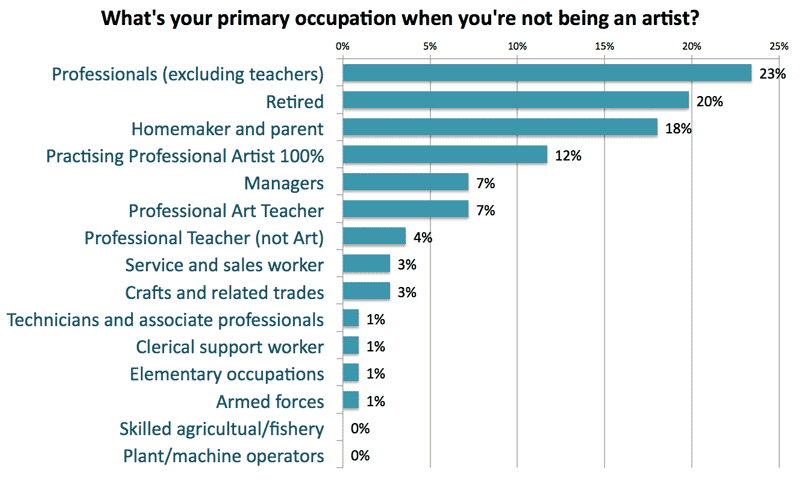
    What do you do when not being an artist? (POLL RESULTS)

    What's your primary occupation when you're not being an artist
    (right click and open in a new tab to see larger image)
    In October the Making A Mark Opinion Poll asked the question What do you do when not being an artist?  This post has the results - albeit a little late due to the month end being on a Sunday.

    On the whole, the readers of this blog are a pretty uniform bunch - although maybe not quite what I was expecting.  See what you think - and do please feel free to make any observations on the results at the end.

    111 readers responded to the survey and the results are expressed as a percentage of the total respondents.

    Slicing and dicing the stats in different ways this is what I found
    • the professional and managerial classes dominate the readership.  Excluding the practising artists who do not teach some 41% are professionals (23% are non-teaching professionals; 11% are teachers) and 7% are managers. 
    • 38% are reading from home because they are either retired (20%) or a homemaker and parent (18%) 
    • 19% have a full time involvement with art - 12% as a 100% practising professional artist and 7% as a professional art teachers
    • those working in less skilled occupations, on the land or in the forces are few and far between - although I have to say I'm always very grateful to get comments from people who have a different perspective on life.
    • Only 3% are involved with crafts.  I have no bias towards crafts in this blog but some aspects are pretty generic and I guess I thought there might be some more crafts people.
    I guess my conclusion is that my tendency to write long posts and at a "people like me" level means that I've got "people like me" as my readership.  

    There's a message in there somewhere for you all....... ;)

    Any surprises?  Let me know what you think by leaving a comment

    You can see
    I'm posting the Opinion Poll for November tomorrow - it's all about affordable art!

      Monday, November 01, 2010

      Makingamark's Top Ten Art Books in October

      Here's my regular monthly update of Makingamark's Top 10 Fine Art Books which has been revised to include the best selling and top rated art books in October.

      Just click a link and go straight to the category of your choice and find out which I think are the top 10 art books in October!
      Remember these change every month - and what you see this month won't necessarily be there next month.

      Movement in titles has slowed down this last month, with the majority of the listings staying the same or reverting to previous top books.

      However new books in the listings this month include
      Tip for aspiring authors

      For artists who are aspiring authors, having repeatedly reviewed the listings and seen the changes over time, I can tell you that achieving a lot of documented high ratings makes a HUGE difference to
      • how well it ranks 
      • the way your book displays in Amazon
      • how many it sells
      • how much money you make at the end of the day!
      Although interestingly the best ranked books are not always the best selling books.

      However the way you market your book via teaching workshops and via your blog is vital to pre-publication purchases, initial sales and overall sales.  By marketing, I don't mean direct sales pitches to your readers.  I mean building a relationship with readers through good quality content which means that they want to read your blog or take another of your workshops - and hence also want to read your book. Plus recommend it to all their friends!