Wednesday, March 12, 2014

2014 - the year of very many books about Urban Sketching?

Each year, I update a website about what seem to be the best of the new books published about drawing and sketching during the course of the year - see 20 NEW Books about Drawing in 2014.

It would appear that the continuing success of The Art of Urban Sketching has generated very many different takes on this topic. My current listing - which will develop as the year progresses - includes a number of new books on this topic.

Sketch Your World: Essential Techniques for Drawing on Location - I've not only got this book by my good friend and fellow urban sketcher James Hobbs, I've got a profile in it!

Urban Sketching: The Complete Guide to Techniques - by Thomas Thorspecken - you can read Thomas's blog in Analog Artist Digital World. I'm going to be doing a more detailed review of this book once mine has been handed over to the designer!

Hello, New York: An Illustrated Love Letter to the Five Boroughs by Julia Rothman - I like the idea behind this book, one woman recording the city where she lives. This woman is an illustrator and does not blog and doesn't seem to publish her sketches, although I could be wrong about this

Citysketch New York: Over 100 Creative Prompts for Sketching the Big Apple - by Melissa Wood who is an illustrator and architectural planner. I'm less impressed with this book, it seems to be targeted at those who also like to doodle (which is the other big theme of 2014 and one which I'm ignoring!).

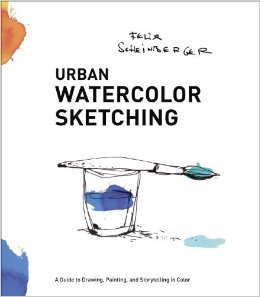
Urban Watercolor Sketching: A Guide to Drawing, Painting, and Storytelling in Color - by Felix Scheinberger. You can see his sketches on his website. This one I'm looking forward to seeing and reviewing as the man actually has a major track record of travelling and sketching.

CitySketch London: Over 100 Creative Prompts for Sketching the City on the Thames by Melissa Wood - I've only included this one as I'm totally intrigued as to what possesses any publisher to commission an American to do a book about sketching London.  Speaking, as I do, as a founder member of the Urban Sketchers London group!

The Art of City Sketching: A Field Manual by Michael Abrams. This chap is the co-ordinator of the Interior Architecture Program at the George Washington University in Washington, DC. This seems to have an aim to become some sort of set text for students in higher education. Looks very techie - just at the point where the theme of urban sketching seems to be becoming more about how to enjoy drawing buildings more in a less techie way!

So - did I miss any?  Are there any more out there?

[P.S. I am aware of the Chinese book which is copying the "The Art of Urban Sketching" title. I've been invited and am ignoring this - it's just plain disrespectful in my view. This is Gabi Campanario's blog post about the book which is trying to copy his book - see Dopress book not my project]

Tuesday, March 11, 2014

DISCUSS: How to draw with confidence?

Sketch of The Cafe Lotus, Ubud, Bali
If you'd like to know what happened that made a big difference to my confidence in my drawing, read the story about a trip to a lotus pond in Bali in this blog post from February 2006 - When I turned the corner............. which starts...
When people ask me about my current style of drawing, I often joke with them about how it took me nearly 10 years (as in YEARS!) to learn how to scribble.
This is a DISCUSSION post - please leave a comment about:
  1. What needs to happen - in the future - to make YOU feel more confident about drawing?
  2. What happened - in the past - that made YOUR confidence in drawing grow?
  3. In general, what do you think most people need to be able to do in order to draw with confidence?

Monday, March 10, 2014

John Smolko's Top Tip for Drawing

I've been asking artists what is their top tip for drawing.

Benj #3 © John Smolko
colored pencils on museum mat
This is John Smolko's top tip for drawing - and the image is one his coloured pencil drawings.  You can see more on his website
I taught high school art for 35 years the one drill that I loved to give my students, and loved to execute myself, was Continuous Contour Line Drawings.

I would start off every school year with all my students doing this exercise for at least four weeks.

The idea is to draw everything and anything, from life, with one line. You are not allowed to pick up your pencil and you must focus on drawing from detail to detail.

I especially liked doing figure drawing with this technique and believe me, my students became masters at figure drawing. I would start out letting them put in a few guidelines to help them begin, but once they put their drawing tool down they had to keep it down. I would grade these by just taking one point off for each time they picked up their pencil. This exercise was total discipline and I would tell my students that if they couldn’t follow a simple direction like this, how could they expect to accomplish the sophisticated drawings we would do in the near future.

We would mix things up by using pencils, markers, crayons, charcoal, pen and ink, conte, and we even used twigs I picked up in my backyard. We would use any drawing tool we could find to make it interesting.

After a short period they were not allowed to even use guidelines.

The exercise was meant to get them to measure with their eyes and make a commitment to where they were drawing on their page.

To really get them to focus I would have them use their opposite hand to do this drill. This would really get them to slow down and concentrate and many of these drawings were dynamic.

After the first four weeks of school we would do these drawings about every two weeks on a Friday. I called these their “Friday Exercise” and I would have all my students stop working on their projects, for the one day, and focus on this skill development. The students started to look forward to this activity and by then I knew I had them hook, line, and sinker.

I loved my job.
There will be more of John's drawings in my book when it is published later this year. There wasn't room for the entire explanation in the book - hence this blog post!

Friday, March 07, 2014

Preparing images for publication #2 (Image Contributors)

Next up in my tips of what to do in preparing images for publication relates to what I'm doing right now. I'm writing a book about drawing and sketching and asking people to contribute images relevant to the content.

Identifying images for the book


I did a callout for people who were interested in contributing pictures at the beginning and that was very helpful - but it didn't provide all the people I needed help from for the book

The big problem for me was that I didn't want to bother people for images until I knew what I wanted and I didn't know what I wanted until I'd drafted most of the book.

However when people are online friends and/or artists you have communicated with in the past, it's a lot easier to invite them to contribute at relatively short notice!

LESSON LEARNED

Being part of and maintaining a good network of artists that you regularly communicate with is hugely helpful to developing artwork for a book.

Finding images


I've learned a thing or two about finding images while developing this book.  I now look at artists' websites in a whole new light!

It also made me think a lot about about how others (eg galleries; agents licensing artwork) must view the artwork which artists choose to put online - and the conclusions they might draw from what they saw.

Here are my conclusions. I hasten to add these are overall impressions from looking at a huge number of websites in the last few weeks.  It's emphatically not a comment on any particular artist!
  • Lots of artists don't make it easy to find good images of their artwork.  This really surprised me. I encountered more than a few websites where there's 
    • not much art 
    • and/or it lacked categorisation (e.g. no drawings category) 
    • and/or the images are too small 
    • and/or the site included "everything I've ever drawn" and left the sorting and sifting to me.
  • Illustrators understand how to display their artwork. People who work at least part of the time as illustrators really understand how to display their artwork to best effect to people choosing artwork for a book.  
  • Flickr is wonderful!
    • People who have their artwork on Flickr, carefully sorted and categorised into SETS are an absolute godsend!
    • Relevant Groups on Flickr with communal image pools are also very helpful in highlighting people producing the type of material relevant to a book - but only if that artist also provides a link to their website and/or a way of contacting them
  • Archives tell a story. Artists who maintain archives of sold images on their website are really wonderful people!

Problem with contacting artists - Of more concern is the fact that it is still very difficult to contact some artists because they put their work online without a proper contact name and/or a contact address. The conclusion I drew is that these people never ever want to be contacted under any circumstances. So I didn't.

LESSONS LEARNED
Finding the right images works a lot faster if you can review a lot of images at once - either on a website or an image database.

If you want to get your artwork in a book make sure the author can see it easily and contact you!

If you want your images found and/or selected for an art gallery and/or by a licensing agent, now might be a good time to review the presentation of your images and information about how easy it is to contact you.

Providing information to potential contributors


As I found out very fast you really don't want to have to write the same email over and over again!

What's needed is a covering email - personalised to the individual - and an information sheet which details the specifics of what type of image is required and the context in which it will be used.

This is what mine says with respect to (The info. sheet also provides more information which I'm not publishing here).  The majority of people are contributing between 1 and 3 images.

Information for Image Contributors

  • The book will contain c.350 images. 
  • Some are mine – including ones I’m producing specifically for the book 
  • Some are photographs e.g. of art materials 
  • And the remainder are ones contributed by other people who draw and sketch. 

What’s in it for you?

  • There is no fee 
  • Your name will be credited on a page at the back of the book. This should also list a website or blog associated with you.
  • The book is likely to get a fair amount of press coverage.
  • I’m happy to share information about the process of writing a book with you - for those who are interested. 

What’s needed

IMAGES should be
  • Print publication quality digital images
  • 300 dpi
  • As large as possible to allow layout flexibility. Files should also be no smaller than 100mm x 100mm. 
  • Files should be sent as JPEG, TIFF, EPS, or PSD, and can be RGB or CMYK. 
  • PDFs will also be accepted, but only if they are of reproduction-quality.
No images can be published unless:
  • Your work is original and you own the copyright
  • A copyright form has been signed and submitted. 
A copy of the copyright form will be sent to you for review prior to discussion of images so we can deal with any queries upfront.

Lessons learned


Always have print production quality images available for any images which you would like to share in a book / licensed by an agent

When you create  an image for archive purposes make sure it is high resolution.
  • When you scan, always scan at 300 dpi minimum and file away this high resolution scan for future reference in a way which makes it accessible if your hard drive fails.
  • I know this is the same message as yesterday - but it bears repeating!
Alternatively, this is the quality of image which you should be using if you are producing your own book of images via any of the online print houses (see my website Print Art on Demand - Resources for Artists for resources for printing your own art)

What I'm finding is that my past practices in relation to the dpi I have scanned at and the file types I've maintained on my computer has been variable. It's not been helped by the fact I went through three computers in 4 years before getting my iMac and hence I've got a problem with lack of back-ups and the loss of original scans for some of my work.  (Guess who now backups on the hour every hour!)

and finally......


If you'd like your drawings or sketches to be considered for the book it's not too late to contact me. Leave a comment below and a link to a website where it's easy for me to review your work

Thursday, March 06, 2014

Preparing images for publication in a book #1

I'm deep in the depths of correspondence with c. 50 artists at the moment in relation to inviting people to contribute images to my book. The next step is to help them generating both the images and the copyright forms and getting both transferred over to me so I can send them to the publisher.

It seems like a good time to record some thoughts on image preparation should you ever get asked whether you'd like your artwork in a publication.

So here's the first instalment. More later....

Generating top quality images for publication


#1 top tip is "assume all art you produce will be needed for a publication"


That's drawings, paintings, sketches etc

That way when you generate it first time round you'll scan it at 300 dpi or take a decent photograph and consequently have a file you can go to when somebody asks if it's possible to use that pic you produced two years ago.

Plus it also means if it's one you're sending to an exhibition and it sells that you still have a decent image of it!

So always, always, always get a decent digital image of everything you produce.

Then do the low res for the web image which is the one you will share with the world! :)

#2 tip make sure you learn how to produce a decent image for reproduction


Basically we're talking about a large image @300dpi or more, preferably saved as a TIF or other format which includes all the pixels. Plus saved in CMYK format would seem like a good idea since these images are being preserved for print publication rather than website.

Here's a couple of links to information and advice about producing top quality images
This comprehensive guide focuses on many common image questions in regards to image resolutions, resizing images, file types, vector and raster images, scanning, saving and more.Last Updated: Nov 15, 2013 URL: http://guides.lib.umich.edu/allaboutimages Print Guide


#3 tip is file and archive your super duper file somewhere where you can find it!


Get a system and follow it!

You might file by year of production or type of image and have subsets. Whatever !  Just make sure that you leave yourself enough clues that you can find it again later.

This is where tagging suddenly seems to look like a very good idea.

I can tell you that a large file totally devoted to and well organised with TIF files suddenly looks like the intelligent answer!

#4 tip is file it somewhere else as well!


Don't forget there are various services now which give you oodles of space for very little outlay which means you need never ever rely on one copy which is on a hard drive which is going to fail at some point in the future.

If you don't backup, be prepared to forgo the retrospective catalogue - and all requests to get your artwork published ......... ;)

More to come.