Tuesday, July 12, 2022

How to assess entries for an open art society exhibition (Part 2) - marking artwork

Today's Part 2 of my focus on assessing entries for an open art society exhibition is going to focus on a method I've devised for giving every entry in an open exhibition a specific mark.

Yesterday I wrote about How to assess entries for an open art society exhibition (Part 1) which focused on the increased use of digital selection following the introduction of digital submissions and, in particular, the pandemic

The rationale behind a marking system

I have 100 marks to award to each of a very considerable number of artworks. 

The challenge for me is to 

  • make the allocation of marks make sense to me 
  • try and achieve consistency across all entries during the time required to mark each one
  • ensure the marking is fair i.e. that each and every artwork ends up being ranked "correctly" in terms of my views of the relative merits of the different artworks
So how best to do this? 

My marking system

Monday, July 11, 2022

How to assess entries for an open art society exhibition (Part 1)

I think very many people might be surprised by how entries for an art exhibition get assessed by most art societies. 

I've written on this topic before in The agony and the ecstasy of art competition judging - which comments on the time involved in reviewing and judging 15,000 entries for the RA Summer Exhibition

This post comments on how the pandemic has influenced how artwork now gets judged.

How entries for open art exhibitions get assessed

In person versus digital

Traditionally, the practice has been to convene a selection panel which sits in a room as handlers bring artwork past. The speed with which the artwork moves depends on how many entries have been received and how much time has been allocated to the selection process. Bottom line it's not long.

Then we began to have digital entry - and selection of entries started to have a digital element to the process. Often with the "first cut" being done via digital assessment of the images submitted by artists, and then final assessment being made by a panel from the "longlist".

During the pandemic, efforts were made to keep annual exhibitions going and many switched to selection being wholly digital and online - and virtual exhibitions.

Interesting aspects of digital selection is that 

  • Selectors will assess much more on the basis of what they as individuals think 
  • "groupthink" is instantly eliminated (assuming no discussion between selectors). 
  • Selectors will spend the amount of time they think they need to spend on selection. It's unlikely to be identical and there may be extremes.
A big benefit of digital selection is that
  • it cuts expenses for art societies dramatically - given there is no need to reimburse people for travel to get to places where artwork is being judged. These expenses can be significant for national art societies and can be a welcome saving.
  • once experienced, you need to come up with a very good reason to go back to being in front of the art to sift out the "no hopers" and "not quite good enough"

HOWEVER The main problems with digital assessment are:
  • people who don't read instructions and submit images which are too small. They're an automatic "fail" in my book as I can't assess an image which is too small.
  • people who digitally manipulate their images to make them look better than they are in reality. This typically affects colour and/or tone. It is possible to detect images where this has happened. Or at least I know how.... ;)
  • It's really difficult to get a sense of the size of the work. I have to make an effort to check dimensions when assessing. Anybody who fails to provide dimensions end up leaning towards a a fail for me.


Sift and sort or mark and grade?

Then there's the issue of how much effort you put into decision-making

Wednesday, July 06, 2022

Bye Bye Boris? About art and Boris Johnson

I've been completely distracted today by the machinations concerning the future of Boris Johnson. 

It's looking very much like he'll be gone for definite after the 1922 Committee elections next week (i.e. rule change and new confidence vote - which he will lose) - and maybe by the end of today (i.e. 35 resignations from the payroll vote so far and likely to continue)

So here's a review of my posts about art and Boris Johnson

Portraits of Boris

This is a portrait I wrote about in Portrait completed in 2 hours wins Ondaatje Prize.

As ever I was interested in what John Ward CBE, 90 this year, was exhibiting by way of pastels on mid-toned Ingres paper. His works were displayed alongside an absolutely splendid portrait of Boris Johnson MP by Felicity Gill (which looks rather better in reality than it does on her website) . Despite Boris describing the experience as a privilege and "glorious ego massage", Ms Gill describes how it was quite difficult trying to pin him down at his offices at The Spectator.

"The sitting was constantly interrupted....eventually I resorted to getting him to climb out of a window onto a small roof where he sat, captive, in an old deckchair"

Here's the portrait by Felicity Gill.......


........and then my sketch of half the portrait!

John Ward meets Boris Johnson at the Mall Galleries (2007)
8" x 10", pen and sepia ink and coloured pencils in moleskine sketchbook
copyright Katherine Tyrrell

Another portrait of Boris


My Review: Royal Society of Portrait Painters Annual Exhibition 2011 (Part 1) (May 2011) contains yet another portrait of Boris
Boris Johnson by Helen Masacz - the hair is excellent! Boris seems to offer endless fascination to portrait artists - I've seen a few of them in recent years.

Boris Johnson by Helen Masacz
oil, 42 x 30cm, (17 x 12")

An artist Mother - who painted Boris frequently


About Charlotte Johnson Wahl - artist and mother of Boris (July 20th 2019) is the post I wrote about his mother who was an acclaimed artist. She died recently.

It includes portraits of Boris as a child and growing up.

She held an exhibition at the Mall Galleries in 2015 called Minding Too Much


Boris and Chequers


This is an interesting post about How to sell a painting to a Prime Minister (April 27th 2021). 
Besides a view of the house and garden, the image includes very simplified images of Boris walking the dog Dilyn near to his fiancée Carrie and their baby son Wilfred having a picnic on the lawn.


Tuesday, July 05, 2022

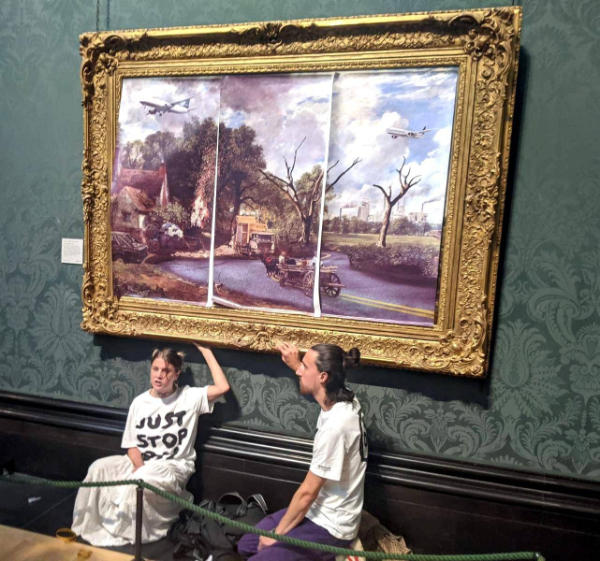
Just Stop Oil is both destructive and IGNORANT!

For many years, I used to visit the BP Portrait Awards Night at the National Portrait Gallery to photograph the winning artists. In doing so, I used to have walk past the demonstrators against BP's sponsorship of this important portrait competition.  I said "Excuse me" and they kindly moved to let me pass. Respect on both sides.

I understood where they were coming from. It made sense - even if I disagreed with them - as explained in a series of posts about sponsorship of art (see end of this post)

However words very nearly fail me when it comes to some of the utter stupidities of the Just Stop Oil's initiatives in relation to art galleries and famous oil paintings - but not quite.  Hence this post!

The demonstrations


Graffiti sprayed onto walls of art galleries and glueing themselves to paintings
is standard practice for these demonstrators

To date there have been various demonstrations around the UK involving destruction of property and demonstrators gluing themselves to very old artwork and archival frames as follows

  • June 29th - Kelvingrove Art Gallery and Museum - 
  • July 1st - Manchester Art Gallery
  • July 4th - National Gallery
  • July 5th - Royal Academy

Not so one of my followers who very neatly summed it up when he pointed out 

It's the wrong sort of oil!

or another who commented

Ian Dugdale
Just think about all the petro-chemical solvent that will be needed to remove all the graffiti. Wouldn’t be needed without their actions.

So let's highlight 

  • it's the wrong sort of oil
  • the wrong places are being attacked for no good reason
The one on the left apparently enjoys foreign holidays involving lots of flights

The wrong sort of oil

Some of the protestors are art students.

You'd think they'd know that oil paint has nothing whatsoever to do with petroleum!

The oil used in oil paint is very often linseed oil.

Linseed oil is:

  • pressed from flax seeds - which have been grown for centuries if not millenium without adverse effects
  • biodegradeable
  • non toxic
Other oils used as a viscous medium for oil paint include walnut oil and poppy oil.

They all sound very green to me - and precisely the antithesis of what these very silly  infantile protestors are complaining about.

The wrong places i.e. no oil sponsorship

NONE OF THE GALLERIES DESECRATED TO DATE ARE SPONSORED BY OIL COMPANIES

Indeed BP has very nearly stopped backing the arts per se.

On the page on its website dealing with sponsorship of the arts in the UK it highlights the following

In 2016, in support of our strategy, we announced a further five-year investment of £7.5 million from 2018 for a range of projects at the British Museum, the National Portrait Gallery, the Royal Opera House

So basically, not one of the art galleries targeted have been in receipt of oil money - and one of them is closed at the moment!

There are no grounds whatsoever for attacking these places.

On 14th June I walked home from an art exhibition along Horse Guards
- only to find that some very expensive machinery involved in 
cleaning red paint thrown on the Treasury Building by Just Stop Oil demonstrators

Indeed I also find the waste of public money involved in cleaning off the paint thrown at the Treasury to be abominable, given others (from Gandhi to Greenham Common to Dame Deborah James) have demonstrated extremely well how effective other forms of PEACEFUL campaigning can be. 

Destructive protests just serve to alienate very many people.

The rules of effective protests are

  1. First do no harm
  2. Get your facts right
  3. Don't annoy the wrong people 
So far as I'm concerned they're getting it very badly wrong on EVERY SINGLE LEVEL! 

While I support environmentalism, in no way do I support people who behave in such an ignorant and destructive way to no good end. 

Many think - and I agree - that they need to grow up and stop behaving like young people with a bad attack of the teenage tantrums.


REFERENCE: BP sponsorship


I've written about BP's sponsorship of the Arts and the various views taken about it on a number of occasions:
My view is clear - as stated back in 2015.
I'll state my case up front. I really am not in the least bit bothered by BP's sponsorship of art galleries and museums. I'm far more concerned about:
  • fossil fuel companies behaving in a social responsible manner
  • those trying to repair their reputation paying a fair price to society for the privilege of being associated with a prestigious art gallery or museum which only exists due to generous state support. 
Of course I'd rather that energy sources came from renewable sources. However until somebody makes energy consumption from non-fossil fuel a cost effective and efficient proposition for most of the companies and families in the UK (and elsewhere) I don't see much alternative to the continued use of fossil fuels.

That in turn means oil companies will be looking for ways of sanitising their image - and offers a wonderful opportunity for sponsorship - so long as this is at the right price.

Saturday, July 02, 2022

Peter Brown's Paintings of Glastonbury Festival

Peter Brown has a new Online Exhibition of his paintings of Glastonbury Festival between 2016 and 2022.

It was such a joy to be back painting at Glastonbury this year after two years of COVID cancellations. To celebrate, I’ve put together this online exhibition of my paintings of the festival that I’ve done over the years: 2016, 2017, 2019 and this year 2022.
Peter becomes the equivalent of an artist in residence for the duration of the Festival - as he has been in years past.

You can see the exhibition on his website at https://www.peterbrownneac.com/exhibition/glastonbury/


About Peter Brown