Sunday, February 05, 2006

Art Quotations of the Week - 5 February 2006

I collect quotations about art. I find they usually make me pause for thought and often give me an insight or an alternative perspective on being an artist and the process of creating artwork. And, of course, sometimes, they just remind you that there's nothing new under the sun and whatever problem or dilemma I am currently faced with has been experienced by somebody else before.

I've got art quotations on my website - I find they can often be a succinct way of highlighting what you want to say about a page without it actually needing to be my words.

I'm going to post a few art quotations each week - because I'll never be able to just limit myself to one! I thought I'd start by identifying those I currently have on my website and why I chose them

Painting is just another way of keeping a diary"
Pablo Picasso

I love this quotation - it speaks of the way in which painting records your life and experience. I love my sketchbooks because they record my travels and different times in my life in a way which nothing else could ever do. I look at each drawing or painting and I remember doing it, where I was sat, what the place/weather/people were like and how it made me feel. Because you connect so strongly with a place or a person or an object when you draw or paint it, the process stores away memories in a way that photos never ever can.

I've used the Picasso quotation to kick off the introduction page of the "Travels with a Sketchbook" ection of my website

(I wonder if Picasso would have had a blog with a daily painting ;) )

"Nothing makes me so happy as to observe nature and to paint what I see"
Henri Rousseau


The quotation by Rousseau is on the introduction page to the galleries of Landscape paintings on my website. I've been painting landscapes for very many years now and most of them were started or completed working from life "en plain air" in front of the subject. The Rousseau quote really summed up for me the way it makes me feel - especially when you get a good site and nice weather.

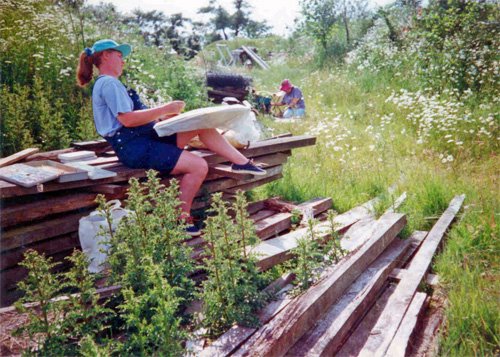
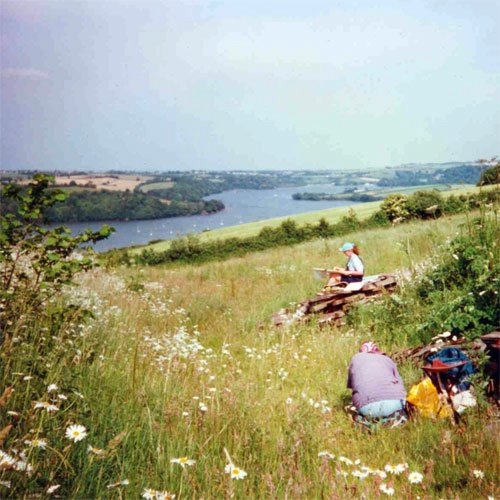
And I've posted two photos of me plein air painting using pastels in Devon. It looks idyllic in the first, but the second shows what it was really like - not the easiest place to sit! But it was still a truly wonderful and very memorable morning!

What I wanted to do was to paint sunlight on the side of a house"
Edward Hopper

Me too! I love painting sunlight and shadows and I use this quotation to start the gallery of paintings of Houses and Gardens within the Landscapes section of the website. There's an awful lot of sunlight and shadows in that gallery! And it includes my very first "sunlight on the side of a house" painting. It's called "The Lemon Tree House" and it's a painting of a small greek house (in Volissos on the Greek island of Chios) with amazing shadows from the lemon trees on its white painted walls. And that's not dodgy perspective drawing - the wall was in fact falling down and lurching very badly! It's not the best painting I've ever done but it was the first one when I began to realise what I might be able to accomplish as it generated a "Wow" reaction from everybody I was painting with. I completed it in one sitting of maybe two and half hours in pastels on an abrasive support (Rembrandt pastel card). It measures 19.5" x 25.5"


Whoops - nearly forgot the Tags
, , , , , , , , , ,

Saturday, February 04, 2006

Technorati tagging

I've started tagging each post using Technorati tags.

What's a tag? Well Technorati suggest we should think of it as a simple category name. If I tag a post it means that when people search blogs listed with Technorati for (say) blog posts relating to "painting" my post should be in that list - once I've "pinged" it to Technorati.

If you click on any of the tags below a post in this journal you'll be able to see any related posts in other blogs. I've only done a couple so far but will be working my way back through all the posts and tagging them. All future posts will be tagged as well

And I'm proud to announce, I've created a brand new tag - "artwork from life". Tada!!!

Better to do some for this one now!


Thursday, February 02, 2006

Painting from Life

Most of what I do in terms of my artwork is usually related to painting from life and I thought I better say a few words about what this means rather than assuming that readers of this journal understand what I'm wittering on about.
  • "Working from life" means working with the subject in front of you whether it's a landscape, an interior, a still life or a person, No photographs are involved, there is no tracing or projection of the subject. The artist has to sight size the subject and make judgements about values and colours using their eyes and the experience and skills they have developed through working from life. Bottom line - it's essentially about trusting your eyes and drawing and painting what is in front of you.
  • "Plein Air Painting" is a term derived from french and is frequently used to describe painting from life in the open air and out of doors and away from the studio. It's also sometimes used as a euphemism for painting nature and the natural world. There's a good description of plein air painting and how it came about on the website of the Plein Air Painters of America. There is a further succinct glossary entry defining "plein air" on the Tate Gallery's website
  • "Life Drawing" is a term usually used to describe drawing (or sometimes painting) a person or people lying or sitting or standing or moving in front of the artist. Life drawing is often identified by artists who work from life as being the artistic equivalent of the scales which musicians practice on a regular basis. Skills in life drawing enhance and underpin a lot of the skills required to draw and paint from life. Life Drawing went out of favour amongst the art establishment and colleges at one point but seems to be experiencing a bit of a revival.
  • Working from life indoors - I don't recollect ever coming across a universally accepted term like "plein air painting" to describe artists who paint from life but do so indoors.
  • "Studio works" is a term frequently used to describe artwork which originally started life as a drawing or painting from life. The information in the original study is hugely valuable - but maybe it was not completed or the artist feels they can improve on it and hence continues to work on the subject back in the studio. Monet for example, when painting Venice, started an enormous number of canvases in Venice in front of the subject - but completed them at Giverny in the studio. However, it needs to be noted there is no guarantee that an artist who indicates that they work in a studio is actually working from life - they may be working from photographs
A lot of the drawings and paintings on my website were produced working from life. Others are developments based on the colour studies or drawings produced on site and in front of the subject and sometimes supported by photographs I took while painting - although these typically relate to painting plein air.
In the past, I have produced and completed large pastel paintings on site - working either "plein air" or indoors (and a signiifcant number of these these can be seen on my website) - however I now tend to focus much more on sketching and gathering material using coloured pencils so that I have a lot more information to work from when I get home.
I'm going to develop a set of links to sites concerned with plein air painting - something which I feel very passionate about. I've kicked off the section with a link to PAPA otherwise known as the Plein Air Painters of America.

Wednesday, February 01, 2006

Interior scenes from life

Today I signed up for a project - "Interior Scenes from Life" in the new Wet Canvas Artwork from Life Forum. The idea is to draw or paint an interior from life (ie no photos allowed) during the month of February.

I very much enjoy working on Interiors as some of the early posts on this journal evidence. My Interiors Gallery of drawings on my website has been highlighted as a reference for the project - as has Laurelines Gallery of Interiors from Laura's January project to draw an interior everyday. I so admire Laura's tenacity with this project. She's turned out a stunning gallery of drawings of various scenes. I love the commentary which goes with them in the January section of her weblog. I also very much like the other references which Jamie has chosen to get the creative juices going - some Edward Hopper Interiors and a website gallery of paintings by an artist called Charles Sovek who I've not come across before. He refers to them as "colourful indoor encounters" and they're certainly very colourful. I'm sure all three artists will be very stimulating in their different ways.

I tried using a sub-gallery on my Interiors gallery page and I'm still not sure whether I want to keep this or not - I'm not sure people realise that there are more images underneath when you click on the main gallery image. Which is a pity as it's for the drawings I did for "Drawing the Bigger Inner Space" of the Interior of St Paul's Cathedral

Now the big question is - do I tidy up or not?

Or do I go back to St Pauls and do that scene I spotted near the end of my series of visits? It's really nice to have the option of hopping on the tube and being there in not very many minutes.

French Window

I was commenting to a fellow artist yesterday about what happens when the Mistral starts to blow in France and makes plein air sketching almost impossible and rather unpleasant. And I started to relate some of the things you do instead - such as looking around to see what has some appeal for drawing purposes. Which is how I came to draw my "French Window" in the late summer of 2004 (and how I learned how to sketch in a car - but that's for another post).

One should never ever judge old French houses by their exteriors - the plaster may be coming off, the windows may need a lick of paint (that sun really gives paintwork a beating in the south of France) but inside you may see gilt mirrors and chandeliers - as indeed were visible in this window. This window was across the road from the house I stayed in Montreal de l'Aude in the Languedoc. I sat in the first floor sitting room, opened the windows and drew.

This was completed using a limited number of coloured pencils on a sheet of blue grey Canson Mi Teintes (smooth side - not the really horrible chicken wire side). I aimed to balance out an accurate drawing of the window and its surrounds (and yes it wasn't square - it was old!) with coloured pencils used in a looser way. I cut the pencil 'lead' long and then dragged it across the page - pretty much as one might do if using a pastel. The real challenge was to get the sense of the reflections in the windows at the same time as using very similar colours to represent altogether more substantial aspects of the building. But I loved doing the stonework and the bricks.