Tuesday, November 09, 2021

Call for Entries: Derwent Art Prize 2022

The 6th Derwent Art Prize is a major INTERNATIONAL art competition for artists working in dry media - and is now open for entries. 

Deadline for entries is Tuesday 4 January 2022 (5pm GMT)

Below you can find out about this major art prize, the prizes on offer in 2022, the selectors and the exhibition and, most importantly how the call for Entries works

The Derwent Art Prize was conceived in 2012 and aims to reward excellence by showcasing the very best artworks created in pencil by artists from around the world.
The Derwent Art Prize is a global art competition with a prize pot of some £12,500. 
The exhibition was conceived in 2012 and has been consistently sponsored by Derwent, the internationally renowned fine art brand since that date. It is
  • A Biennial Open Exhibition
  • Open to artists from around the world; and 
  • Rewards excellence by showcasing the very best 2D & 3D artworks created in pencil or coloured pencil, pastels, graphite and charcoal.
Last time, this exhibition was held in 2020, there were:
  • 4,756 entries 
  • submitted by 1,884 artists 
  • from 72 different countries. 
  • The Derwent Art Prize judges selected a shortlist of 70 pieces.

The last Derwent Art Prize exhibition in a gallery - at the Mall Galleries in 2018


The Prizes


CONGRATULATIONS TO DERWENT for maintaining the prize fund in an era when many commercial / organisational sponsors have been turning their faces to the wall and leaving formerly prestigious art prizes to disappear.

I also like the fact that the main prize fund pot is equally split across 
  • all entrants and 
  • those aged 25 years and under.
Derwent Art Prizewinners with Selectors in 2016

Prizes valued at £12,500 will be awarded to entries selected for the exhibition at the Private View at the Exhibition at the Gallery@OXO, London.

A total prize fund of £12,500 will be awarded. Prizes are as follows:
  • Derwent Art Prize (£6,000)
    • First Prize £4,000 plus a year’s supply of Derwent products**
    • Second Prize £2,000
  • Young Artist Prize - for artists under 25 years (£6,000)
    • Young Artist First Prize (For artists under 25 years) £4,000 *
    • Young Artist Second Prize (For artists under 25 years) £2,000
  • People’s Choice Award £500
All the First and Second prize winners will also receive a special box of Derwent Lightfast Pencils which have a core which is resistant to prolonged colour change- meaning artwork hung in archival/museum conditions will not fade for up to 100 years.


The Selectors


This year’s entries will be judged by a panel of selectors comprising an artist, a critic and a curator. a fourth Judge is to be announced.

Writing and speaking about art history in an accessible and fun manner, my goal is to readdress the gender imbalance in the art world by reinserting women back into the canon of art history.
he has worked for more than twenty years in the art world in senior roles for the Contemporary Art Society, The Showroom, the Serpentine Gallery, and Royal Academy of Arts in London. He has been Director of Modern Art Oxford since 2013.
Her work is concerned with what she calls ‘memory stories’. She creates these stories primarily through research connected to the African Caribbean diaspora, and then maps the stories onto life sized figures. 

The Exhibition


From the open submission applications the panel will select approximately 80 works for exhibition.

At the bottom of the page you can find my previous reviews of this art competition, the prizewinners and the exhibitions - and see the diverse range of artwork which has been selected in the last eight years. 

The exhibition will be held at Gallery@OXO in central London will be from 24 February – 6 March 2022.
This is situated on the Riverside Walkway at the heart of one of the richest cultural areas of London, between the London Eye, The Hayward Gallery and Tate Modern.


How to enter the Derwent Art Prize


Who can enter

Entries are invited from international artists

What can you enter

Artists may only enter once, with a maximum of 6 images.

Sunday, November 07, 2021

Review: Celebrity Landscape Artist of the Year 2021

Series 7 of Landscape Artist of the Year started last week with a special episode - Celebrity Landscape Artist of the Year "does Climate Change". Actually it was the first ever Celebrity Episode they'd had - and it saw a renewal of competitive paintbrushes for Jim Moir and Tomasz Schafernaker who have both previously appeared in Celebrity Portrait Artist of the Year.

So a bit of a fun programme - except for Jim and Tomasz - with the stakes raised when the contestants were told that they weren't just painting what they could see but rather they were painting on a theme of Climate Change.

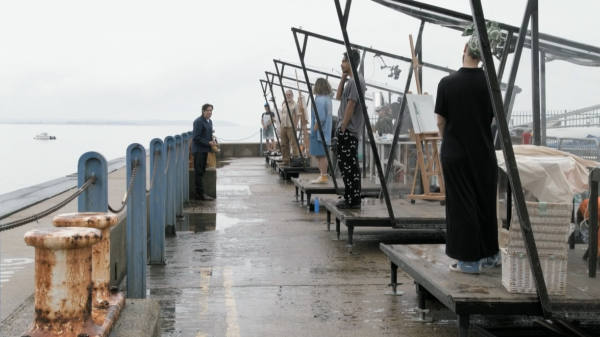
Artists lined up with pods behind at the harbour at Whitstable


Artists


The celebrities / amateur artists participating in this episode were
  • Jim Moir - a comedian, actor, musician and artist known best for his TV work under the name Vic Reeves. He's a previous winner of the Celebrity Portrait Artist of the Year episode in 2018. He's also a resident of Kent. (This is about Vic Reeeves the artist on his website
  • Tomasz Shafernacker - a meteorologist for BBC Weather. I've yelled "get your hair cut" at him many times in recent months.  He owns a very arty apron which has a layer of paint spatters - so very obviously a keen amateur painter. (This is his art website)
  • Caryn Franklin - a British Fashion journalist and Educator who has a BA (Hons) in Graphic Design from Kingston and did a postgrad year at Central St Martins and can obviously draw plus a MSc in Applied Psychology in Fashion at London College of Fashion. She was sewing for this episode - and brought her sewing machine bought with her 18th birthday money with her to the seaside.
  • Jessie Cave - an English actress, comedian and cartoonist, known for her role as Lavender Brown in the Harry Potter film series. Her cartoons are observational and somewhat child-like.
  • Rose Matafeo - a New Zealand comedian, actress, and TV presenter. - who has produced dioramas in the past - and produced another one for the programme.
  • Jordan Stephens - half of the English hip hop duo Rizzle_Kicks - who was perhaps the least experienced of the six artists.
Interestingly all the artists normally work in their studios - so the experience of being outside and the changing weather was a new experience for all of them. I think some might be trying it again...

The artists with their artwork after the four hours were up

Location: Whitstable

A grey day in Whitstable

The location for this episode was Whitstable - a small seaside town on the North East Kent Coast. The only time I've visited Whitstable it was exactly the same as the weather in the episode - cloudy grey skies and rather windy. 

The town is famous for its Oysters which have been grown just offshore since Roman times.

The pods were all lined up along the West Quay of Whitstable Harbour, next to a boat park. It was obvious the filming became a little bit of a local attraction over the course of the day with a few people stopping to take a look at what was going on. 

Artists in pods on a wet day in Whitstable

Ifv you fancy visiting and having a go for yourself, the location was on the concrete strip on the rectangular bit jutting out of Whitstable Harbour (i.e. the East Quay - just past the Harbour Car Park and RNLI Station)

A bird's eye view of Whitstable Harbour


Artwork done before the show

Friday, November 05, 2021

The END of the Sunday Times Watercolour Competition?

It seems to me that the the largest and most prestigious watercolour competition in the UK has very probably died.

Without a death notice.


The Sunday Times Watercolour Competition website only contains details about the 2020 competition.
 

It references subscribing to the ArtOpps newsletter to find out about the 2021 competition - but here we are in November 2021 - with no time left for a competition or exhibition this year - and there's absolutely no communication anywhere about what's happening.


 Let's look at the facts

  • The planned exhibition at the Mall Galleries in early 2021 did not happen due to the lockdown - and indeed is not even listed on the Mall Galleries website as a past exhibition
  • Prizes for the 2020 exhibition were much reduced compared to its heyday.
  • The announcement of the prizewinners in 2020 is locked behind a paywall. Nor are they listed on the website - which mean it's of very littleo marketing benefit for the prizewinners
  • The website has not been updated in a very long time
  • The date of the last entry on the Facebook Page was 17th February 2021
  • The Judges of the competition in years past have been some very prestigious people e.g. Director, Government Art Collection; Desmond Shawe-Taylor CVO, Surveyor of the Queen's Pictures; Dr Kim Sloan, Curator, Department of Prints and Drawings, British Museum and a Sunday Times critic who actually knew what he was talking about. Less so in the recent past. Indeed last year they announced the competition without announcing the Judges!
I last did a post about the exhibition in August 2020 when I wrote 10 changes in the Sunday Times Watercolour Competition 2020 Call for Entries
The significant reduction in prize money and other prizes really takes a LOT of prestige away from this competition. Which is incredibly sad as this competition has been seen as very prestigious for very many years - until recently.
I can do no more than highlight what I said in that post - and reiterate that the time has really come for a very major change.
Like I said last year (see Sunday Times Watercolour Competition 2019 - Prizewinners & Exhibition),  in my opinion it's time for 
  • another MAJOR CHANGE in the competition/of the main sponsor
  • to one which wants to provide more credibility and prestige that this art competition has enjoyed in the past
  • more involvement of painters in traditional watercolours as Judges.
This is because:


The impact of lockdowns


The lockdowns have very obviously had a massive impact on all sorts of exhibitions and art galleries. 

Nobody would have thought twice of an organisation or organisers who announced that there would be no competition in 2021 - but that the competition would be back in 2022.

But they haven't done that (see above re. lack of communication)

So why's that? Can't be bothered. Still mulling things over?


The reality


The reality is there is NO PRESTIGIOUS ANNUAL WATERCOLOUR COMPETITION in the UK any more.

Thursday, November 04, 2021

Review: Episode 4 of Portrait Artist of the Year 2021 (Series 8)


This is a review of the fourth episode of Portrait Artist of the Year (Series 8). It follows the identical format of all the others - as does this post. Just the artists and the themes are different.

Apart from the fact that I've swopped the colour of the main headings and sub-headings after Google and Blogger got really silly some time ago about removing controls over font size for different headings. It drives me absolutely bonkers to have the main head and sub-head as options and yet they're exactly the same size when I'm doing posts with lots of sub-heads!

On to this episode. If you missed it, it's repeated tonight at 7pm.

THE ARTISTS


Nine artists split into four professional and five amateur artists this week. As always I split them into the two self-defined groups and order alphabetically by surname. Links to their website are embedded in their names and social media links listed where they could be found.

It looks as if they sat on their end of session break next to the person who was wearing the most similar shoes....

The artists

Professional Artists

  • Thom Koefoed [Facebook | Instagram | Twitter] - an artist and illustrator who studied fine art at Brighton and graduated in 2009. 
  • Lionel Playford [Facebook | Blog ] - MA in Fine Art from Newcastle University. Describes himself as "best known 'up north' as a landscape painter of northern sensibility." He specialises in landscapes associated with climate change and works on projects typically as an artist in residence. He also makes sculptures, environmental art and installations.Not quite sure why he's on this show rather than Landscape artist of the Year
  • Harriet Selka [Facebook | Instagram | Twitter] - an Edinburgh based painter and photographer. Graduated with a BA in Fine Art Painting from Edinburgh University in 2015.  Has exhibited in the Scottish Portrait Awards (for photography). Was studying on the part-time Postgraduate course The Bigger Picture at The Essential School of Painting in London when filmed for this episode
  • Lucy Threlfall [Facebook | Instagram] - Studio in Royston in north Hertfordshire. Graduated with degree in Art History at UCL. In 1990 she went on to study at Charles Cecil Studios in Florence. From 1997 she worked principally as a portrait painter, undertaking portrait commissions while looking after a young family. Completed an MA in Printmaking at the Anglia Ruskin in Cambridge in 2012. She has painted portraits since 1997.

Amateur Artists

  • Rob Burton [Facebook | Instagram] - From Cambridgeshire. London-based saxophonist Rob Burton won the Woodwind Category Final of BBC Young Musician 2018. Currently studies Classical Saxophone on a full scholarship at the Royal Academy of Music. He is a self-taught artist, starting for fun at the age of ten, and going on to attain 100% in GCSE Fine Art and an A* in A-Level Art. Usually works in a combination of pencil and black ink
  • Lois Laryea - uses oil pastels
  • Holly McCann [Instagram] - draws in ink and marker pens
  • Leonardo Santomalazza [Blog | Instagram] - From Rome. Studied architecture. Moved to Cornwall to run an art supplies shop. 
  • Emily Schofield [6th form college | Instagram] She's currently in her second year at university.

THE SELF PORTRAITS


Small to very small self portraits - mostly of heads


The self portraits were overwhelmingly small to very small heads and shoulders only. Very disappointing in that respect. 

Only one person produced a larger interesting format - and an interesting painting - the youngest painter in the heat!

Having seen the size of the self portraits, the interesting question for me was all about who was going to make up for the fact they had such a downsized approach to creating a portrait in the heat. In the event only one artist - Harriet Selka - tried to balance out by doing a full figure. Good for her for having a go. 

I cannot emphasise too much how the submission of the self portrait is really, really important - and "sets the scene" for how the Judges think about the participants.

THE SITTERS


The sitters were:
  • Alastair Campbell 
    • b. 1957 a British journalist, author, strategist, broadcaster and activist who was Tony Blair's Press Secretary in Downing Street
    • painted by Harriet Selka, Leonardo Santolamazza and Emily Schofield
  • Lydia Wise 
    • b 1993. a British Actress - known for her television roles in the BBC One series Years and Years and the Channel 4 series It's a Sin.
    • painted by Lionel Playford, Thom Kofoed and Holly McCann
  • Celeste 
    • an American-British singer and songwrite who has won a Brit Award and been nominated for more plus for an Oscar.
    • painted by Lucy Threlfall, Rob Burton and Lois Laryea

EPISODE 4: THEMES


What you really need to focus on (aka Lucy Threlfall's Note)


There are two truisms which help artists do well in this series
  • practice painting to less than the time limit
  • have a plan
Lucy very sensibly wrote down her "to do" list for herself - with lots of sensible reminders.  It's a great idea to have your reminders to self in view which you get underway - and as a checklist to come back to as you come to natural break.

It also provides fodder for minds which can go blank - and the latter can happen to the best of artists.


Painting to the time limit


I rather liked Emily Schofield's plan which essentially was to "paint fast". She had her underpainting down in the first two minutes.

Just saying....

It's also clear that others (eg Thom) had practiced to the time limit.

HOWEVER - the key thing with the time limit is to remember that YOU NEVER EVER GET THE FULL FOUR HOURS unless you make up for the time you lose to talking to presenters / having your photo taken etc by painting through the lunch hour. But then you risk not giving your eyes and brain a break - and that wonderful feedback when you set eyes on your work again after a break and realise what you need to focus on next!

This is NOT a "Painting the Head" competition!


Artists would do well to remember that portrait painting as a practice is not defined by the head. There were a few floating heads in this Heat. 

Somewhere between the submission and the Final, it's very advisable to demonstrate you can 
  • paint a neck, 
  • sit the head on the shoulders properly and 
  • paint a hand - at the very least!
What was interesting is that two of the artists (Thom and Lionel) managed to get one hand into their self portrait submissions.

Only ONE artist had a go at more than head and shoulders in this Heat - and painted hands too.  Everybody else painted just the head - and if the sitter was lucky they got to see shoulders too. 

Below is the heat portrait Harriet Selka completed after the filming stopped. I think if it had looked like this at the end of the four hours she would have stood a good chance of being shortlisted.


I do also wish more people would practice creating larger portraits on larger supports. It's very hard to create both impact and a good impression with a small drawing or painting.

Going bigger also means getting looser. Those which look tight - or even too tight - are invariably small also. 

Going bigger can also be easier than drawing or painting small - so long as 
  • you have good draughtsmanship skills and 
  • you've developed some skills in painting larger than normal - 
  • and bought/brought the right size brushes with them! (i.e. you can't fill a mlarger canna using small brushes!)

Why not invest in some bigger brushes - you know it makes sense!

Painting Hair


Hair is part of the likeness of a sitter - and there can be some amazing diversity in the hair of different sitters

There was some absolutely wonderful hair on the two female sitters. This turned out to be something of a challenge which some rose to while others lacked volume, fell flat and/or went rather 2D.

The important thing about hair is to:
  • FORGET it's made up of strands and
  • look hard at the overall volume, shape and tonal value pattern. 
You can titivate all you like with detail only AFTER you've got that convincing head of hair is in place in terms of a 3D entity - and you've addressed any other issues which are important to how the overall image reads as a portrait.

Age of the Sitter


We had two portraits which aged the sitter
  • Alastair Campbell ended up looking a lot younger in one portrait - painted by a young artist
  • Lydia West looked a lot older and a little heavier too in another portrait - painted by a middle aged artist


It occurred to me that one's eye is more accustomed to seeing faces of a certain age group - and that tends to depend on your own age group.

Another truism of this competition: there is no way of knowing the gender, age or ethnicity of your sitter in advance - and you need to be prepared for anything.

It struck me that maybe artists entering this competition need to focus on practising fast portraits with a VARIETY of sitters - aiming for
  • every age group
  • every gender
  • as many ethnicities / skin tones as possible

Alternative Media


It was good, as always - to see some alternative techniques and use of media. We had:
  • Leo used water with charcoal to create some very interesting effects. You can see more of these in his Instagram account
  • It was good to see Lois's use of oil pastels and how she built and developed her portrait - and how it changed as she progressed. I'd love to see a demonstration close up!
What was rather more risky was using media for the first time - or the first time for a long time - as Rob did. Instead of drawing with oil, he drew with pencil. Instead of using oil throughout he started with graphite, underpinned with acrylic and finished with oil. Obviously this was to try and ensure he got the head dimensions right and to get it finished on time. An alternative approach would have been to practice "alla prima" painting before the heat - which is the approach that the pure oil painters use.

DECISION TIME


Sitters choose a portrait


The sitters chose as follows:
  • Alastair Campbell chose Emily Schofield

Emily Schofield with her portrait of Alastair Campbell

  • Lydia West chose Them Kofoed


  • Celeste chose Lucy Threlfall

Judges choose shortlist of three


Judges doing their circular perambulation around the three segments of the hub
- judging the portraits


Artists lined up with their self-portraits waiting to be shortlisted

The three artists the Judges chose were:
  • Emily Schofield
  • Lucy Threlfall
  • Rob Burton

Portraits by Emily Schofield


Alastair thought that he looked in Emily's portrait the way he felt.

Tai though her portrait of Alastair was a fantastic likeness - but that it wasn't flattering. Kathleen thought she'd flattered him with gravitas.

Tai thought she was a very more mature artist for her age.


Portraits by Lucy Threlfall


Kate felt Lucy's portrait started spectacular and stayed spectacular. 

Kathleen thought the tonalities were beautiful and the colours were stunning. She also thought that Lucy benefited from the intensity of the day

Both preferred her Heat Portrait to her submission.


Portraits by Rob Burton

They agreed Rob's self-portrait was a very distinctive submission.

Kate was excited by the colour palette he used for Celeste. Tai thought he'd created a better portrait partway through the afternoon but that it was still a good portrait. He also liked the mood he created.

In my opinion it was his submission which made the difference at the end of the day. As I always say - never ever underestimate the importance of the submission for getting you into the shortlisting arena - which not all artists achieve.

Winner of Episode 4


The Judges decided that the winner of the fourth Heat of  Portrait Artist of the Year 2021 (Series 8) was Lucy Threlfall.


Lucy Threlfall with her Heat portrait of Celeste

Lucy gave us the most wonderful portrait of Celeste - its was sensitive and spiritual and I know with that Florence training and pushing at those boundaries that she's going to give us something very special at the semi final.
Kathleen Soriano
I agree. I had her marked down as the Heat Winner from very early on - just in terms of how she approached her portrait.
Wasn’t I so lucky to have the gorgeous, poetic Celeste as my sitter on #paoty a dreamlike experience all round Lucy Threlfall 

Portrait of Celeste by Lucy Threfall


Episode 5


The sitters in the next episode on Wednesday 10th November 2021 are: Kelly McDonald, Hugh Skinner and Polly Walker.

Wednesday, November 03, 2021

Art Talks Online & Webinars for Artists

I find I'm signing up for more and more ONLINE TALKS about art and artists. I've just signed up for two more! 


This post is about:
  • What is a webinar
  • Webinars for Artists
  • Webinars by Art Societies - and Artists
  • TIPS for signing up for an event - or hosting your own


What's in a Webinar?

Webinar is short for Web Seminar - and they started within the context of educational institutions and teaching / training / engaging with target audiences.

A webinar is

“a live online educational presentation during which participating viewers can submit questions and comments.”
It takes place at a set time on a specific date and they usually last an hour. Those speaking generally are experts in their field and/or the topic of the talk

Some are free and some require a small fee.

Some are recorded and those who have signed up for them - particularly if they have paid - can sometimes view online via another link for a short period of time. Which helps enormously if you want to hear the talk but have a commitment clash with the date and time.

Some pre-recorded webinars which are kept accessible can generate a lot of traffic for those host.
 

Webinars for Artists 


There are more and more webinars relevant to artists
  • either in terms of art from a practical perspective
  • or learning more about art history - popular with major art galleries and museums
The great thing is it really doesn't matter where you live - you can access from anywhere!

Here are some of the places which do live talks / webinars - typically via Zoom.
Interestingly there is no way of picking up on Online Events at the British Museum besides following via Facebook and keeping an eye out!

By and large, you can tell how much webinars have permeated the thinking of art galleries and museums by whether or their Events Menu has an "Online" option
  • if you can filter events using "Online" they've been doing it for a while and probably have quite a good range of online events on offer
  • If you search on their website for "online talks" and nothing comes up, then they are now switched on to the latest method of communicating with their target audiences - which means they have a learning curve to climb too....
They're also used for Virtual Open Days for various art educational courses

An upcoming example is the Courtauld's Graduate Diploma in the History of Art Virtual Open Day

Webinars by Art Societies - and Artists


Why don't more art societies do webinars?

Good question - why don't they?