Showing posts with label decorative art. Show all posts

Wednesday, March 08, 2023

About Wren 300 in the City of London

Today is the tercentenary of the death of Sir Christopher Wren (1632-1723) 

He's the closest equivalent to Leonardo da Vinci - except he didn't paint! He was however a mathematician, astronomer, physicist, anatomist and one of the United Kingdom’s greatest architects. 

One of the more remarkable things he did was rebuild 51 churches in the City of London after the Great Fire in 1666. This of course included what is generally regarded as his masterpiece, St Paul’s Cathedral. Wren is buried in St Paul's and part of the Latin inscription on his gravestone translates: 'If you seek his monument, look about you.'
In 1670, the first of the Wren churches was built; 87 churches had been destroyed in the fire, some parishes were united, and 51 were eventually rebuilt. Over the next 46 years, Wren was to design and supervise the building of these churches (and much more).
The Wren 300 festival is celebrating his achievements with a year-long education and conservation programme for children and adults.
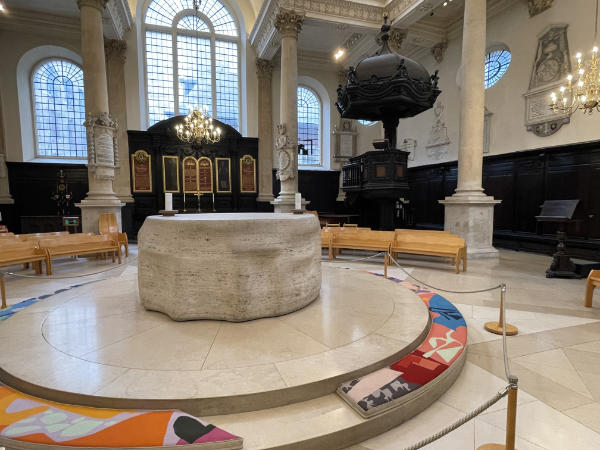
The Henry Moore Altar - made of Traventine Marble
in St Stephen Walbrook, surrounded by very contemporary Matisse like knee cushions!

His tercentenary is being marked by The Wren300 Square Mile Churches programme which has been awarded a £241,00 grant from the National Lottery Fund. It offers a range of opportunities to explore the work of Sir Christopher Wren through conservation, heritage, and musical activities. The idea is to help a great range of people to appreciate the architecture, arts, heritage and music of his time.

Projects include: 
  • A Schools Programme 
  • The 'Dastardly Triple Dome - school pupils building a replica of the dome of St Paul’s during School Science Week
  • A Conservation Workshop - about new construction techniques and sustainable conservation materials - run by Cliveden Conservation Workshop
  • The ‘Wrenathon’ - working with choirs from across The City of London to sing music ranging from the baroque to the contemporary and jazz!
Plus an exhibition of fire artists. In September 2023, a number of churches will be hosting exhibitions of fire artists, depicting the destruction and rebuilding of Churches by Wren following the Great Fire of London.

I had the very great pleasure on Monday of being taken on a walk of four churches:
  • St Stephen Walbrook (1672 and 1679) - The 63 feet (19 m) high dome is based on Wren's original design for St Paul's, and is centred over a square of twelve columns. This is also the church where the Samaritans were. founded by Chad Varah and started out in the crypt.
  • St Mary Abchurch - first mentioned in 1198–1199 / rebuilt 1681–1686. It which has a magnificent alterpiece carved by Grinling Gibbons
  • St. Mary Aldermary - the most important late 17th-century Gothic church in England, according to Pevsner - and looking not unlike Kings Chapel, Cambridge but on a smaller scale - with a cafe at one end!
  • St Mary-Le-Bow - which has the Bow Bells
with guidance from Harry Mount, the architectural historian and Editor of "The Oldie". 

Wren was hugely skilled at making churches seem extremely spacious even when they were located on tiny sites. He also was able to create designs which mixed the Gothic spires with the Classical style he preferred - so the skyline looked the same - but the interiors felt light and spacious

Below you can see some of the photographs I took of the amazing designs and interiors. 

Thursday, August 22, 2019

Art Education: Courses, Workshops and Talks at the V&A Academy

The V&A Academy provides courses, workshops and talks for Adult Learners at the Victoria and Albert MuseumThey are predominantly art history related and also focus on design and decorative art as well as fine art.  They also include professional development courses which may well have wider application to those involved in the business of art and design.

At this time of year people often start planning any courses they want to do over the winter months - hence his post!

If anybody wants to recommend any other venue for courses please contact me

Courses

The 2019–20 V&A Academy Course programme is our richest, most varied yet. Whether you’re looking for an inspiring weekend or an in-depth exploration of your favourite subject, we welcome all kinds of learners. You can expect exclusive lectures from V&A experts, hands-on sessions with museum objects, behind-the-scenes access and day trips to see history in context.
examples of some of the courses

They've recently published their V&A Academy 2019 - 20 Courses brochure PDF (3.1 mb)

Titles of Available Courses in 2019-20

The Courses vary from:

  • Year Courses 
    • these take place on one fixed day per week for three terms.  
    • Day tickets are available for some of the days in these courses. 
    • There are also optional visits to External Locations
  • Short Courses - often frequented by those who have retired.
    • in each of the Autumn, Spring and Summer Terms
    • typically 4, 8 or 10 week courses
    • some are in the evenings
  • Weekend Courses - unsurprisingly are on Saturday and Sundays making them accessible for those who work.
They also include professional development courses for those working in art galleries and museums or wanting to do so.  For example

Monday, August 14, 2017

65 years of Royal Gifts exhibition at Buckingham Palace

As Prince Phillip retires and the Duke of Cambridge steps up to his new role of representing the Queen on a full-time basis, there's a certain sense of an imminent sea-change in the operation of the British Monarchy.

It's not at all surprising therefore to find that there is a retrospective exhibition at Buckingham Palace of a very tiny sample of the Royal Gifts that the Queen has received in the last 65 years - since she ascended to the throne on 6 February 1952.

Put simply there will never ever be another exhibition like this one - simply because it will be a very long time before any monarch reigns for more than 65 years...

Also - if you enjoy the British Museum and its ethnographic displays of people and their heritage then you will enjoy this exhibition - where you can see some of the very best of the very best examples of craftsmanship, skills and materials from around the world.


Royal Gifts exhibition 

A view of the Africa Exhibit in the State Dining Room gives you a sense of scale
The extremely popular Summer Opening of the State Rooms at Buckingham Palace (until October 1st) has an exhibition every year.

It's not at all surprising that this year's exhibition looks back at one particular aspect of the very long reign of Queen Elizabeth - and also one which will be of much interest to people from all over the world.  Which during August is most of the people on the streets of central London! ;)

I visited the exhibition last week (for a special Bloggers Preview) and was able to see and admire the gifts on display. (PS I had intended this post for Friday but Blogger went on strike!)

All the gifts were presented to the Queen
  • as part of official duties - such as state visits and audiences. 
  •  during visits she makes in the UK for various events - such as a visit to a School (and it was very pleasing to see a number of gifts related to children)
The exhibition explores Her Majesty's role as Head of State, Head of the Commonwealth and Head of Nation through gifts presented by people from all walks of life and from over 100 countries and territories during State Visits, overseas tours and official engagements both at home and abroad.
The exhibition is an excellent example of ritual and decorative art and has been organised by Sally Goodsir, Assistant Curator of Decorative Arts. She told us that she  aimed to select one piece from all the countries visited and to make that selection representative of the country and in particular of particular materials or skills unique to that place.

I'm going to give you a sample of images of items below from the different continents.

Plus an insight into the nature of the Tribute to Diana, Princess of Wales which comes at the end of the exhibition - to mark the 20th anniversary of her death at the end of this month.

Display of Diana Princess of Wales personal possessions
within the context of her timeline

Friday, July 13, 2012

What is "Decorative Art"? DISCUSS

This week I've been asking myself just what is this thing called "Decorative Art" in the context of those who appear to define it by saying that it's something which isn't "Real Art".

I must confess I'm becoming a bit of a Show Me the Monet addict (see 'Show Me the Monet' - X factor for Artists?) - mostly because of the critiques by the panel which are incisive and in some cases highly opinionated.  It's very educational to see how people who judge art judge the pieces presented to them by artists from a variety of backgrounds.

For the most part I've been pretty much in agreement with their choices.

However one thing keeps niggling - and these are some of the comments which I keep hear being repeated.
"There's not enough "art" in this piece for me"

"This is decorative art and doesn't reach the standard I'm looking for"
They say them - but they don't explain them.

It struck me that the notion of what art is - and what decorative art is obviously vary depending on your perspective.

It made me wonder whether the term 'decorative art' was being used by the judges to refer to 'bad art' - or art of a 'lower standard' having 'mass appeal'.
  • Was it being used as a euphemism - a polite way of saying "This is bad art"?  
  • Was it being used to refer to art which tried too hard to look attractive?
  • Was it being used to reference art with no emotional inner meaning?
  • Was it being used in such a way as to negate the very positive aspects of what I understood to be decorative art?
It then struck me that the way The Hanging Committee were thinking might rule out anything by people like Grayson Perry (ceramicist and textile artist)  - who is an artist who comments on the social condition and is one of the more innovative artists around today.  Then I began to wonder whether this explained why so many people hadn't taken him seriously as an artist - until he became a Royal Academician.

Then I began to wonder about other artists who were not seen as "proper artists" because they failed to conform to the conventional idea of what is "real art".

Three Questions for Discussion

I'm turning this blog post over to my readers - here are some questions to get you started
  1. What is the difference between art (as in 'real art') and 'decorative art'?
  2. How does an artist know when they're making 'real art' and not 'decorative art'?
  3. Should 'decorative art' be spoken of in a disparaging way?
Do please feel free to COMMENT BELOW and add in your opinion of what is art and how you define decorative art - and what makes decorative art "OK"?